
Blocking Time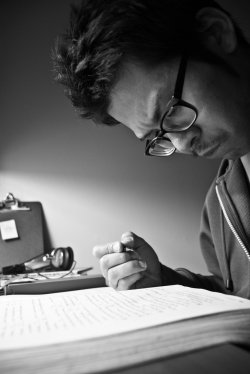
Earlier this year, I made an important improvement to my infamous 9 to 5 student work day. Instead of treating these hours as one undifferentiated mass, I added the following simple structure:
- Writing
- MIT #1
- Midday
- MIT #2
- Shoulder
The accompanying rules were simple. The first thing I do when I arrive at my office is write. I wrote my first two books predominantly between the hours of 9 and 10:30 am, and I’ve finished 2/3 of my new book during this same interval.
Next, during the MIT #1 block, I tackle graduate student work. This description is purposefully vague because this work varies. These days, this block is often dedicated to thesis writing. But it also frequently includes reviews, thinking about new problems, and working on other research papers.
The midday block is chaotic. This is when I first check my e-mail. It’s also when I surf the web and browse my RSS feeds. I eat lunch during this time and often also go for a run. Finally, it’s when I take care of the annoying small tasks that tend to pile up.
Once the blessedly distracting midday block is complete I continue with MIT #2, which is the same as MIT #1.
Finally, if it’s not too late, I end the day with my shoulder block which is when I write blog posts. On a good week, I have time for this block 3 days out of 5.
Focusing on Focus
Why did I add this extra structure to my day? I was worried that I was increasingly losing my ability to focus on hard thinking for extended periods of time. Too much of my day would be interrupted by small tasks and inexplicably frantic inbox checking.
I know, of course, that’s it’s fashionable to describe our current fixation on taking in huge amounts of simultaneous information as some sort of evolution of the human mind. Maybe this is true. But for the two fields I’ve devoted my young life to — academic research and writing — the ability to focus is everything. It’s also, I’ve discovered, incredibly rewarding.
So I built a schedule that confines all of my unfocused mental wandering to one, well-defined, midday block. I admit, that junkie-like urge to check e-mail still persists. And I probably violate my structure 2 days out of 5. But it used to be more like 4 days out of 5, and that desperation for immediate novelty is starting to diminish as I reacquaint my mind with the minor aches of mental exertion.
Conclusion
I’m not recommending that you adopt my exact structure. It evolved, over time, to fit the particular demands of my particular situation. But you might want to consider the broader point and reflect on the role focus plays in your life. Ask yourself what efforts you’re making to keep this ability from whithering into vestigial disuse.
Related Articles
- Have We Lost Our Tolerance for a Little Boredom
- E-Mail Zero: Imagining Life Without E-mail
- The Steve Martin Method
- Would Lincoln Have Become President if he had E-mail?
(Photo by aldrin_muya)

I’ve been dealing with similar issues, as I am a parttime graduate student.
So I get up at 5, spend an hour walking/ reading, and from 6-8 I work with focus on my graduate studies.
Then I leave for work, which is at a school, and I generally leave school at 3.30 so I try to get to a coffee house to do another focused work cluster, I leave this open for various mathematics problems, sometimes preparing notes for school/ my other jobs as a tutor for mathematics (High School). I find the flow works well, and I generally try to goto the gym etc in the evenings.
Any suggestions?
Great post, my graduate degree went quite differently. I’d get up around 11 in the morning, breakfast, workout then off to my office from 2-6ish.
During my ‘office hours’ I’d check my university email, my personal email, and my facebook but I would only give myself half an hour to complete that task. Therefore, most of the time I would only get through my uni email before my timer would go off…. Yes, I’m a dork, I had an egg timer, (Which I still use).
I then shut off my wifi till 6. This is a crucial step for me as it organized my day. I would look for articles that I needed at the beginning of the day, downloaded them into my endnote and then shut the internet down.
After 6 I’d usually hang out at the graduate bar till 8-9 then I’d head out to my second work space which was usually my coffee shop, I’d work there, preparing articles and generally fooling around till midnight.
Somewhat of a different schedule but it worked for me.
I am impressed that you can wait till the middle of the day to check your email. Too many of us do it as the first thing when we sit down at our desks, and that is usually the wrong way to start the day.
This is great stuff. Probably the best and worst thing about student life is how you can schedule your work pretty much as you please. Like you say, focus is paramount and without constant self-vigilance my days tend to become a mess. I’ve had to adopt a system quite similar to yours.
But please humour a non-native English speaker: why do you call the fifth block ‘shoulder time’?
I think this focus is needed in what you do.
Focus is the thing which makes someone productive or not, if you can’t focus just one hour on something, you would never get it.
Thanks,
Stefan
Hi StudyHacks,
I wanted to know what is your honest opinion on listening to music while working?Does it break focus by a lot?
Thanks!
Also when you’re into the music mode, do you have suggestion to get yourself out of them? There are times when I find myself stuck into the cycle of listening to music simply cos I can’t get myself to stop. It’s like I want to live the music for as much as I can because its melodic, sort of like living a fairytale
Sorry for another comment, but I just wanted to add something to the focusing on focus section of this article. To help yourself be more focussed, always make sure you vent out any bad lingering emotions before you get to work and get your feet back to ground if there are any intensely good lingering emotions before beginning work. Even if you have to yell/hate/be angry at someone from inside your heart, get all those bad thoughts out of your system before beginning work. Working with emotional baggage, whether good or bad, almost always disrupts focus.
Thanks for putting this together. I really like your idea of creating a time slot entirely for writing in the morning. How do you handle the change in schedule during peak exam weeks?
People are different in every aspect, therefore, we also have different needs. This article would serve as our guide on how to do such things but not necessarily follow everything that was written above. I think the post would be very helpful for everybody especially a lot of us these days are so preoccupied of lots of things that we don’t even know where and what to start with.
This is a very informative post and I am hoping it could aid others to regain their focus.
I don’t know if you’ll ever read this, because the newer posts don’t seem to have Study Hacks replies:
Could you give 10 days of your final used time-blocked schedule and how you divided up these large portions of time? In one of your books, you recommended giving about an hour each day to small tasks, and you also recommended giving an hour to lunch, so that’s two hours already gone from the day, so I was wondering how long your MIT blocks and your midday blocks actually are, and especially how you split up the MIT blocks between classes, studying, research, and homework.
Even if you don’t undertake this little project: thank you so much for having created this blog. I’m definitely experimenting with time blocking and autopilot scheduling. Many more detailed examples is the only thing missing; the article about the pre-med (“Of Pre-Med Schedules and the Possibility of Finishing Your Work Before Dinner” https://calnewport.com/blog/2011/01/21/of-pre-med-schedules-and-the-possibility-of-finishing-your-work-before-dinner/) was exactly what I was looking for in this regard. 🙂 I haven’t gone through the entire website, so I know I may still find more like “Of Pre-Med Schedules.” Once more, thank you so much for the website. And I must mention your books, too! Thank you so much for those!
I really enjoyed this blog. I love the idea of blocking time. Especially time to get the little things done. This is definitely something I want to apply in my life.