
Diving into Deep Work
Last week I introduced the deep work philosophy — an approach to knowledge work that (in theory) increases the quality and quantity of your output. Since then, I’ve put the philosophy to the test in a mini-experiment. Starting last Saturday, I’ve dedicated roughly 1 hour of my day to deep work on a specific proof that’s been on my queue for a while.
This is a small scale experiment. My goal is to develop a preliminary understanding of how my deep work philosophy translates to practice.
Here are my observations so far…
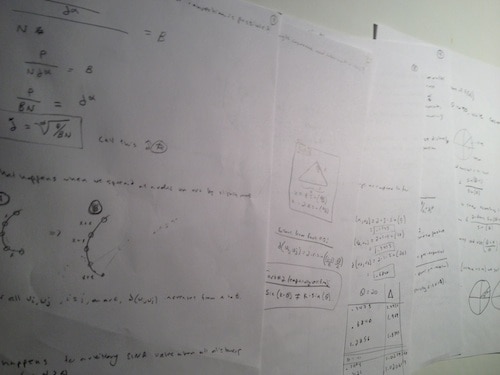
- I was surprised by the amount of output produced in a small amount of time. The image above shows the notes produced so far by my experiment. These notes capture an essentially complete proof for the problem I was tackling.
- Deep work definitely induced the deliberate practice of new concepts. To work out the proof notes above I had to re-learn a bunch of geometry that I hadn’t touched since high school. My tendency in these situations is to look for a theorem somewhere that proves exactly what I need, and, failing that, ask someone for the answer. The deep work mindset, however, inspired me to actually go to first principles and prove the properties I needed from scratch. I now know a little more about geometric proofs than I did four days ago.
- It helps to explain things out loud. My mind, like most minds, resists the energy demands of concentrating deeply on something complicated. If I explained what I was working on out loud, however, it helped keep me focused. Yesterday, for example, I gave Max a mini-lecture on the derivatives of trigonometric functions. He responded, naturally, by crying. But I still found it useful.
- Clarity is crucial. The problem I was working on this week didn’t come out of nowhere. Over the path month, I dedicated a dozen hours toward learning the main results in the relevant model. Since then I’ve been discussing these ideas with a specialist. By the time I started deep work on this particular result I had confidence that the problem was useful and had a good general strategy for solving it. Without this clarity, mustering the resources for deep work would have been harder. (A couple years ago, I wrote an article for Ramit Sethi’s blog about this idea that “just get started’ is bad advice.)
- I need a stronger ritual. I was working at home without much transition into this deep work. I had the feeling that I wasn’t 100% committed to what I was working on, which probably blunted my effectiveness some. I’m working on the details of my ritual.
- I assume I’ll get better with practice. There were many moments in this experiment where I felt strain and still persisted (the key to optimal quality and improvement). But I also felt like this strain was of a lightweight variety (at least, as compared to what’s possible in academic theory). With practice, I think I’ll be able to tackle increasingly complex mental puzzles — which inspires me to maintain this practice much like a runner maintains a running habit to build mileage.

I love this series of blog posts! As a coach for knowledge workers (programmers and so forth), I want to steal and expand on your ideas and create a training program based on it. 😉
Who knows how far it will go? If you want to chat more about the notion, drop me a line!
Cal –
I’m looking forward to you applying “Deep ____” or “Deliberate ____” concepts to educating your child.
My daughter is almost 18 months and I’ve started to think about how we read together, the toys we allow in the house, how we play, to challenge her (not in a boring way or in some obsessive educational strategy).
??? Deliberate Education???
I’m very interested in how your Deep Work process works out. I’m trying to apply deliberate practice / deep work techniques as I start my new business.
I like the large pieces of paper taped/tacked to the wall. I will have to do that. – Cheers, Hein
I think deep work is a skill to definitely start training while a student. It was, I learned in my days writing about student success, a key factor dividing those who can score A’s with small amounts of time, and the rest of the late night, stressed out studiers.
Hi Cal,
I applied this method this evening, to something I haven’t seen as a Mathematician (still in Gradschool) for some years. I had to prove denseness in a functional analysis example, and whilst I ‘knew’ the methods and the ideas, I was unable to reproduce it immediately. So I sat down and focused for a few hours and realized that I didn’t quite understand this family of methods. Now however I have more insight to these methods, and have a concrete mental example to think of when a Professor says ‘ohh you just prove it by using the smoothness by convolution’ or ‘you prove that it is dense in a larger Banach space’ or when someone says that the Schwartz Space is dense in L^p. Nice article and nice experiment. I might up my own theorems on the wall 🙂
I’m currently reading Robert Greene’s book on Mastery and he talks exactly about this process where the great Masters of the world, weren’t always the smartest, but they often had the persistence and deep focus and exposed themselves to diverse ideas without judgmental bias which promoted creativity.
He even starts with the discussion of the evolution of our eyes and the placement on our heads. An elephant also evolved on the savannah so to speak but eyes on side of head for scanning for predators…meanwhile, our eyes our in the front…for depth of focus, and the most primitive learning is through mirror neurons, so we would seem to perform at our best when we were at deep focus on something and allow ourselves to do the extra work to make sure we do it right the first time, mimicking actions of those we want to be more like but adding our own experience and style to it, eventually venturing off on our own.
Meanwhile our brain wants the quick fix and to fill in the gaps with a description with only a few details, and you can lose your sense of focus just from disuse atrophy. So finding those rituals can be important and aligning with the right heroes and a deeper purpose.
Thanks for the post, look forward to future work.
Hi Cal,
these deep work techniques are really useful.i have seen others tips on your blog. what i mean to say is that you are an enthusiast who would like to share the experience!
I second point number 3. I’m in the middle of taking the seven exams required to become a licensed architect — sat for the structures division last night. In the three weeks leading up to my scheduled test, I was pushing myself to work as deeply as possible.
And I noticed, when the strain would get particularly tough, I would just blurt answers out loud to an empty room. Sometimes it was a single word, other times an entire explanation. But it really did help! It’s like my brain couldn’t hold it all in.
On point (3): let us know what Max’s first word is. If you keep doing this it might be quite interesting.
Deep work is exhausting. What do you do to recover?
Hi Cal,
Great post as always.
I was wandering if you could some insight about the relationship between your deep work philosophy and Malcolm Gladwell’s 10,000 hour rule towards expertise in any given field. More specifically I would like your reflection on the following question”Does one require 10,000 hours of deep work to achieve expertise”?
My own Lessons on Deep working
Strategy 1: Don’t look for more information – Instead, think it through.
One of the common mistakes knowledge workers make is to give up too soon. Whenever someone stops thinking and wants to consume more information, it implies that he/she has given up.
Trying to find more information is pseudo-work – It looks like your doing something productive but in reality, its wasteful.
For the past week, whenever I got the urge to Google something (e.g. Matlab Code to do something simple, proof of a theorem), I stopped and tried it myself.
You will realize that you have all the answers – it just takes patience and effort.
This habit will (hopefully) sharpen your abilities to think stuff through.
Strategy 2: A Million What Ifs.
A friend of mine, was amazing at this. Whenever he started learning something, he wouldn’t just stop after understanding the basic idea which is presented in the notes.
He would instead come up with various “what if” questions to test whether he truly understood a concept.
Sometimes it is hard to just come up with these scenarios from nowhere. So, I am trying a variation of it by trying to incorporate a similar strategy when I am solving problem sets.
Previously, as soon as I solved a question, my brains would switch off and look at the next question.
With the “What if” Strategy, I attempted to:
Come up with alternative questions
Find a general class of questions which this question belonged to
You can get a deeper understanding of a subject matter with the same material, if you think through it.
Conclusion: The theme behind the 2 strategies mentioned here is to start thinking more.
My one question:
Is this “hard focus” under a different name, or described with a different strategy? It seems a lot like it – as if you narrowed down hard focus to a more solid concept.
I attempted a pass at it with a relatively easy project just to get a feel for how it would go….and because the project was easy, not only was it done in an amazingly quick amount of time, but because I pushed beyond normal thinking limits my work was deeper and higher quality all at the same time.
It’s getting INTO the state that’s the clincher, apparently. A solid routine (even a long one) is crucial.
My (other) one question:
Do you think you might write again about student success, or have you changed focus?
Whatever you do, it’s wonderful, however! Your blog and books are so helpful!
Regarding transition rituals: the artist Twyla Tharp gave excellent coverage of what she called “Rituals of Preparation” in her book, https://amzn.com/0743235274 . Her book is likely to be appreciated by Study Hacks followers. I recommend it!
I’m going to try out a literal “thinking cap” as a ritual. At first I plan on not worrying if I get off task, I’ll just take off the hat as soon as I notice Im off task; I’m hoping to train myself to quickly move into a deep study. Maybe its too silly to work, but it’s Christmas break now, so what’s the harm?
Today is my second day of trying deep work. I am finding it insanely hard. I will use the tools you have suggested. I will keep posting here for my record. No Response Required.
Hi Cal,
You mentioned that you applied deep work during your PhD studies. I am applying it too. It works really well, but somedays I feel very tired due to the amount of time I spend focused on my work. Do you have any recommendation?
Wilson