Someone recently forwarded me an essay from a blogger named Henrik Karlsson. It opens with an admission: “When I started writing online, the advice I got was to publish frequently and not overthink any single piece.”
Karlsson was not alone in receiving this suggestion. As social media erupted into cultural dominance over the past decade, it carried in its wake a force that thoroughly disrupted written media: virality. An article or post that hit the Twitter or Facebook zeitgeist just right could summon hundreds of times more readers than average. Because it was difficult to predict which pieces might ascend to this cyber-blessed state, the optimal strategy became, as Karlsson was told, to publish as much as possible, maximizing the odds that you stumble onto something sticky.
What makes Karlsson’s essay interesting, however, is that he decided to test this hypothesis on his own work. “I’ve now written 37 blog posts and I no long think this is true,” he writes. “Each time I’ve given in to my impulse to ‘optimize’ a piece it has performed massively better.”
Using new subscribers as a metric of success, Karlsson calculated more specifically that spending twice as long on an article yields, on average, more than four times the number of new subscribers.
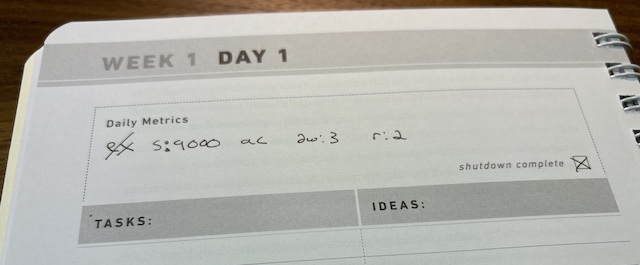
One of the least understood components of my time-block planner is the “daily metrics” box that tops every pair of planning pages. Given that we’ve recently arrived at the beginning of a new year, an event that inevitably suffuses our culture with talk of reinvention and self-improvement, it seems an opportune time to look a little closer at this under-appreciated idea.
The mechanics of metric tracking are easy to explain. At the end of each day, you record a collection of symbols that describe your engagement with various key behaviors. These metrics can be binary. For example, you might have a specific symbol to indicate if you meditated, or called a friend, or went to the gym. If you engaged in the activity, you record the symbol. If you did not, you record the symbol with a line through it.
Metrics can also be quantitative, capturing not just whether you engaged in the activity, but to what degree. Instead of simply recording a symbol that indicates that you went for a walk, for example, you might augment the symbol with the total number of steps you took throughout the day. Instead of capturing the fact you did some deep work, you might also tally the total number of hours spent in this state.
The resulting information might seem an inscrutable cipher to an outsider, but once you get used to your personal metrics, they will provide, at a glance, an elaborated snapshot of your day.
Consider, for example, the sample “daily metrics” box from above. In this case, its terse scribbles might capture the following about the date in question:
In the fall of 2016, I wrote an op-ed for the New York Times that pushed back against the conventional wisdom that social media was important for your career. “In a capitalist economy, the market rewards things that are rare and valuable,” I wrote. “Social media use is decidedly not rare or valuable.” Aided in large part by an attention-catching headline — “Quit Social Media. Your Career May Depend on It” — my piece touched a nerve, soon hitting the top of the paper’s Most Emailed chart.
This sudden prominence generated a fierce backlash. I was invited on a radio program only to be ambushed by two surprise guests invited to refute my ideas. A well-known communication professor began emailing me invitations to debate. One online publication described my call to use less social media as a call to disenfranchise marginalized peoples. (I’m still trying to figure that one out.) Perhaps most notably, two weeks later, the Times took the unusual step of publishing a response op-ed — “Don’t Quit Social Media. Put it to Work for Your Career Instead” — that went through the main points of my piece one by one, explain why each was wrong.
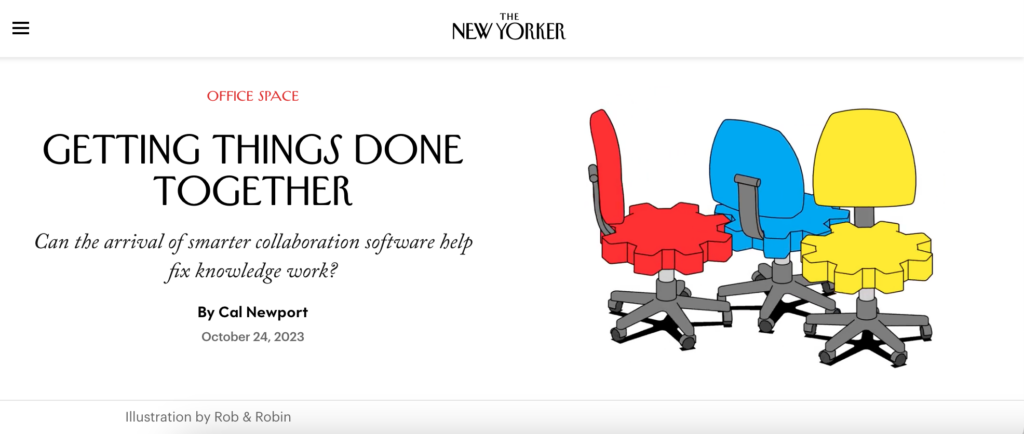
In my most recent essay for The New Yorker, published earlier today, I revisit this incident from seven years ago. As I write, my distinct impression of this period was that of being targeted by a cultural immune reaction: “The idea of stepping away altogether from powerful new tools like social media just wasn’t acceptable; readers needed to be assured that such advice could be safely ignored.”
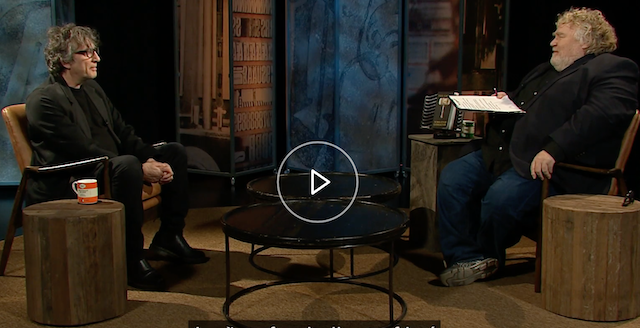
Earlier this week, Neil Gaiman was interviewed on Icelandic television. Around the twenty-five minute mark of the program, the topic turned to the author’s thoughts about the internet. “I love blogging. I blog less now in the era of microblogging,” Gaiman explained, referring to his famously long-running online journal hosted at neilgaiman.com. “I miss the days of just sort of feeling like you could create a community by talking in a sane and cheerful way to the world.”
As he continues, it becomes clear that Gaiman’s affection for this more personal and independent version of online communication is more than nostalgia. As he goes on to predict:
“But it’s interesting because people are leaving (social media). You know, Twitter is over, yeah Twitter is done, Twitter’s… you stick a fork in, it’s definitely overdone. The new Twitters, like Threads and Blue sky… nothing is going to do what that thing once did. Facebook works but it doesn’t really work. So I think probably the era of blogging may return and maybe people will come and find you and find me again.”
In these quips, Gaiman is reinforcing a vision of the internet that I have been predicting and promoting in my recent writing for The New Yorker (e.g., this and this and this). Between 2012 to 2022, we came to believe that the natural structure for online interaction was for billions of people to all use the same small number of privately-owned social platforms. We’re increasingly realizing now that it was this centralization idea itself that was unnatural. The underlying architecture of the internet already provides a universal platform on which anyone can talk to anyone else about any topic. We didn’t additionally need all of these conversations to be consolidated into the same interfaces and curated by the same algorithms.
In the context of knowledge work there are two primary ways to communicate. The first is synchronous, which requires all parties to be interacting at the same time. This mode includes face-to-face meetings, phone calls, and video conferences.
The second way is asynchronous, which allows senders to deliver their messages, and receivers to read them, when each is ready. This mode includes memos, voicemails, and, most notably in recent years, email.
Which communication style is better? This simple question requires a complicated answer.
Starting a few years ago, ads for a web-based software start-up called Monday.com began to show up everywhere online. A subsequent S.E.C. filing revealed that the company spent close to a hundred and thirty million dollars on advertising in 2020 alone, which worked out to over eighty percent of their annual revenue. By the end of this blitz they had generated more than seven hundred million views of their YouTube-based spots — an audience larger than the preceding four Super Bowls combined.
“Monday.com claims to help knowledge workers collaborate better: ‘Boost your team’s alignment, efficiency, and productivity by customizing any workflow to fit your needs.’ This objective might sound dry in our current moment of flashy social apps and eerie artificial intelligence, but helping organizations manage their workflows has proved to be surprisingly lucrative. Trello, one of the early success stories from this category, was launched in 2011 as a side project by an independent software developer. In 2017, it was purchased by Atlassian for four hundred and twenty-five million in cash and stock. Another workflow-management service, named Wrike, subsequently sold for $2.25 billion. For its part, Monday.com went on to leverage the user growth generated by its advertising push to support a successful I.P.O. that valued the company at over seven billion dollars.”
This sudden shift in the business productivity market away from tools that help you better execute your work (like word processors and email clients), and toward tools that help you better organize your work, is important.
Disruption and disorder have always stalked the human condition. This reality sometimes plays out on the grand scale, as in the brutality of terror and war, and sometimes more intimately, as in the sudden arrival of ill health or a personal betrayal.
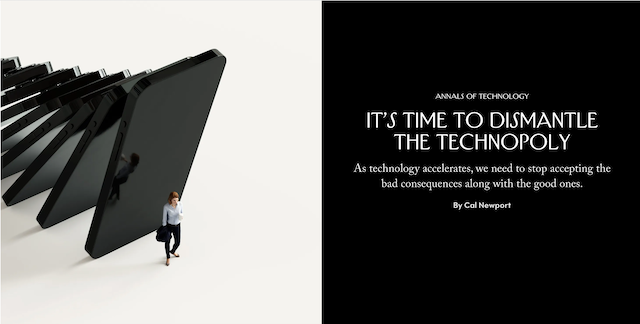
Though such upheavals are timeless, our options for response have continued to evolve. The last decade or so has added a new, culture-warping tool to this collection of coping mechanisms: smartphones. Or, to be more specific, the algorithmically-optimized content delivered through these devices.
The techno-psycho dynamics at play here are straightforward. The algorithms that drive content curation platforms such as TikTok, Twitter, or Instagram are designed to increase engagement. This is an inherently interactive process: the services decide what to show you by combining what they already learned about you in the past with observations on what seems to be drawing more of your attention in the moment. In a period of disruption, this will, more likely than not, lead you deep into digital grooves that promise to offer some relief from your emotional pain.
This relief can be delivered by drowning out your pain with even stronger emotions. These platforms are adept, for example, at stoking a satisfying fire of anger and outrage; a repeated electronic poking of a psychological bruise. For those who were unlucky enough to wander onto Twitter in the immediate aftermath of the horrific terrorist attack on southern Israel last week witnessed this effect in its full unnerving power.
These platforms are also able to move hard in the other direction and serve up the grim surrender of apocalyptic narratives. This was made apparent during the coronavirus pandemic when many were lured by their phones into a sense of survivalist despair that left physic scars that persisted in constraining their lives well after the virus’s inevitable transition toward endemicity.
This relief delivered by our phones is not always about amplifying feelings. It can also be delivered in the form of numbness: drips of endless, meaningless, shiny, shallow distraction that take the edge off your distress. TikTok specializes in this style of deliverance: swipe, swipe, swipe, until you temporarily dislocate from the moment.
As we right now find ourselves mired in an extended period of unusually heavy disorder, it seems an appropriate time to step back and ask how well smartphones have been serving us in this manner. Has the escape they offered led us to a lasting calm or a sustainable response to our travails? Few believe they have.
In search of a better alternative, I reached out to my friend Brad Stulberg, who earlier this fall published a bestselling book, Master of Change, about how to navigate unavoidable upheaval. (You can also watch my recent podcast interview with Brad here.)
The other day the low tire pressure indicator came on in my car. I didn’t see an obvious flat, so the likely explanation was some combination of colder temperatures and natural pressure loss over time, meaning that there was no immediate danger. Nonetheless, the bright orange warning light on my dashboard injected a steady dose of subliminal anxiety when driving.
So, as I was leaving my house this afternoon, somewhat late to catch a matinee showing of The Creator (which I had convinced myself was necessary “research” for someone who writes professionally about artificial intelligence), I decided to take five minutes to pull out the pump and add some air. Soon after I pulled out of my driveway the pressure warning clicked off.
I’m telling this story because of what happened next: I felt a short-lived but intense feeling of satisfaction.