
In typical Friday fashion, I’m taking a detour from the college-specific advice to tackle something larger, more philosophic, and, quite frankly, something well beyond my ability to credibly speak about. Which is what makes it so fun…
The Making of Steve Martin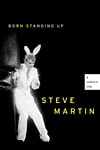
Steve Martin is arguably one of the most important figures in 20th century comedy. Much of the modern comedy devices that us young people types think are so cutting-edge owe a serious debt to Martin’s efforts in the 70’s to explore comedy beyond the punchline. (You can’t have, for example, Seth McFarlane’s 10-minute Family Guy chicken fight sequence without Martin’s never-ending banjo tuning bit). This quest, of course, made Martin rich and famous and award winning and all that other good stuff.
But how did he do it?
In Martin’s recent memoir, Born Standing Up, we gain unprecedented insight into this process. Indeed, Martin stated that one of his motivations for the book was to explicitly capture the how, not just the what. (As he mentioned in a December interview with Charlie Rose, he was frustrated with reading other entertainer biographies in which, all of the sudden, “the guy’s performing at the Copa, and you’re like: ‘how did that happen?”).
Even better, the insight Martin provides is applicable beyond just the entertainment industry. It covers most any field in which you might wish to make a name for yourself. In this post, I extract from this source material a simple system — which I call the Steve Martin Method — that captures the essence of Martin’s thoughts on making it big.
The Steve Martin Method
People often ask Martin about the secret to making it in the entertainment industry. His answer often disappoints. It does not involve any tricks (or, as we might call them: “hacks”). No insider path to getting an agent or special formatting to get your screenplay read. Instead, it’s all built on one simple idea:
“Be so good they can’t ignore you.”
Let this resonate for a moment. I think it captures something profound.
Sure, it’s scary. But, even more so, I find it liberating. It simplifies the quest. Forget all the frustration, the tricks, and the worry. Just focus on becoming good. Really damn good. Outstanding. Unlike anyone who has come before you.
If you can figure out how to do this one thing, recognition will follow. It will, like it did for Martin, probably come so fast that it will overwhelm you.
Martin’s Two Pieces of Advice for Applying the Method
Dig through Martin’s book tour interviews, and two consistent pieces of advice arise for how to succeed with the Steve Martin Method:
Martin Tip #1: Intellectualize.
Paying your dues is overrated. Simply putting in the time is not enough. Martin’s story is one of a constant urge to innovate. He was trying to figure out the essence of “funny.” He then yielded these insights to move beyond the static structure of the punchline that dominated performance comedy at the time. This restless urge to understand then innovate led him to be outstanding. Without it, he would have just become another good comedian. Like hundreds of others.
You need to do the same. Understand what the best exemplars in your field do well. Figure out why. Then ask how you can mix, match, and reconstruct these elements into something new and even better.
Martin Tip #2: Don’t wander.
Martin credits “diligence” for his success. But he’s quick to clarify that he’s not referring to working hard over time. What he really means is staying diligent in his interest in the one field he was trying to master; being able to ignore the urge to start working on other projects at the same time.
It can be hard to ruthlessly whittle down your ambitions to a needle-thin point. But Martin is clear on this point: if you don’t saturate your life in a single quest, you’ll dilute your focus to a point where becoming outstanding becomes out of reach.
Putting the Method into Motion
My instinct is to rev up my productivity blogger engine and start churning out my own, over-specified tips for following this approach. But I’ll resist. The Martin Method rests about the level of systems and hacks. It is a mindset.
If you’re looking to become a leader in your field, honestly evaluate your talent level. Don’t compare yourself to others who have had success. That’s a path toward frustration. Instead, ask yourself, candidly, whether you’re so good you can’t be ignored. If not, then get back to work.
Quality banjo jokes don’t write themselves.

I think it’s interesting to compare Martin Tip #2 with Ben Casnocha’s ideas on pursuing randomness. To achieve each of our own definitions of success, we must dilute ambitions down to a few. At the same time, life may not be as fulfilling if we don’t just stumble upon new ambitions. This isn’t really a point, but both interpretations of success lead in opposite directions. Perhaps, to each his/her own?
As with the entry on Ben Casnocha, I was referring to this, for anyone who might not have read this post: https://calnewport.com/blog/?p=245
@Vincent:
This is an excellent point. I’m wondering if the two could be intergrated. That is, Martin Tip #1, I think, fits well with pursuing randomness, so long as the randomness is confined to the field in which you are trying to become famous. Exposing yourself to many different unusual things in your field could aid the intellectualize process.
The bigger point, however, is that the Martin Method is extreme. It’s not for everyone. I’m not even sure if it’s for me yet. But it seems right. That is, I think, for better or for worse, he’s captured the essence of the fame question.
there is a more accessible interview with Steve Martin in the February 2008 edition of The Smithsonian where he mentions some of the concepts in your entry
https://www.smithsonianmag.com/arts-culture/funny-martin-200802.html
@malcolm:
Thanks. That’s an excellent article. Just read the whole thing. For anyone who wants more nuance on Martin’s story without reading the book, take 20 minutes to read this.
Brilliant productivity example. Martin has always had a supreme grasp on doing things his own way, and doing them masterfully. He made it look easy to be a ‘wild an crazy guy,’
I recently read Martin’s book and was impressed far beyond my already high expectations; he worked so hard at being funny that he managed to take it to a whole new intellectual level. I love his comedy, I love his fiction, and I love that he drew such a perfect picture of his career and his process in Born Standing Up.
Using Steve Martin’s comedic process as a guiding principe for making it big in any other field is a brilliant. Great post.
Thanks Alexa. Since I wrote this post, I’ve been surprised how relevant it continues to prove to my life…
You’re welcome. And I apologize for my two typos–although, I’m sure they’re killing me more than they’re affecting you. Here are the correction so I can sleep tonight:
“…as a guiding principle…”
“…is a brilliant idea.”
I just want to pile on with the terrific post comments. Really. Terrific post.
I particularly like the idea of intellectualizing. So often it feels like we’ve made a cult of the amateur. People think that you have to be a natural, that many people have equal expertise. But I think this is dead on: To innovate, one really must understand and break things down in parts. And be willing to have bad banjo jokes on the way to the good ones.
A profound axiom if I’ve ever heard one!
The trickster thing about a quest is that a quest is not a track. Staying on the quest might look to outsiders, and even to oneself, like doing a bunch of unrelated things. This is basically what Joseph Campbell said about following your bliss and doors opening that wouldn’t have opened there for anyone else.
Thank you for your insights.
Although i understand your analysis, I have to point out a single fact – Martin is not funny anymore -.
Yes he was, 30 years ago, but the simple fact is that, if he had a strategy, it only worked for a while and never allowed him to get out of the comedy genre.
Nevertheless, “Intellectualize” and “Don’t wander” are good advices if you tend to be Practical or a Dreamer.
I would say: Just focus on something you’re good at and enjoy it, the rest is out of your hands.
I think that the “Steve Martin Method” is extraordinary.
Most of the success literature currently out there doesn’t go into the importance of being exceptional.
You can even see the importance of it in everyday life.
If you’re a waiter and want a raise, many people would advise you to suck up to your boss or do some form of trickery to make yourself look better.
If on the other you use the “Steven Martin Method”, a raise is sure to come and you don’t have to be deceptive to get it.
I’m going to do my own investigation into this method, Thanks for introducing it to me! 🙂
Success did not come “fast” for Steve Martin- one thing i loved about the book is you see all the WORK he did, starting with performing at carnivals as a teenager.
What explains his doing bad to awful serious acting jobs?
I love the Steve of the 70’s, but he lost the speed on his fastball along the way and seemed to be sleepwalking.
I saw It’s Complicated the other day…where was the humor, I didn’t buy what he was selling one bit. The movie was horrible.
I think that if you know you are special, you probably aren’t. In other words, the truly gifted don’t know they are. Work is part of it, but so is innate skill and the honing of that skill.
Can one lose that gift if he knows he has it? Does self-awareness remove that special bit of the secret sauce that comprises the gift of talent? If you know you are good, do you stop working on being good…
I’m a musician, and this question scares me a bit. The metaphysics are probably there to be metaphysics and not part of our consciousness.
Steve can talk about his success in doing circus acts, getting people to laugh is not always easy, but can evidently be easily accomplished much like turning on a light switch.
I recommend Maxwell Maltz’s book Psych-Cybernetics for further thoughts on this stuff.
But… While successful… Somehow… Steve Martin is about as funny as a dead baby.
Great article, very simple approach. Reminds me of that quote… Life is really simple, but we insist on making it complicated. ~Confucius
Be So Good They Can’t Ignore You. I love it. No half-baked efforts allowed. Fantastic advice.
Absolutely brilliant.
Martin’s brilliant, in so many ways, and so are you. Thanks for this.
Diligence is so vitally essential, I don’t even know what to say. It comes under different names: consistency, persistence… focus.
Focus, focus, focus 🙂
Amen.
Interesting post. The problem that I have is that I want to become good at a particular thing to break in to the field, but it is hard to become good at it if you’re not in the field, so breaking in becomes a bit of a crapshoot. I don’t know if this makes sense, but I would be interested to hear what you have to say about this.
This is an interesting take.
Right now I am in a job that I just dont care much about. Ideally I want to be great – the best even – but I dislike my work, and I logically cannot quit due to debts, and promotion or transfer will not occur due to the structure of the job. So I dilute my work experiences with other things that make life bearable. Doing so will never make me the best, but it will preserve my sanity. Mediocrity is an asset.
Wonderful post, Cal. Martin’s Tip #1, “Intellectualize,” reminds me of Weezer frontman Rivers Cuomo’s “Encyclopedia of Pop.” In the late ’90s, Rivers started filling a three-ring binder with handmade charts in which he systematically analyzed the structures of songs by Nirvana, Oasis, and Green Day, hoping to determine an essential formula for reliably excellent songwriting. Using this encyclopedia, he pinpointed several songwriting methods–from the “Incipit-Melody-Guitar-Develop-Tea” to the “Arbitrary-Progression-Distortion-open-Strum-Intro-Melody-Arrange”–which he eventually used in writing his own (very successful) songs. IMO, the “intellectualize” method is highly useful, not to mention ridiculously empowering, to those of us in creative fields.
(I have found a role for it in school, too. Paper writing, the bread and butter of humanities academia, has become easy ever since I made up and started using my own one-size-fits-all “essay schema.”)
You misspelled Seth MacFarlane’s last name. What a shame, Cal!
Just one way of impressing a future boss whenever being interviewed is to try to ask positive inquiries, as you are asking them questions you will be in addition getting understanding
One more typo towards the end of an amazing article on deliberate practice:
The Martin Method rests about the level of systems and hacks. It is a mindset.
i think it is above?
Really a great tips. Thank you for sharing this information.
Cal —
May I offer an iteration on Steve Martin’s theme — all these many years later? One that might be even more pertinent?
Be so unique they can’t ignore you.
I was there when Steve Martin exploded — I was his audience. I was IN his comedy audience when he burst on the scene.
There were many of my peers for whom Martin fell flat. For those of us who couldn’t take our eyes off him . . . it was because of his transcendentally-charmed goofus qualities.
His uniqueness.
He was unlike any other comedian and entertainer at the time. Freeflowing, light-hearted, un-cynical.
He individualized his craft.
As you point out his success didn’t come because he rocked a punchline. He inhabited a persona.
He could not be ignored because he immersively became his own unique character. And that was mesmerizing..
He went supernova because his full-bore uniqueness couldn’t be ignored.
Identify your comedy character.Explore your comedy.To be a successful comedy actor, you have to study the art form.Comedy is all about rhythm, timing, and pace, and it’s your job as a comedic actor to identify those things in each and every piece of scripted comedy you perform.There are so many legends old and new in this business, and watching them work is vital to building your comedy career.
Yes, I love Steve Martin and his work. He has a lot of good points about focusing on your main intent within your Comedy.
Being the best takes your souls desire, the other half is working your ass off!
Thank you Steve Martin for your great advice!
Very interesting post. I’m a new reader to this gem of a blog. Been scouring through tons of goodness in the blog archives, at the cost of the other work that I should be doing.
Great work Cal
-Prateek from India.
This is definitely going to make a positive impact on my life and the perceptions I have for success Mantra. Thank you Cal
– 20 Years old reader from India (Marketer at QPe – Best Ecommerce Platform in India)