
Peer Pressure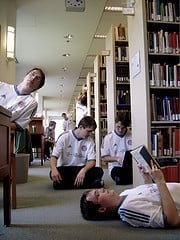
In the summer of 2000, a Dartmouth economist named Bruce Sacerdote published a paper titled Peer Effects in Randomly Assigned Roommates. His premise was interesting: Incoming students at Dartmouth are assigned to rooms at random. He knew, therefore, that when two roommates first arrive on campus, their behavior should have no more in common than any other pair of students.
Sacerdote’s insight was to wait until the end of the year and then look for traits that roommates had become more likely to share than random pairs. The idea was that these shared traits would be due to the roommates’ influence on each others’ behavior.
Sacerdote found that for some behaviors, such as major choice, roommates didn’t affect each other. But for one trait in particular, GPA, they had a lot in common. He attributed this finding to a simple idea: students’ study habits are heavily influenced by their peers.
It’s important that you recognize this reality, because these peer influences shape more than you might imagine about your own habits. Like a pair of behavioral blinders, carefully slipped into place without you noticing, peer influence may have prevented you from seeing a variety of radical strategies that could greatly simplify your student life.
In this post, I want to describe one such strategy…
The Definitive Guide to Acing Your Schedule
Studying for a class starts out as a crap-shoot. Until your first exam (and, more importantly, your first post-exam post-mortem) you have to take a random stab on how best to prepare.
Or do you?
One of the “laws” that emerges from peer-influenced study habit formation is that you must attack each course by yourself. Sure, you can bitch with other students in the same class, and maybe perform the occasional group study session, but in the end, it’s you alone battling the mysterious forces of your professor and his capricious whims.
Here’s the thing, it doesn’t have to be this way. Consider the following simple strategy for improving your performance in given course:
- Setup a separate chat with your professor, your TA, and a student who took the same course in a previous semester.
- In each chat session, ask the same question:
If you were to write an advice guide about doing incredibly well in this class, what would the chapters be?
It takes around an hour to complete this exercise. But it’s results are near magical. Gone is the guesswork about notetaking, reading, and how best to review. In its place is specific advice that is tuned to the specific challenge you face. You’d have to be a real slacker not to do well with this treasure map in hand.
Yet almost no student does this…
With this in mind, I hope the advice in this post serves two purposes. First, it’s a great way to do better as a student; so try it. Second, and perhaps more important, it can act as a gateway that helps you move beyond the blinders of peer influence, and start seeking your own approach to mastering the college experience.
The most effective strategies for improving your student life are often also the simplest. You just need the ability to see them.
(Photo by jackbrodus)

Excellent point!
Sometimes the best way to seek advice is to just ask for it. I know that some of my professors mention how to succeed while covering the syllabus, but not all do.
This sounds like solid, simple advice. I’m an incoming freshman at Stanford this year, so I’ll try it out with my classes this quarter.
That is probably the best question you could ever ask! Not too pushy and insightful! I was working with a student today who I encouraged to do pretty much the same thing. However, she gets nervous around professors and feels uncomfortable about setting up a meeting. Anybody have any tips on how to break the ice with a professor?
It’s always come naturally to me and I couldn’t give me student adequate help.
Sounds great! I’ve added a reminder to implement this advice on the first day next term.
I’ve a question that I’ve been thinking about time and again, but I don’t want to make other replies go off topic, so I’ll request just
ONE
answer to: other than push-ups, what exercise(s) do you do when you’re stuck in your dwelling (like after dinner)?
Sometimes its also good to talk to the dean or department chair. Knowing that intelligence does not matter in college, what was the primary factor that determined who went to ivy league schools from high school and who went to average schools? Do you find that the SAT’s do in fact predict success in college? Also, if intelligence does not matter,
how does one become a top student, by efficiency alone? How do you attack courses where there are only primary sources that have too densely packed chapters to take strategic notes on? I have also found that in order to do quiz and recall, quizzes must be made as soon as possible, to eliminate procrastination as a factor. Do you find this to be the case as well?
Sometimes academia seems easy, if you know how to attack it. The paradox that I notice is that sometimes doing well in academia does not have any significant correlation with intelligence or even hard work. Academia seems to be its own animal and language, but once it is conquered and deciphered it can be conquered in very little time and effort. Do you find this to be the case as well?
Great suggestions on how to get everything started for the freshman year.
Though in our college we are assigned single rooms… haah.
I’ve found that doing well in classes often has nothing to do with what the professor thinks you should do to do well in classes, though. Whenever I ask, it’s a unanimous chorus of ‘go to class, do all the reading and take comprehensive notes on it before class, and make a detailed outline of the course’. Only the first of these is really actually necessary – with the second, it’s more time efficient to take class notes and afterward only do the reading that plugs the gaps in your understanding; and with the third, often a minimal outline (ideally a picture or a chart) backed with precise citations to the original makes more sense. I spent my entire first two years in college following the advice of professors before I realised I was better off following what worked for me in high school (where I was a zero-effort valedictorian). My prof’s advice got great results – but I could get the same or better grades on a quarter of the effort my own way.
Report back how it goes.
Go to office hours early in the semester, before students are showing up to try to change test grades and get problem set answers. The professor is required to be available during that time, so will be happy that someone actually showed up.
I’ll ask our resident fitness guru, Adam from My Body Tutor. Check back here for the answer…
I don’t believe in courses that are impossible to do well in. Every course has students get A’s, the question is how to most efficiently become one of those students.
I agree. Efficient study strategies coupled with an ability to do hard focus and avoid procrastination is by far more important than being a grind or a genius.
How do you find out what students have taken the course before? Can’t say I’m uncomfortable asking a professor especially not to be seen as all about the grade.
@ xtheunknown0 great question!
This question inspired me to come up with a fun but challenging workout that can be done anywhere! All that’s required is a floor.
You can pick any of these you like, or you can do them all in order (recommended).
So start with:
1. Jumping jacks – Do 4 sets of 50
2. Body Weight Squats – Do 3 sets of 20 (shoulder width)
(https://www.youtube.com/watch?v=zqj1qjIA6E0 – Great video to watch for form)
3. Wall Sit – 2 sets of 1:30 each
(https://www.youtube.com/watch?v=tDjKeOCgisw – Good video to watch for form)
4. Calf Raises – 4 sets of 25 each
5. Push ups (shoulder width) – 3 sets of 20 each (Go slow and steady. Own the exercise!)
6. Push ups (close grip) – 3 sets of 20 each (Go slow and steady. Own the exercise!)
7. Lying Torso Raise – 3 Sets of 15 each
Directions: Lie face down on the floor and place your hands loosely behind your head. Slowly raise your upper body until your chest is a few inches off the floor. You should feel your lower back muscles contracting as you rise up. Hold the top position for two-seconds then slowly return to the starting position and repeat.
8. Crunch – 3 sets of 15 each
(https://www.youtube.com/watch?v=TKg_cdwq9l4 – Good video on how to do them. Most importantly crunch your chin up towards the ceiling. Look up! And hold!)
9. Bicycles – 3 sets of 30 each (Every time you touch a knee it counts as one)
(https://www.youtube.com/watch?v=vPKXFarXbys – Very good video with great form!)
10. Plank (Hold for 2 minutes or as long as you can. 2 minutes is the goal though!)
(Perfect form – https://www.youtube.com/watch?v=9Ar2iRusnnc)
What I love about this workout (if I do say so myself) is that it involves all of your muscles; Legs, calfs, glutes, abs, arms, chest, lower back (great for posture) and shoulders. It also shouldn’t take more than 30 minutes.
I’m actually going to try doing this exact workout today.
As always, I’m here for you guys.
Any questions – let me know!
Great advice Cal. Another way of putting it is “why reinvent the wheel?” or “learn by other people’s mistakes”
Hey Cal. How often would you recommend creating mega problem sets?
Create them a couple weeks before each exam. (Some students also try creating them as they go along during the semester. Either way works.)
Hi Cal, what software did you use to create your mega problem sets? Math/physics student here
So in the interim, how would one study, if he wanted to know everything as it came along?
Thanks.
To be honest, I feel very uncomfortable about asking a question which to me essentially reads “Can you tell me how to do well in the exam?” But that’s just me and my curious middle-class prejudices.
You’re right-I definetely would like to ask these questions, but I never will, because people are sometimes so reluctant to give clear, straight and helpful answers. As soon as they get the impression that someone is asking for advise, they decide to become ambigious.
Personally, I try to put those “how to do well”, and “how to study” kinds of things in my syllabi, but I would still enthusiastically welcome students coming in to my office hours to ask about how to do well. What baffles me is the occassional student who keeps getting bad grade after bad grade, and doesn’t respond to *any* of the suggestions I put on their homework assignments or come in to ask me why they’re doing poorly. Of course, I am assuming the students actually read the syllabus…
It can be baffling. The more I work with students, the more I’ve encountered that there are deeper, social and emotional issues underlying many academic problems. This is part of the reason I spend as much time on the “why” as I do the “what” here…
Take care of who you hang around with if it’s your first year this year. They will force their habits onto you.
Once again, I completely concur with you Cal! I just have one question though, how can this work when you are taking a class that is in a community college how can one find who might have taken this class before with the same professor or the same class? (FYI … One of the reasons I am going to be taking some classes at the community college as the classes are smaller and cheaper and eventually take them at the remainder at the university.)
Hey Cal
I just have one question. I’m still in high school but I’m transferring to a high school where the school day is 8am to 4pm every day except for Wednesday which is 8am to 12pm. According to the teachers, there is about 4-5 hours of homework. How can I ace this schedule?