
The Minecraft Revelation
Markus Persson got me thinking.
Markus is three years older than me, he’s Swedish, and he’s rich. He made his money in an field not usually known for its wealth-generation: indie computer game development.
Markus’ story starts in 2009, when he quit his job as a game programmer for King.com to build Minecraft, a java-based world building, zombie fighting, mine digging sandbox game. (You probably have to see it to understand to it.)
People, it turns out, really like Minecraft. In January of this year, Markus sold his millionth copy. Earlier this month, sales passed the 2.5 million copy mark. Markus has made somewhere between $30 – 40 million dollars on the project.
Here’s what troubled me about the Markus Persson story. On Study Hacks, I’ve been promoting the idea that you have to be good at what you do before you can expect your job to be good to you. This is why I push myself and others to stop worrying about their “passion” and day dreaming about courageously bucking the status quo. Navel-gazing and conformity-defiance, I argue, is not how people end up loving what they do. Instead, they start by getting good at something rare and valuable, and then leverage this “career capital” to construct — not discover — a fantastic career.
Markus seemed like a good case study of this philosophy. Before he could develop Minecraft, he had to become excellent at game development. Not surprisingly, it turns out he started programming at the age of eight and then after college worked for a half-decade at a game company to further hone is skills.
But here’s the problem: lots of other people are also really good at programming and also build indie games, but are nowhere near as successful at Markus. The implication here is one that I’ve been encountering time and again, in many different settings, and I realize I can’t ignore it any longer: Becoming “so good they can’t ignore you” is a pre-requisite for building a remarkable life, but it’s not necessarily the whole story.
Once you have acquired career capital, you still have to figure out what to do with it, and the best strategies here — the strategies that separate the Markus Perssons from the hordes of other talented game programmers — are not obvious.
Project Remarkable
I want to explore these non-obvious strategies. In other words, I’m going to assume that my Rethinking Passion series has throughly convinced you that “follow your passion” is bad advice and that you must instead start by becoming good at something. Now it’s time to figure out what comes next.
Here’s my plan: I’m going to use myself as the guinea pig. As I start my new job as a professor, I have a base of rare and valuable abilities to draw on, in that I’m relatively adept at producing cutting-edge research in my field. But so are lots of other young professors. The question, then, is how can I most productively leverage this capital to stand out from the crowd and nudge my career in a more remarkable direction.
Over the next few months, I’ll use my Lab Notes series to report on the efforts I’m deploying. But in the meantime, I want to learn from you. If you’ve found success leveraging hard-earned ability to take control of your life and move it in a remarkable direction, chime in on the comments and share what you’ve learned.
That is, if you can tear yourself away for a few minutes from the sweet new tower you’re building in Minecraft.
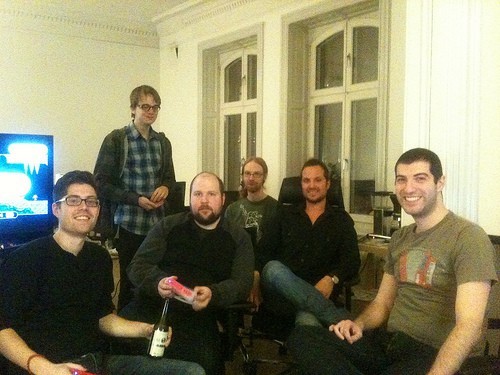
(Photo of Markus Persson and his newly formed development company by paulamarttila.)

I think a serious problem with the “be good enough” line of thinking is that we’re all looking for definite, guaranteed steps. With a lifetime warranty and money back if we’re not satisfied. But the truth is that life by and large doesn’t work that way. The path to success (whatever your definition of success is) is paved with equal parts skill and “luck”. Luck here being defined as exposure to lots of interesting situations and people and projects and getting involved in enough of them that eventually one of them will have a big payoff. The others can still be rewarding and fun, but not necessarily bring in a $40 million paycheck. The trick is, I think, to become make sure you’re having a lot of fun doing what you’re doing so that you’re always pushing yourself to come into contact with potentially lucky opportunities.
Leveraging anything requires a fulcrum. In the working world, it is a combination of things and the difficulty in its definition is the shear variability (as described in Malcolm Gladwell’s book Outliers). For me (and by no means do I consider myself remarkable but), my ascention from peon engineer to peon upper level manager was facilitated by my ability to read people and give them what they wanted without them explicitly asking for it. Any single person’s success is only made possible through the people (s)he directly communicates with. Consider this the social/political adjacent-possible of success ascention; at least, that’s how I remember it.
Personal qualities surely improve the odds of success. And for that, you have to start early. I’ve seen no better primer for teachers and parents to develop those skills in kids than J. Donald Walters’s book Education for Life: Preparing Children to Meet the Challenges. There’s more to success than filling one’s head properly; also involved (because de knee bone connected to de shin bone) is the heart.
Do you think this style of luck can be systematized to some degree?
This is an interesting metaphor. I like the notion of figuring out what a fulcrum is in your setting (i.e., in your case, personal skills).
I think the distinction that needs to be made is the difference between passion and the vehicle of that passion. For instance, Braintree isn’t passionate about credit transactions, but they are passionate about providing service. The skill that they are good at here is the credit transactions services they provide and it’s the vehicle for their passion (providing exceptional service).
I used to have an article about it on an old blog. I have it saved on a HD, I think. I can email it to you if you want and see what you think of the idea and see if it fits with yours.
First, I am pretty sure notch never went to college. Formal education, while customary in the US, is not a requirement for doing great things.
Next, and I do know this is controversial in the US where people generally seem to value hard work over everything else, I believe notch’s Mensa-level IQ (he’s a member) is a significant factor. It’s not that Minecraft contains genius-level code, but that he was able to figure out something (the concept of the game) than no one else had, even though the tech had been there for decades. His intelligence allowed him to create a real game (which, taking look at the game companies recruitment section, is assumed to be a bad idea without math/CS/related degree), and his lack of being taught already processed ideas specifically enabled him not to make implicit assumptions many other game developers make.
Therefore, I would like to add to your hypothesis that when seeking to became the best in the world at something, one should do something differently than other people. Of course, different for difference’s sake is not a good idea. It’s very difficult to find a new way of doing an old thing so that the new way is not worse in any significant aspect than the old thing, but that, I think, is the true key between a common superstar and the very best.
Marcus, Jordan Tice, Larry Wall, Issac Asimov, the Angry Birds guys, the Google guys, Leonardo Da Vinci and others are successful because
1. They create things that are stimulating for themselves
2. They enjoy letting others enjoy their work, too.
3. They let their work take the credit
4. They aren’t afraid to improve upon their own work
It’s very hard to create something stimulating that makes you want to look at, play with, think about, and create stories around it. Giving that work to others to enjoy is difficult, too, especially since it usually means cleaning up imperfections and temporarily stop improving it. Getting the word out is hard, too, especially since marketing doesn’t come naturally (or cheaply) to most people. Finally, being able to step back and let the work speak for itself instead of discussing everything you’ve put in to it requires a level of modesty that is hard to achieve after producing something special.
The real success lies in being great enough to create something that others will admire. Create great works that are stimulating, then market them to ensure people know about them. Let the work’s greatness illuminate you while you continue to improve. It will only make you more successful.
If you haven’t read this speech already, “You and Your Research” by Richard Hamming is very pertinent to the question of how to be successful in a given field. You’ll probably find it even more interesting as an academic computer scientist. What separates other programmers from Persson is probably what Hamming lists as “some of the reasons why so many people who have greatness in their grasp don’t succeed.” Here’s a link: https://www.cs.virginia.edu/~robins/YouAndYourResearch.html
I can only speak from my own limited success, but I think marketing has a huge part in elevating your status from great to “so good they cant ignore you” land. And I dont mean marketing in the buy an ad on a website kind- I’m speaking in very broad terms.
Cal, if you look back at Steve Martin’s book, from where you got the great nugget “be so good they cant ignore you”, he mentions a very specific Rolling Stone article that helped launched him into great stardom. It took that bit of marketing to push Martin’s name and brand into the mouths of the public.
Cal, for you I would imagine being a great prof means you have to publish. But I’m sure this is nothing new/you havent heard before/is different from what all your co workers will be doing. Perhaps its the type of journal you get published in. Or, more importantly, if you can get your ideas published in something outside the required journals. Say, an article in Wired or something. I’m not a PhD, so hopefully this post wasnt to daft.
About systematizing luck: personally I believe that “all” you can do, once you have reasonable technical skills, is to be at a lot of places and talk to a lot of people. While I’m still quite early in my career, I have noticed that one thing that separated me from many other graduate students was that I talked to a lot of senior researchers that were far outside my specific community. What enabled this was partly reading more papers that were “outside” my immediate research focus.
Later on, and perhaps somewhat surprisingly, I have been able to combine things these researchers said with said with things I’ve learnt/discovered, which in turn has given me knowledge that others lack. I’ve also heard several people describing how they turned down offers for help about their research from people with grey hair approaching them at conferences — only to later find out that the modest man trying to talk to them about their research was indeed someone really famous in their field.
This “success” is by no means anywhere near the 40 million dollar paycheck you are describing, but my current working hypothesis is that it’s essentially the same mechanism, I’m just tapping into it for getting to do the work I want (research) instead of money.
I would love to be wrong on this though, and eagerly awaiting more posts about it.
Mikael: I agree that you need to do something different from all the others trying, but I’m somewhat skeptical that his lack of formal education is the key. (If it is, that’s essentially saying that professors makes your brain rot).
Just a thought here…
While Markus is clearly successful, I wonder how successful other people with his skills are. It seems somehow unreasonable (I’m not sure exactly why; this is perhaps a point of inquiry) to expect that everyone can achieve this level of success, but that doesn’t mean that other game programmers aren’t successful.
Anyway, what would seem to set Markus apart is his ability to move beyond simple technical skill into idea-generating. Coding Minecraft is something that many people could do; coming up with the idea for it is not. As a musician, I relate this to music. There are people with enormous technical ability. And by enormous I mean truly spectacular (I know a clarinetist who can sight-read the most difficult of etudes, then turn them upside down and sight-read them again.) But many of these people lack the ability to write original compositions. It seems that something similar is happening here with the idea of Minecraft.
“Becoming “so good they can’t ignore you” is a pre-requisite for building a remarkable life, but it’s not necessarily the whole story”
Read Outliers by Malcolm Gladwell
Sam:
I agree, it’s not that simple, and in many fields the situation is not like that. I was speaking from my own perspective (I’m a student of a field of science that has been around for a long time), where (some) professors really do discourage people from questioning old facts, even if those “facts” felt really questionable. And the sad part is that many of my co-students, no matter how open they have been before, assume the point of view of the professors and not only stop questioning, but start to discourage anyone else from doing so. I do not believe science will progress that way.
However, to defend my previous claim, I think that if one gets a degree in computer game design, he/she has to be very careful not to take everything that the professors say as a truth, or he/she will have no chance of creating anything original. Degrees not directly related to the job, such as math/CS, do not have that risk, I admit. For (revolutionary) science, however, I am very worried.
Minecraft is fun, but before you say too much about “so good they can’t ignore you”, make sure you understand the flipside of the game’s history.
Minecraft is basically a re-make of Infiniminer, another indie game. I mean, check out this video: https://www.youtube.com/watch?v=j_H34uvSUns
By re-make, I mean that Minecraft is a wholesale commercial rip-off of a project that another indie developer made available for free.
Also, the Minecraft team was notoriously bad about fixing bugs and introducing new ones with each release. Even after they had over $10 million in sales, they ignored the growing pile of complaints for the better part of a year. They took weeks off to fly around the world and accept industry awards intended for released games, while at the same time telling their customers to stop complaining about bugs because the game wasn’t finished yet.
It’s pretty commonly accepted by the Minecraft modding community (who work closely with decompiled versions of the source code) that the code behind the game is not high quality, and that several major decisions about how the game was coded have had major negative repercussions in terms of speed and stability.
Minecraft might be a good example of something: a clever person can take someone else’s idea and make money. You can still accidentally become rich and semi-famous without being that good at what you do. You can offer bad support, bad customer service, and increasingly broken products and people will still buy it, if the code idea is good enough.
There are some great indie game success stories out there, but I cringe when I hear Minecraft and “Notch” held up as the best one. If winning is measured in dollars and tigerblood, though, then Minecraft is definitely winning.
In my humble opinion, creating a hit game is similar to creating a hit movie, i.e. it’s highly unpredictable. You can have the most talented, skillful, and experienced director and cast and yet have a flop. And yet you can get sleeper hits that escape all the attention of the so called industry experts. George produced Star Wars but also Howard the Duck which was a flop.
This is not to diminish the skills and experience of Markus. But I do believe luck and timing play an important role.
The way to “systematized” luck is to “survive” and keep going to bat. Eventually your time will come and you will have a hit (assuming you are talented). A good example of this is the renowned martial artist Donnie Yen.
Donnie started in the film industry 20+ years ago playing many forgettable roles (despite his exceptional martial arts skills). Then finally in the past 3-5 years, he had a few good film projects (Yip Man) and became a massive hit in Hong Kong and China.
Just my two cents worth.
Why yes, I do. A lot of it comes down to exposure. You have to start with some inkling of what it is you want to do with your life. In your case (and partially in mine) it is to do great Computer Science. So you go to a place like MIT (or Cornell) where you know there are people who do great computer science. You spend time around such people, listen to their ideas, use it as a basis to develop your own. You listen to forums and mailing lists pertinent to your interests, where experts in your field hang out. You join in the discussions. Start asking stupid questions and gradually move on to asking more intelligent. When people come to your institutions for conferences and such tell them about your ideas, sometimes interests will align. You will start collaborating, publishing, meeting even more people. You will keep getting lucky. So on and so forth.
Of course, it’s not that simple. After all no said generating luck was easy.
Also, read Hamming’s lecture on how to do great research.
Based on my experience, I have found that you really just have to have a focus and and a strong belief in yourself. It is true that you do need to work hard and “become so good they can’t ignore you”, but on the same token there are a lot of successful people that are really just mediocre. Some successful people are really not the best at what they do and some of the most successful companies are not the best, but they may have the most money. The only difference is that they had a focus and they believed in themselves, and they just kept moving in the right direction. The most important thing you can do is set goals, believe in yourself, and know that you will get there eventually.
Cal, it has just hit me that what you’re describing is the process of becoming an artist in your chosen domain. It is vital to master the basic skills through deliberate practice yet you have to nurture that creative spark. I think your balance of structured, focused work which creates the space for leisure allows that to happen. It seems to me that we easily get caught in a good enough grind that leaves us with no energy left for new discoveries. Thanks for sharing your thoughts with us. I look forward to your thoughts on inspiration and leveraging your career capital.
Cal, the fact that you are an MIT Ph.D. wants to share with us his real-time strategy for success is an extremely generous gift. However, please be advised that the best strategies, are the ones kept secret, only to be revealed after the fact. To your success!
Cal, I always enjoy your thoughts and to be candid I continue to struggle with your aversion to the ‘passion’ leads to success issue. Particularly when I see passion in your writing and methods. Here you are starting a new job as a professor, having experienced success with your efforts to become a professor and you are not sitting back or resting on your laurels. Instead, you are implementing a plan to leverage your skills and abilities to stand out as a professor. There is passion in there somewhere, maybe not for the specific subject matter, but passion for success or to stand out.
Or am I miss characterizing this issue and your previous writings?
I think you’re spot-on with your theory in general, but there’s room to add in positive and negative external factors, such as luck and discrimination. Certainly in many cases, success has at least something to do with luck. Even if we can make a lot of our luck ourselves, we can’t make all of it. Also, if someone is doing great work, but their potential clients/customers or their boss has too much difficulty seeing a person of color, woman, lesbian/gay person, etc. as being successful at something, they will have less success than others who are not facing that bias.
Creativity has to be part of the ‘remarkable’ equation. I think it can be systemized. Here’s a great post on ‘structured serendipity that i’ve been thinking about lately:
https://www.edge.org/q2011/q11_2.html#zweig
All very interesting. I’m processing this all closely because I’m concurrently writing something on this issue (to be revealed later).
One quick response…
The key clarification: I think passion for your work is good. I have a lot of it. But I also think it tends to come later than people think. That is, you don’t start by identifying your passion and then matching a job to it. It’s common that people find a pursuit, start to get good, start to leverage this capital in interesting directions, and passion begins to grow.
The Killer Strategy := repeatedly take intelligent risks
An Intelligent Risk := a situation with limited downside and greater to unbounded upside
Moreover, I don’t think it’s a necessary requirement to be “so good they can’t ignore you.” I think one just has to be good enough to exploit an intelligent risk he or she has taken.
Yeah,you can still accidentally become rich and semi-famous without being that good at what you do.Here you are starting a new job as a professor, having experienced success with your efforts to become a professor and you are not sitting back or resting on your laurels.
Have you read Rich Dad Poor Dad?
A chapter deals with almost exactly the same thing, about how there are so many talanted people who are poor and never become successful. You ougt to check it out if you haven’t alraedy.
Or Malcolm Gladwell’s ‘Outliers’.
He’s just at the right time, with the right resources and the right attitude!
The _Rich Dad Poor Dad_ author never made any money in real estate – only got rich pushing his book. Take anything he says with a tablespoon of salt. Don’t believe me – Google it.
A much better and very thought-provoking book, particularly relevant to this situation of drawing conclusions from a tiny data set, is _Fooled by Randomness_.
This is really well written, cool article. I only recently started playing minecraft and never knew any of this.
Hi Cal, the issue that’s been bothering me about your arguments is that you repeatedly say, “don’t follow your passion.” Perhaps the real problem is not that people choose to follow their passion, but that people are undermining the work it takes to build the necessary skills to succeed in it. Even in your books (including the most recent one “So Good..” that I’ve read) your examples of people passionate in their work, have you considered that the very reason that these people chose their work was passion itself? That the programmer who started doing so at age 8 had an inherent personality and mental proclivity to using his mind in a programmer fashion, and THAT itself is passion? Can you find a case of someone who hated his work starting out, applied your principles, and then finally became “passionate” about his work?
I realize that it’s too late for me to comment here. But I do it bcoz’ I find this topic fascinating. So, what Mr.Cal is saying is that ” Step 1 .Get too good at something rare and valuable ; Step 2. Use the skills strategically in exchange for a remarkable lifestyle “. Now, there is a clear path to complete step 1 (which is deliberate practice). We need to get examples for step 2. One great example which clearly illustrates this theory of craftsmanship approach is the story of Elon Musk. (step 1. He gets too good at something rare and valuable ) : At age 12 he sells a software for 500 dollars (videogame). The next software(maps) he sells for 307 million dollar. Then the next one (paypal) he sells for 1.5 billion dollars. Clearly he has acquired the skill of developing software which is really in demand and sell it. once he acquired enough career capital (entraprenuer skills, money, etc) he exchanges it for the lifestyle he really feels remarkable. He has the freedom to choose his own projects.
Anyway, What I would say is that the story of Elon Musk is a great example illustrating the theory proposed by Mr. Cal and it would be great if he could spend some time to write about it.
I thought this article was very interesting how the author pointed out that we need to use our abilities that we have to use to our advantage to get the job that we want. I liked how he points out we all similar skills. The creator of “Minecraft” had many talented peers who could have made “Minecraft,” but the way he used his abilities helped him gain the success that he has. I liked the article. Thank you for writing it.
I like were your coming from. Passion can cloud a persons vision and there ability to improve on there basic skills. I do not however agree with your view point. Markus was successful for a number of reasons. His did learn his craft at a young age and used it in his profession but there was also the secret player called luck. In any profession no one knows just what is going to be the next greatest hit. Markus used his ability to make something that he personally was passionate about. To take passion out of the equation is to simpy lose yourself in translation.