
Lab notes is a regular feature in which I report on my efforts to make my life more remarkable.
The Zurich Initiative
Around this time last summer, I found myself at an espresso bar in Zurich Airport’s newly redesigned Terminal 2. I took out my idea notebook and titled a blank page: “Core Principles: Computer Science.” I then sketched out a new, three-part system for tackling my academic research.
As I explained in my last blog post, I’m fascinated by people who build remarkable careers. In my field, building a remarkable career requires remarkable research. This is why as I sat sipping espresso in Switzerland, my last pre-professor year looming, I decided it was time to get serious about exactly how I tackled my work.
My original three-part system, sketched at the airport, quickly faltered in practice. It called, for example, for me to separate “exploration days” from “logistics days,” a level of isolation I found unrealistic.
In other places, it was so vague as to be useless. It said, for example, that “when an exciting problem presents itself, [I should] start working on it early and persistently” — a request way too abstract to translate into day to day action.
But I kept at it: I studied the CV’s of professors I admired; I read books on innovation and craftsmanship; I dissected many years worth of award-winning papers from relevant conferences; and above all else, I tried things — lots of things — to see what actually worked.
Now that I’m a month away from starting my new position at Georgetown, I’ve arrived at a relatively stable research strategy. I assume it will evolve as I gain more experience as a professor, and I’m somewhat nervous that the more experienced among you will scoff at my naivety, but it’s a starting point — a way to start my new position with a proactive (not reactive) mindset.
In this post, as part of my effort to be more transparent about my own quest to build work I love, I explain this system.
Research System: Bottom Level
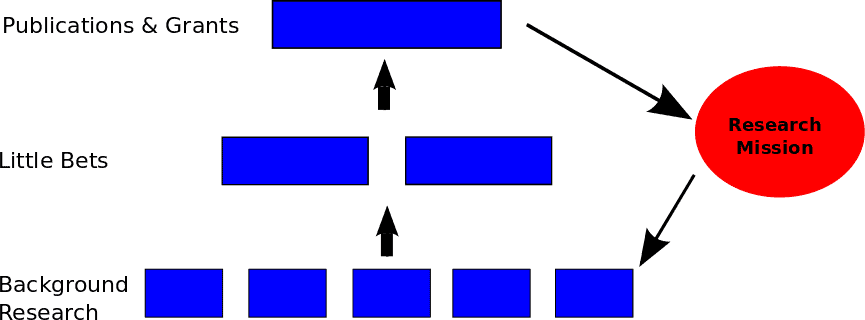
The best way to understand my research system is as a three-level pyramid (illustrated at the top of this post).
At the bottom level is background research. Every week, I try to learn something new about my field. I either read a paper, attend a talk, or schedule a meeting.
To ensure that I really understand the new idea, I require myself to add a summary, in my own words, to a growing document that I call my “Research Bible.”
Here’s a screenshot of the first page of the table of contents for my bible (as of June 23):
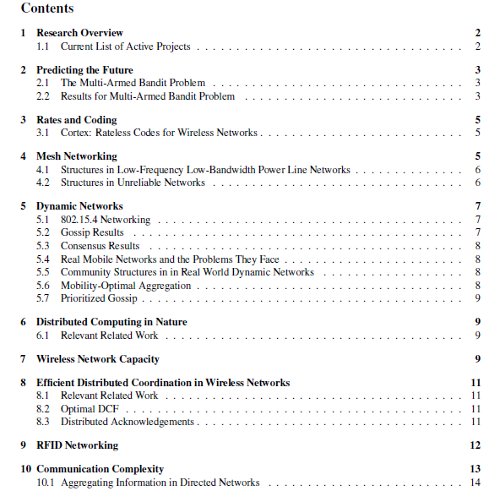
Because I particularly admire professors who make innovative connections between different fields (often a recipe for an interesting career), every other week I focus on adding an “exotic” topic to my bible. This week, for example, I added a chapter on the MIT Media Lab’s Junkyard Jumbotron.
In addition, I set aside one walk each day (usually my walk back to my office after lunch) for brainstorming. There’s no structure here: I allow the ideas in my bible to combine and recombine in novel ways.
Notice, this strategy is lifted directly from the liquid networks concept promoted in Steven Johnson’s book, Where Good Ideas Come From.
Research System: Middle Level
My background reading and brainstorming generates concrete projects. Borrowing a nice concept from Peter Sims, I call these projects “little bets.” Each little bet has the following characteristics:
- It’s small enough to be completed in less than a month.
- It forces me to create new value (e.g., master a new skill and produce new results that didn’t exist before).
- It produces an output that I can use to gather concrete feedback (e.g., a talk or a short write-up).
I try to keep only two or three of these bets active at a time, and I attack them aggressively, tracking my hours using the tally I discussed in a previous post. This provides a simple metric I can aim to maximize.
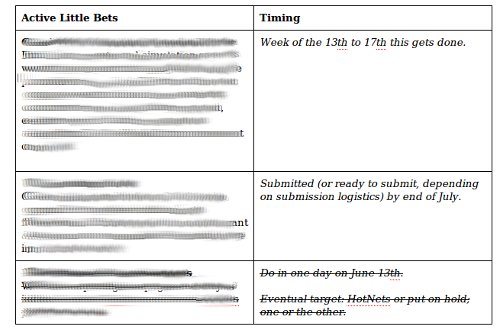
I also force myself to be specific about my timing for these little bets, as I find I get better work done faster when I’m fighting to meet a specific deadline.
Here’s a screenshot of the Google Docs page where I list my active little bets. I blurred out the description of the bets, but notice the timing column to the right:
These bets produce the following two advantages:
- They force me to master new skills and produce results that generate feedback. This is classic deliberate practice. The system, therefore, helps accelerate my ongoing efforts to be “so good they can’t ignore you.”
- Of equal importance, these bets — and the feedback they generate — help guide my research in more productive directions. A lot of young researchers jump at any idea that is potentially publishable, but this has a way of building a scattered CV that’s hard to later justify. I’m trying instead to evolve a research vision that other people care about. This is really hard. The bets allow me to be more systematic in my efforts.
Research System: Top Level
My little bets lead to publications and grants. In my recent experience, maybe one out of every three bets directly leads to something larger. But the system is too new for me to be confident about this metric.
Research System: My Mission
Off to the side of my three-level research system is my research mission. Here’s how I currently word my mission:
To apply distributed algorithm theory to new settings with the goal of creating new functionality and improving performance.
This mission helps direct the background research that occupies the bottom level of my system. The response I get to my publications and grants, produced at the top level, help evolve the mission. In other words, the system as a whole is a closed feedback loop — constantly evolving itself toward better and better results.
Moving Forward
This current system took around a year to develop. I’ve been using it for only a few months now, but it’s already proven more stable than any iterations that came before it.
I fully expect it to evolve — perhaps significantly — once I deploy it at the professor level. But at least I’m hitting the ground with a plan in hand.
I’ll keep you posted about how this plan unfolds.

Cal,
Today you mentioned “I read books on innovation and craftsmanship.” What are your top two in each category?
One of my faves: Tharp, Twyla. (2005). The Creative Habit: Learn It and Use It for Life.
I love HS Superstar. My son(16) and I are almost through it.
Thanks for all the good stuff.
JT
For innovation, I liked the Johnson and Sims books that I mentioned in the post. On craftsmanship, if you’re interested in a more academic approach, check out Richard Sennett’s “The Craftsman.” For a more philosophical approach, I liked “Soulcraft in Shop Class.” For a more practical approach, “Talent is Overrated.”
Hey, Cal. I really like the idea of your bible. I’m considering modifying it for use as a general learning log/boob/bible/whatever. What software do you use to create it?
Ditto to that, Matt, I’m also interested in this idea of a personal idea anthology. I’ve been keeping a personal wiki to track snippets of ideas, but I think I need to start putting into practice the use of a summary as well.
Thanks for the post, Cal!
This is why as I sat sipping espresso in Switzerland,because there is a kind of coffee feeling.Love HS Superstar
Thanks for sharing this important part of your life with us!
Hi Cal,
thanks for sharing the research bible idea; it seems a very comprehensive way of tracking thoughts.
I was just wondering, though, how do you capture the results of your brainstorming? Do they evolve into the little bets, do you add them to your research bible, or are they only in your head?
Good luck with your new job!
Latex.
I don’t have anything too formal surrounding the brainstorming. Sometimes it leads to a new little bet. Often times, it helps my work on an existing bet. A lot of times, it’s just a lot of configuring and reconfiguring that doesn’t necessarily go anywhere.
Hi Cal,
how do you decide which articles will be included in your research bible, especially the ones that are somewhat outside your field? In my experience it just takes too long to really work through and understand every article that seems interesting. What kind of screening process do you have?
Superb! Thanks for the post, and I sincerely hope your research mission to be successful, not only for your own good but also for the good it can do to others. 😉
Seconded
I really like your system. In general, systems seem to do a good job of keeping people focused and organized, so this should help you stay productive.
Partially, just based on experience: you develop a good sense for what might be important. But partially, it’s just random. You have to focus on the process of updating the bible, and worry less about bigger picture goals like capturing all relevant information.
Thanks for the great post – I really enjoy reading your posts on research, as I’m looking for ways to improve my work all the time.
Can you talk more about how you construct your Research Bible?
Hey Cal,
This is a great post. I am a long time reader, first time poster on your blog. I really love the way that it tracks what it takes to be truly excellent at what you do. We live in world which seems to put a premium on results without the wait. Its refreshing to know that the best in the field don’t come out of nowhere, and that there is a way to optimize our own processes and routines to strive to be great at what we do.
As a law student, there is always a way to try and be better. I am trying to implement your strategies to work on my full time job, my part time research, and the various hobbies I try to keep (fitness and learning a new language) while also being a normal 23 year old. I love seeing how much easier it is to handle all of this everytime I implement one of your strategies. Keep the great posts coming!
Cal,
As a Computer Science undergrad, one of my current goals is to try to find some niche or aspect of the field that I want to pursue in my career.
How might you modify this for the undergraduate, like myself, who has no research experience?
Also, I use the ACM and IEEE databases for articles. Are there better sources than those?
Thanks!
Adam
Your willingness to share this process is remarkable. Thank you.
I am a beginner at using PBWiki and Latex, both of which I’ve learned about from your blog. Could you explain why you don’t make a wiki for this research?
omg cal you are sooooo cuteeeeeee! 🙂 oh and im reading ure book: high school superstar and i love it !
I recommend a literature review matrix approach to organize reading.
https://www.ncsu.edu/tutorial_center/writespeak/download/Synthesis.pdf
The matrix helps you to identify potential gaps in the literature by seeing patterns more clearly. It can identify ways of combining methods in previous papers that may be helpful. Simplified example: Researcher A used method A with population/problem A; researcher B used method A with population/problem B; However, no researcher has combined method A and B or used either method A or B on population/problem C.
Mindmapping the core concepts and approaches in a given field. https://freemind.sourceforge.net/wiki/index.php/Main_Page is also useful.
Most advocate mindmapping for basic brainstorming and some like Cal prefer a more linear approach, but I find it actually more valuable for integrating readings. What authors agree/disagree on a specific research question? Which authors agree/disagree about a particular approach? What are the key papers/concepts in this research area? The author name and article year and title can be the basis for grouping papers and thereby “mapping” out a given research field. Using software one can also link to the original article PDF from the map for review or copy the abstract into notes attached to a node. Files/wiki pages can also be linked to the mindmap when more detail is needed.
Also good for review for a dissertation defense.
This software also has potential for integrating notes, thoughts and draft documents.
https://www.literatureandlatte.com/scrivener.php
Also,
http://www.mendeley.com
Would be interested in what others use for graduate level work.
Cal, thanks a lot for the insight; I found it so helpful that I spend some time this past weekend implementing my research bible with emacs + org-mode.
Cal, please tell us you’re working on a book about graduate school and/or academia.
I second “The Productive Philosopher” I would be very much interested in a book about getting into and thriving in graduate school and academia. Thanks for sharing this post, I love the idea of a research bible.
Yes,
Write more about the nuts and bolts of the graduate and faculty research process. Link to old relevant posts but add more about the research process with specific details and examples. There is too much vague advice on things like “narrowing a topic” or “research design” without concrete examples out there. Make the thinking and reading process more transparent for novice researchers as you are doing with this post.
Cal, this is awesome. Project Remarkable is really inspiring me to try to do something more remarkable with my career. Can you give us an example of a typical “little bet?” Obviously you’ve blurred these out for a reason, but I’m curious what kind of thing you might consider significant enough to count as a little bet and yet still be doable in 1 day or just a few days.
Love your site. Having been in this game a lot longer than most on this site, I have two questions.
I would be interested in your thoughts as to how your “research bible” fits into your diagram in the beginning of the article?
Further, I would be interested in how you plan to incorporate students? You may not want to tell all here but a schematic box on the diagram might not hurt. You are going to have lots of interested students and you need a plan to allow them to help you. As you must realize, no matter how amazing your research, this site is what makes it impossible to ignore you.
Hi Cal,
Really enjoyed this article. I was wondering about your “bible”… is it digital – like a word document? Or a journal, handwritten?
Good luck with your first year as a professor!
Hello Cal:
I’ve read your blog and thought about how to find a useful community for fiction writers, but I cannot contrive a foolproof method. Especially for writers, it is difficult. How can I ensure that the community I choose to get involved in is not a waste of time?
Thanks, and good luck with your professorship.
organsied practice of this nature can be evolved into something highly complex and productive,talking about little bets its probably your best bet in this endevour
Great Posts. These are really helpful as I am also thinking about accelerating my own academic writing.
Check out Belcher’s “12 weeks” book on academic publishing. There is valuable info in there on writing and publishing journal articles. I think you would like the approach.
Cal, it would be great to get an example your “little bets”? I think it would help get some insight on their scope. Is it “read this publication” or is it “read these 3 publications and start working on a proof of concept”, or more?
Cal, how does this work with the “strategies” text files you described as a replacement from to-do lists from a previous article? Is this used in conjunction or as a replacement?
Cal, surely this is not a closed loop. You interact with the world through your publications and research grant application, and the world gives you feedback. What is the grant situation in the USA? It’s dire here in Britain.
I’m curious as to what sort of things constitute “little bets”. Would they be mostly smaller projects (I know you mentioned they were only a month each)? How do you choose them if they’re totally new skills?