
Less Than Ultra Learning
As part of my craftsman in the cubicle project, I spent this past week monitoring how I learn new information.
I wasn’t impressed.
At one point, for example, I needed to dive into a topic I didn’t know much about: how information disseminates in random power law graphs. I went to Google Scholar and begin downloading papers with promising abstracts. I printed three and skimmed another half-dozen or so online. In retrospect, I think I was hoping to find a theorem somewhere that described exactly what I was looking for in notation I already understood.
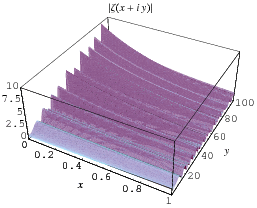
Not surprisingly, I didn’t find this magic theorem. The two hours I spent felt wasted. (Well, not completely wasted, I did learn about the Riemann Zeta function, which turns up way more often than you might expect.)
This experience recommitted me to cracking the code of ultra-learning. Mastering hard knowledge fast, I now accept, requires more than blocking aside time on a schedule; it also demands technique.
The Chair
With this in mind, here was my first stab at cracking ultra-learning:

I bought a traditional leather chair (a longtime dream of mine). My wife and I still need to add some bookcases, a rich rug, and an old brass lamp — but my general theory here is that this library nook will be make it impossible to avoid mastering new bodies of knowledge, and perhaps also pipe smoking.
Under the assumption that I might need more than the power of The Chair to become an accomplished ultra-learner, I do have one more strategy to deploy — which is what I want to talk about in this post. It’s actually a strategy I’ve known for years (my PhD adviser taught me soon after my arrival at MIT), but have seemed to forgotten recently.
The Textbook Method
This screenshot is from a web page I built as a grad student:
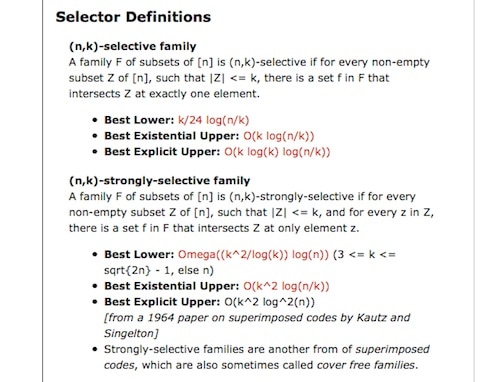
I needed to know about a certain family of combinatorial object sometimes called selectors. I actually needed to know quite a bit about these things because my collaborators and I wanted to prove the existence of a new one. My approach to this learning challenge was to build an annotated bibliography that listed every known result, with citations.
The web page took me a couple (hard) hours to make, which is roughly the same time I wasted this week “studying” power law graphs. I’ve probably used this knowledge on a dozen different occasions since, and I know at least two other scholars that have used it in their own research.
Here we have a nice comparison. In two cases I spent roughly the same amount of time trying to learn new knowledge. In one case, I efficiently mastered a new area, while in another, I ended up frustrated.
The comparison highlights the power of a simple act: describing and organizing information in your own words.
I call this the textbook method as you’re essentially writing your own textbook on a topic. One thing I like about it is that it works nicely with different levels of required detail. Whether you just need to organize what’s known about a subject, or build a deeper understanding of how results are derived, the textbook method seems to extract an optimum amount of learning out of the time spent.
It also leaves a written record that’s easy to reference later when you need to deploy the information.
Over the next week or two I’m going to take this method for a spin by applying it to some tough learning challenges in my queue. I’ll report back what I learn. I invite you to join me in this endeavor. Pick your own challenge, apply the textbook method, keep us updated in the comments below.
In the meantime, if you need me, I’ll be in my chair.
#####
This post is part of my Craftsman in the Cubicle series which explores strategies for building a remarkable working life by mastering a small number of rare and valuable skills. Previous posts include:
#craftsmanincubicle

I did something similar in my general chemistry class- I wrote final exams to study for the test. In this case, I was not so much doing it to learn but to reinforce already learned material- I couldn’t write questions that could (theoretically) evaluate someone’s understanding of a topic without having a decent understanding of the topic itself. It was also a fun exercise trying to get into the mind of my prof, trying to figure out how they would test.
Thank you so much! for writing about this… it’s something I discovered earlier this year. I like to call it the Synthesis Method since that’s what your brain is doing as you organize & process the information. I think it’s very cool that actively teaching & writing about what you’re learning boosts the actual process of learning. That’s incentive to share with others what you’re learning… which is a good thing!
Thanks Cal!
Having a tough time seeing how this means anything other than “take concise notes while reading.”
This is very similar to an idea I wanted to try where you make your own wiki page on a topic you are learning (I think the name of the site was PBworks). It is easy to link to other pages you wrote which saves time when going back to previous ideas. But it is your own personal wiki based on ideas that you have a good intuition on. That way the difference between the level of information on your wiki and different texts are the info that you don’t fully understand well enough to make an entry on in your own words.
I was recently reading Richard Feynman’s book, and he said that the technique he used for learning something new was to make an example in his mind. As the theories became more complex by adding condition, his picture would evolve. In my experience things that I don’t understand exactly are things where I can’t easily make up an example of or figure out what problems this could be used to solve.
So I think by combining these ideas I can start a personal wiki and on each page of whatever topic I am learning about I will try to make a very basic example of how it works and focus on the intuition or the things that refresh your memory in 10 years of why you learned it in the first place and at the end of each example link to the texts or articles that go into the tough details that we eventually have to go through anyway.
Soon you’ll be finding that zeta function everywhere.
@Lindsay. For me the difference is filling in blanks or rephrasing in a different representation. Best example I can think of is with linear algebra — texts might have succinct and notationally efficient equations using matrices-as-mathematical-objects, even though sometimes the best way to understand matrix equations is entry by entry using subscripts, or column by column, etc. So I’ll write notes as if writing a overly complete textbook: e.g. here’s SVD as A = USV’, here it is as a sum of rank-one matrices, here it is entry-by-entry etc.
Though I guess that’s a different matter altogether? — taking notes using different representations as the source.
Hey Lindsay,
I somewhat agree.
Hey Jefferson,
Take a look at tiddlywiki. It’s used at times for programming language documentation.
Joe, tiddlywiki definitely looks interesting thanks for the tip!
I am not a star student but don’t see this as “take concise notes while reading; it’s different. Read the material; understand it and then make notes in your own words. When you write your understanding (in your own words), you better identify flaws in your understanding and knowledge.
I’m in the process of moving fields, I’ve been thinking for a while about this. And it is away from Mathematical Physics into Statistics and Machine Learning. So there is a lot of carry over from what I’ve learned (in terms of raw Math) to what I need to learn. Still the problems are morale, using the best textbooks and getting over feeling like an idiot. So the textbook method sounds excellent. I propose I document my progress on learning about ‘Mining Large Data Sets’ using the textbook provided for free by some CompSci professors at Stanford.
This is most definitely not “take concise notes while reading.”
What I see is the solo equivalent of teaching something to learn it, a technique I discovered in grade 9 – I was part of the school’s peer tutoring program, both taking and tutoring grade 9 math at the same time. My “student” improved her understanding immensely, and I absolutely aced the course because to explain correctly and clearly so that she could improve, I had to fully understand the material.
Great post. This kind of approach has always seemed to help me focus. I’ve even coded an app to help me systematize the process.
While I was in school, I found that this same learning effect happened any time I made a “cheat sheet” for a test. We’d be allowed one side of an 8×11, or an index card, or whatever, and I’d spend a couple hours looking up all the information I’d learned and reformulating it to fit on that sheet.I think that physically writing it out (rather than typing) had a positive effect on my memory retention too.
When I walked in to take the test the next day, cheat sheet in hand, I’d often find that I didn’t even need to refer back to the cheat sheet because those topics had been burned into my memory.
This happened at least a dozen times during my college career, so I don’t suspect it was a fluke. And I know that by comparison, “studying” by trying to re-read chapters from the book or review old homeworks was never as effective as making those cheat sheets.
MB, this is the same as the Sorbonne Method of Study, a book written by Edmond Bordeaux Szekely (1905–1979) and it proves itself. The book is small, and I never have it far from me (in years).
Nice post.
About quickly learning new subjects, I think that the hardest part (and the most time consuming) is to get good sources from where you can learn (books, articles, etc.). As soon as you have that, things can get much easier.
Probably, to be an ultra-learner, you have to have good skills in finding good learning material.
What do you think?
There’s a version of this strategy that’s especially effective if you have writer’s block: make a presentation out of the study content. Once you’ve presented something ~20 times, it will be much easier to organize and integrate ideas in a meaningful way. You understand the deep relationships and writing becomes a much more natural process.
I can relate to this discovery. I’ve found that when looking for some paper or other source that has “the keys”, it almost always ends in frustration. Figuring out what to do is the result of mastering more fundamental concepts, which requires a lot of patience.
I think this also fits into a larger idea of separating what’s flashy and “high tech” from what’s practical. The “lifehacking” movement usually seems reducible to a message of using some form of “technology” to achieve superior results–which is sadly the exception rather than the rule.
Umm.. ” My wife and I still need to add some bookcases…”, why were we not told you got married?? As a long time reader, I love this site and your books. They’ve helped me through high school and now college. I just wish there was a way that you could open a little bit more up on how you’ve implement what you advocate on here to your personal life. I know..I’m reiterating a question that you semi-answered in a previous post.
I will try this soon though. Google Docs and/or DropBox is a great tool to use. Classes start in one week!
Doing serious thinking probably requires writing down some stuff. How will you do this with just The Chair and without a desk?
Really interesting post, Cal. When I would study in college I found myself writing on paper (both copying word for word text I would read in textbooks and my own explanation of a topic) and voraciously taking notes even though I would not look over those notes again. I found that just the act of writing it down and putting topics in my own words help me understand whatever it was that I was reading or trying to understand.
@Lindsay
Read it again.
That’s a good name too.
Notes, to me, often mean glorified transcription. You are taking text from one source, and writing it more concisely — an exercise in text processing. The textbook method requires you to demonstrate actual understanding, which in turn induces learning.
A common observation. “Active recall” — a more general name for strategies like the textbook method — is at the core of my advice for students.
True. Though I’m not sure that doing so is all that hard in the age of the social web.
I’ve had this experience time and again. When you try to write out what you know, it forces a deeper understanding than you had before, which in turn opens up new ways forward. There’s a demonstrable difference then discussing/thinking about a topic, and actually writing it out in detail.
A crucial question! Fortunately, I have a home office around the corner from The Chair.
Nice post. This method of learning is relied on heavily in law schools. Called “outlining”, it is used when learning large amounts of new information when textbooks are not available. Law is generally taught out of case books, and the rules are derived from the readings, so in order to assemble the rules in some digestible format we were encouraged to prepare outlines to use as a study aid for exam preparation. It’s a good method for legal research as well, especially when one might need to recite the rule orally in court, where your learning skills are on display.
Thank you.
I am in an internship this semester where the end goal is an article published under the auspices of my professor. And understandably, even though I have taken a class on the subject and studied it for years, I certainly haven’t learned enough to write something publish-able on the topic — yet.
I think this method is a good way of locating what you definitely do know, what you don’t know but need to know, and what is fluff that you can concentrate on later. It’s also helpful for laying the foundation that allows you to build interesting connections and analyze problems independently.
I’m definitely trying this out.
I feel like this method is an extrapolation of the mini-textbook method described earlier in your book, “How to be a Straight A*” student, just implemented for the specific purpose of publications. It also goes back to my belief that the best way to test understanding is to teach. By writing out the concepts, it’s a great way to test one’s knowledge.
I’ll tell you how my experiment goes when the semester closes.
Thanks again!
Here is an interesting study technique I read about a few years ago. Tried it out and it really works!
https://www.garynorth.com/public/1701.cfm
I came across an interesting book called “The Overnight Student” by a Dr. Michael L. Jones. In the book he describes a technique he calls “Teach Out Loud” and it sounds very similar to the Textbook Method. According to Dr. Jones, it’s completely changed the learning abilities of everyone who have used this method.
Here’s a link to check it out: https://www.scribd.com/doc/77487794/The-Overnight-Student-by-Dr-Michael-L-Jones
I am doing this too, although I am doing it on a word processor. I am writing a journal with the idea being that I would want to teach someone else the skills I am learning.
It has helped to solidify the information.
This is a great technique!
How is this different than outlining?!
This is one of the few times I’ve found reference to someone else trying to optimize how they learn. I most optimize learning via charts and diagrams, and this method is analogous to that. My theory is that refinement and testing would actually prove general better models that would improve learning for the population at large… but unsure if that is too ambitious and generalized (perhaps everyone needs to build his/her own model.) Nick Parlante teaches a CS101 class that I found on coursera.org, which seems to exemplify ultra-learning in lecture form — and I have never seen anyone explain a concept so clearly.
This ‘textbook method’ is what law students like to call ‘outlining’. I can’t speak for every law school but this is how we are generally encouraged to study for out final exams. When I began my MBA classes I continued using the outlining method and found that I was blowing past most of the other students.
If you do this for a course, share the result with your classmates! I studied Linear Algebra with this method, and my peers where really thankful for my “Linear Algebra mini-notes”.
Fascinating. This was how I learned in grades 7-12. I took copious notes by hand, basically copying what the teacher was saying, word for word. Then, at home, I would type up and organize my notes into outlines. I never studied for tests. And when I stopped doing this (in college), I didn’t do nearly as well in school.
Hi Cal,
As an adult learner i’ve found very useful study skills tips and insights in you blog. Thank you.
Regarding the Textbook Method, i think is very similar to an ancient technique called commonplacing:
I implemented a digital commonplace book with workflowy.com complemented with legal pads and my active reading time efficiency has been much improved.
CAGS
Bro unlocked the Take Notes technique