Study Hacks Blog

Are You Using Social Media or Being Used By It?

A Social Experiment

If you, like many people, use social media and generally agree that it’s an important technology, try the following experiment.

Take out a piece of paper and list your most important uses for these services — the activities that social media is well-suited to provide and that unambiguously enrich your life. This list, for example, might include items like:

  • The ability to see new photos of your nephews, nieces, or grandchildren.
  • The Facebook Group used to run a local organization you belong to.
  • The  hashtag that keeps you up to date with the latest news from an activist movement that you support.

The social media industrial complex* likes to point to lists like these to justify its importance. “It would be crazy to dismiss our technology,” they cry, “look at all these useful things people do with it!”

But here’s the second part of the experiment: estimate honestly how much time it would take per week to satisfy these important uses. In my experience, for most people, the answer is around 15 – 30 minutes.

And yet, the average American adult social media user spends two hours per day on these services, with almost half this time dedicated to Facebook products alone.

Read more

Spend More Time Alone

A Lonely Binge

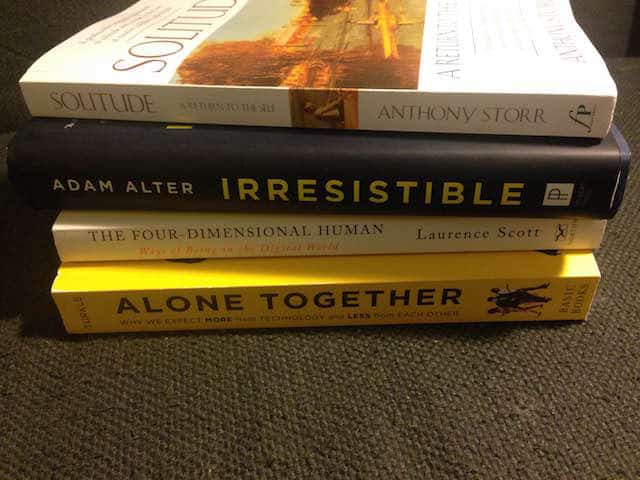
I recently read three books on the topic of solitude. Two were actually titled Solitude, while the third, and most recently published, was titled Lead Yourself Firstwhich is pitched as a leadership guide, but is actually a meditation on the value of being alone with your thoughts.

This last book resonated with me in part because it was co-authored by a former Army officer and a well-respected federal appellate judge, meaning it’s written with the type of exacting logic and ontological clarity that warms my overly-technical nerd heart.

Style aside, Lead Yourself First makes many interesting points, but there were two lessons in particular that struck me as relevant to the types of things we talk about here. So I thought I would share them:

Read more

Approach Technology Like the Amish

Kevin Kelly and the Amish

Eight years after dropping out of college to wander Asia, Kevin Kelly returned home to America, bought an inexpensive bike, and made a meandering 5,000 mile journey across the country. As he recalls in his original and insightful 2010 book, What Technology Wants, the “highlight” of the bike tour was “gliding through the tidy farmland of the Amish in eastern Pennsylvania.”

Kelly ended up returning to the Amish on multiple occasions during the years that followed his first encounter, allowing him to develop a nuanced understanding of how these communities approach technology. As he reveals in Chapter 11 of his book, the common idea that the Amish reject all modern technology is a myth. The reality is not only more interesting, but it also has important implications for our current culture.

As Kelly puts it: “In any discussion about the merits of avoiding the addictive grasp of technology, the Amish stand out as offering an honorable alternative.”

Given such a strong endorsement, it seems worthwhile to briefly summarize what Kelly uncovered during these visits to rural Pennsylvania…

Read more

Franklin Foer on Technology’s Surprising Threat to Humanity

Contemplating the Importance of Contemplation

Franklin Foer has a new book coming out this week. It’s titled, World Without Mind: The Existential Threat of Big Tech.

I haven’t read it yet, but this morning, on returning from a family camping trip, I read Foer’s essay in today’s Washington Post and a recent interview with The Verge (as, of course, there’s no better time to contemplate the existential threat of technology than right after a weekend in the woods).

According to the interview in The Verge, Foer writes in the book: “the tech companies are destroying the possibility of contemplation.”

This premise is one I obviously support, having written an entire book on why we should fight to retain our diminishing ability for sustained attention.

But whereas my main issue with digital distraction was limited to issues of personal satisfaction and productivity, Foer, in elaborating his contemplation quote, goes much broader in his concern:

Read more

Apple’s New Open Office Sparks Revolt

Not Open to Openness

Apple’s new Cupertino headquarters cost $5 billion (see above). One of its prominent features is a massive open office space in which many Apple engineers sit on benches at long shared work tables.

As Apple aficionado John Gruber revealed in a recent episode of his podcast, not everyone is happy with this decision.

“I heard that when floor plans were announced, that there was some meeting with Johny Srouji’s team,” said Gruber, before explaining that Srouji is an important senior vice president in charge of Apple’s custom silicon chips.

Srouji, to put it politely, was not pleased with the idea of moving his team to a cacophonous, distracting, cavernous open office.

As Gruber tells it:

Read more

Toward a Deeper Vocabulary

When Writing is More than Writing

As a professor who also happens to opine publicly about productivity, I’m often invited to stop by dissertation bootcamps — a semi-annual ritual at many universities where doctoral students gather to hear advice and work long hours on their theses in an atmosphere of communal diligence.

Something that strikes me about these events is the extensive use of the term “writing” to capture the variety of different mental efforts that go into producing a doctoral dissertation; e.g., “make sure you write every day” or “don’t get too distracted from your writing by other obligations.”

The actual act of writing words on paper, of course, is necessary to finish a thesis, but it’s far from the only part of this process. The term “writing,” in this context, is being used as a stand in for the many different cognitive efforts required to create something worthy of inclusion in the intellectual firmament of your discipline.

Read more

How I Read When Researching a Book

The Reading Writer

As a writer I’m required to read lots of books, especially when ramping up a new project, as I am now. The picture above, for example, shows the books I’ve purchased only in the past two days.

I’ve already finished one of them.

My approach to the books I process in my professional life is quite different than my approach to the books I savor in my personal life. The former requires the ruthlessly efficient extraction of key ideas and citations, while the latter unfolds as a slower, more romantic endeavor.

I thought it might be interesting to briefly reveal the method I’ve honed over the years for my professional reading. It’s simple, and the basics should sound familiar to any serious nonfiction reader, but it has served me well.

Here’s the strategy:

Read more