
To-Do Lists Are Dangerous
Many students are tempted to run their day based on a comprehensive to-do list. In practice, these lists are hopelessly ambitious. Few things get completed. Many small tasks get punted day after day. And frustration mounts.
In short: to-do lists are a terrible daily planning tool. Why is this? They are missing two key pieces of information:
- How long each task requires.
- How much and where your free time is available for the day.
Without these two facts, you are stumbling blindly, hoping your random decisions of what to do (or not do) at a given moment will lead to an efficient schedule. Here’s the secret: it won’t.
Case Study: A Typical To-Do Debacle
Consider the following case study. On the left is a standard student to-do list. On the right is a standard student schedule. The arrows connect the tasks to when the hypothetical student, running his day off of the list, tackles them:
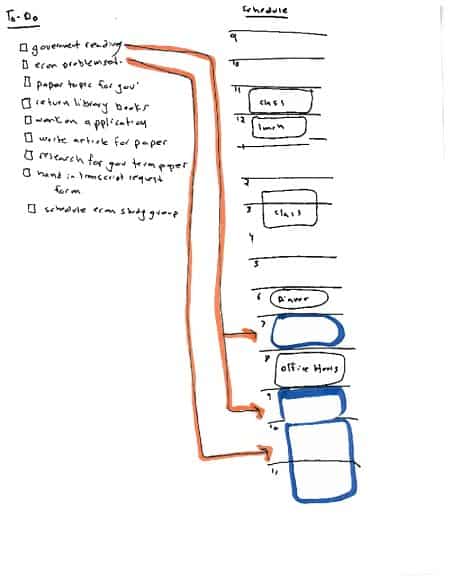
The student procrastinates until after dinner when he feels the time is right to get some work done. He sorely underestimates how long his tasks will take. His reading assignment gets split by office hours, and the econ problem set takes him until midnight. In the end, his evening was exhausting and a lot was left unaccomplished.
The Time Blocking Solution
There is a simple addition to your to-do list that solves these problems. The idea is simple: Assign specific times on your schedule for when you want to complete specific tasks. This approach provides a surprising number of immediate benefits:
- Starting from your schedule, you are more likely to take advantage of smaller chunks of time open earlier in the day. (Chunks you would have otherwise wasted).
- Assigning work to times reduces the urge to procrastinate. You are no longer deciding whether or not to work during a given period; the decision is already made.
- You are more likely to fit in urgent small tasks between the bigger time-consuming tasks.
- Over time, the technique will increase your ability to predict how much time work really requires — leading you to start things early enough to get them done without late night pain.
Case Study: Time Blocking Cleans Up the Schedule
Here is the same to-do list and schedule as before. This time, however, the student uses time blocking to lay out a reasonable schedule in advance.
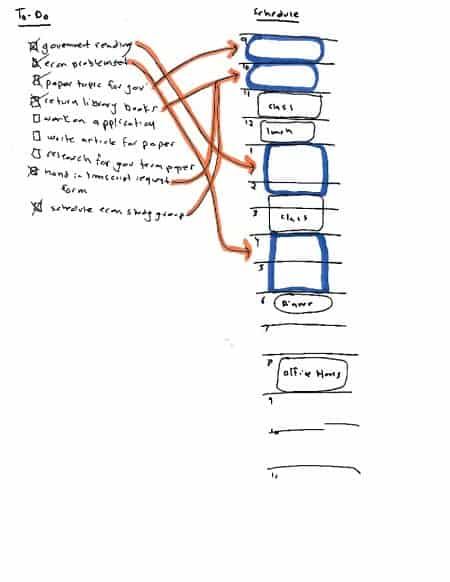
Notice how much more work gets done and how much earlier. Those five minutes, first thing in the morning, to work out a blocking schedule, provides the student full control over his time landscape.

I love time blocking. Once I started time blocking I realized I had a lot more time in my days, and I could easily schedule an hour or so for free time. Scheduled free time is great because it gives me something to look forward to.
I completely disagree. I actually find the opposite to be true – time clocking (aka scheduling tasks) interferes with me actually doing stuff… I get really bogged down in when I have to do things…. and most people life’s are not so ridiment. Often times in the course of the day, there’s some sort of surprise event that warrents my immediate attention. Sometimes I have to move non-essential tasks, and add in sme more urgent surprise tasks…. for this reason I really prefer a to do list, simply because its more flexible. I especailly like daily to dos because they at the least provide a framework for what needs to get done for the day… but since it’s just a to do list it’s still flexible unlike rigid scheduling…. I’d actually recommend a site called ZoToDo.com for a simple daily to do…. I think some daily to do managers are too complicated… ZoToDo is simple and stuff which again leads to a flexible gtd management tool which I think actually helps in productivity.
Look, there’s other tools that are good too… I’m just saying I actually like Daily To do lists a lot and dislike block scheduling.
@Venkat:
I use block scheduling to estimate how many things I can fit into a day; then, if I feel like doing them in a different order, I do that. This keeps me from scheduling so many “fun” activities that I don’t have enough time to do work.
From ZoToDo.com:
“Copyright Venkat Koduru. ZoToDo.com is a Venkat Koduru creation.”
I guess I understand now why he happens to recommend the site…
I stand by my comments. I was trying to say that I belive using daily to do lists in general, actually helps productivity, contrary to what this article states. Yes, I do think ZoToDo is the best. Yes, I am biased, because yes I did created ZoToDo… but I still think my comments are valid. I’m saying use some daily to do list (preferably ZoToDo of course)… but there are definitely others
@Venkat:
You’re right to mention surprise tasks that pop up. Those really can complicate daily schedules. Probably for most students some balance between totally schedule and totally listed works best. For me, for example, I tend to schedule major chunks of work on important things — and don’t violate that schedule. But then I have more general “mosquito task” time and try to leave some time free so I have flexibility on minor things.
In terms of your specific software program, I’m sure it’s fine. My general advice to students is use whatever seems like you’ll stick with.
I’ve been wanting to implement this since I read the article and have found a site that provides a printable pdf that allows you to do exactly this. davidseah.com has an “Emergent Task Planner”. It seems like something that fits the bill. I’m also going to try his “Emergent Task Timer” to track what I actually do during the day. Love this blog…unfortunately I read it more than I study.
All you need is a blank piece of paper and a pen.
I tried doing this in conservatory when I was a fanatical music student who practiced 7+ hours a day. These won’t work any better than regular to do lists because human fallibility is too monumental. You plan all your free time like this, then if you are tired or have one of the many random things in the world happen to you, then the whole thing goes to shit. Then you just feel bad about yourself. You shouldn’t plan your day. You should instead make routines for yourself for the things that you do daily. All other things you should do as early as you can in the day.
I sort of do this. I block off time where I will get things done, but then use a to-do list to determine these things, instead of specifically laying them out. If I use purely a list nothing gets done, but I have a nervous breakdown going off purely scheduled time. Compromise is lovely.
What is Cal Newport’s email address?