
The Zen Valedictorian Decoded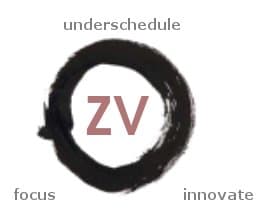
Last week, I introduced the Zen Valedictorian Philosophy. This concept captures the general approach to student life that I’ve been promoting on this blog. The big idea is to find a way to become less overloaded and less stressed without becoming less impressive. I believe that a student should be able to have an engaging, fun college experience, and still get into a top graduate program or professional school, and have the ability to choose between outstanding job opportunities. I lived this dream. I’ve met dozens of other students who have as well. In this article, I explain how you can achieve it too.
The Framework
As with the Straight-A Method — which provides a structure for all of my study advice — here I will describe a general framework for the Zen Valedictorian Philosophy. This framework can be realized with any number of specific strategies. Specifically, there are three main principles: underschedule, innovate, and focus. If you can satisfy all three — however you do it — you can achieve the Zen Valedictorian lifestyle.
PRINCIPLE #1: Underschedule
The Zen Valedictorian has more free time than he has activities or classes to fill it. He does not stuff his schedule to capacity. Instead, he purposefully underschedules. Rare are the days in which the Zen Valedictorian is working for most of his waking hours. More common are relaxing nights and last-minute adventures.
The goal of this principle is to leave room in student life for relaxation and participation in activities that generate happiness. It rejects the degenerate belief that if you’re not working every free minute than you’re somehow failing as a student. It also provides the flexibility needed to pursue the random interesting opportunities that often lead to big positive results.
To satisfy this principle requires two strategies:
- Simplification: Have one major. Balance easy courses with hard courses during a given semester. Slash and burn your extracurricular commitments to the bare minimum.
- Efficiency: Improve your study and productivity skills. Live the pillars of the Straight-A Method. The better these skills, the easier it will be to underschedule.
Previous posts that will help you understand and satisfy Principle #1:
- The Radical Simplicity Manifesto
- The Laundry-List Fallacy
- The Straight-A Method
- The Danger of Pseudo-Work
- The Auto-Pilot Schedule
- Fixed-Schedule Productivity
PRINCIPLE #2: Innovate
The Zen Valedictorian strives to be interesting not widely accomplished. The psychology of impressiveness reveals that people are more impressed by someone who makes them ask “how did he do that?” than someone who has a sizable laundry list of standard activities. Achieving the former, fortunately, requires less time — and significantly less stress — than achieving the latter. The Zen Valedictorian takes advantage of this reality by constantly looking to push his involvements into the rarefied territory of interestingness.
The goal of this principle is to stand out from the crowd by means other than simply outworking your peers.
To satisfy this principle keep looking for low-hanging fruit. That is, identify interesting, unexpected directions toward which you can push your involvements. Take the normal course of action for someone in your situation then pump up its ambition by 50%. Next ask: if I had to make this happen, what would it really require? More often than not, you’ll realize that what once seemed hopelessly ambitious is, in reality, possible if you’re somewhat clever and, more importantly, actually follow-through. Keep completing. Keep pumping up your ambition and finding ways to get somewhere more lofty. The interestingness will rise sharply with each new push.
Previous posts that will help you understand and satisfy Principle #2:
- Action is Overrated
- The Law of Complementary Attraction
- The Steve Martin Method
- The Grand Project
- The Information Theory of Success
PRINCIPLE #3: Focus
The Zen Valedictorian is a specialist. He focuses on a small number of areas and works consistently over time to become outstanding in them. He realizes that the relationship between reward and skill level is not linear, but, instead, exponential. A corollary of this truth: being excellent at one thing can yield significantly more rewards than being good at many. Even though the former requires much less time than the latter.
The goal of this principle is to maximize the rewards and interesting opportunities afforded while minimizing both the time investment and the schedule footprint; i.e., total number of unique activities: a metric that strongly predicts stress. The world rewards experts. It is indifferent to generalists. And it could care less how hard you worked.
To satisfy this principle the Zen Valedictorian will, by default, make his academic major an area of focus. He chooses a subject that intensely interests him (not the subject that seems most practical). Because he believes in underscheduling, he has the time need to put serious thought into his class assignments. He soon becomes a department star, which opens up a wealth of exclusive opportunities and rewards hidden from most students.
He will also typically chooses a single extracurricular activity in which to become excellent. By the time he graduates, a Zen Valedictorian should be well-known on campus for his focus-area skill.
Previous posts that will help you understand and satisfy principle #3:
- The Einstein Principle
- A Rap Star and a Rhodes Scholar Walk into a Bar
- Productivity is Overrated
- Would Lincoln Have Become President if he had E-mail?
- The Project Purge
Pulling It All Together
The Zen Valedictorian Framework derives from a careful understanding of two important questions:
- What generates stress?
- What makes someone impressive?
It notes that the answers to the two questions are different. It takes advantage of these differences to make possible the dream of a low-stress impressive student lifestyle.
Specifically, it notes that stress comes from having too many obligations pulling at your time. The principle of underscheduling prevents this situation from occurring.
Impressiveness, on the other hand, comes from doing things very well in a way that defies expectation. The principles of innovation and focus generate these accomplishments. The principle of underscheduling indirectly helps the effort by keeping you low-stressed and providing the time needed to chase down relevant random opportunities as they arise.
Moving Forward
We have a lot more ground to cover. Each of the three principles provides a rich area of exploration. Over the coming months we will dive into these ideas and improve our understanding of how to satisfy them and the types of strategies that might work. Also expect more case studies of real students who are living the Zen Valedictorian lifestyle.
My goal here is nothing less than to dramatically remake your vision of a successful college career. This transformation is not trivial. But I assure you it will be worth it.
As always, I look forward to your feedback and interaction.

Hi Cal,
I really like the philosophy behind this concept (as I like the philosophy behind the rest of your material on this site).
Just one question: why is the Zen Valedictorian a ‘he’? I’m sure some people might think I’m being pedantic, but I really think gender neutral pronouns are important – otherwise 50% of the population are implicitly excluded.
Cheers, L.
Making it gender neutral would make it grammatically incorrect. It has to be either “he” or “she” for accuracy.
Hi, just to alert people that there exists a gender neutral pronoun “they”. It’s not that hard. – Thanks.
@L:
I’m glad the philosophy strikes a chord with you. I’m not a big fan of gender neutral pronouns as I think it muddies the writing. I tend to fix the pronoun one way or the other for a given article. The decision is basically random. (If you go back through the archives you’ll see as many “shes” as “hes”.)
I’m aware of this.
Hi, I’m new here and I wish I had found your site when I was still an undergrad!
Do you think this philosophy can still apply to grad students? I’m finding that grad school almost inherently satisfies principles 2 and 3. But how does one underschedule when simplifying isn’t an option (seminars, courses, TAing, meetings, research…)?
@Shan:
Welcome to my world (I’m a fourth year PhD candidate.) First, in many fields, “focus” and “innovate” are not that obvious for graduate students. At least, not to the level they need to be. I think it’s reasonable interpretation of “focus” to attempt to become world class at a given technique (or time period, or framework, etc.) This can take several years. Most grad students don’t innovate. They do incremental adjustments guided entirely by their advisor. So, though hard, these two principles have their place.
In terms of Principle #1, the best place I can think to apply it is to keep yourself focused on a single research project at a time, turn down as many obligations as you can without really hurting yourself, and pump up the efficiency techniques to their maximum.
You might check out my article on fixed-schedule productivity (linked under Principle #1) which describes how I contain my grad student life between then hours of 9 to 5.
Point taken about grad student innovation 🙂 It’s far too easy to fall into the trap of doing only what your advisor tells you to do.
I’m glad to be in an environment where developing the focus and innovation you speak of is possible without too many obstacles. You can bet I’ll be taking this article to heart as I get into my research this summer.
definitely food for thought. 😀
I’ll be working more on principle 1. I have only one extracurricular and one major, but I get overwhelmed by how many other things I want to try during my free time.
If nothing else, your blog taught me to work on those little extras — or mini-adventures, shall we say — one at a time. Thank you!
@Daisy:
An additional thought — which I haven’t worked through completely — is the difference between obligatory and non-obligatory activities. That is, I think it’s safe to say that the Zen Valedictorians I know do *many* different things in their free time. It’s just that very few of them require their regular commitment. That is, there is a difference between being a reporter for the school paper, and having to hand in an article every few days, and joining the outdoors club, which requires, basically, nothing, but makes available all sorts of hikes and trips if you happen to have the time. I love the idea of piling on the latter. It’s the former that can lead to stress.
As usual, this is some good stuff. I’ve been reading this blog for a while now and love this new philosophy. It encapsulates a lot of what I was trying to do, but couldn’t quite make as explicit.
I do have a question though. One thing that I feel is important is balance — social and academic skills, math and english skills, everywhere. Standing out in one field can be unimportant if an individual is particularly weak in something else as a result. It doesn’t seem as if there’s any emphasis here in taking classes “cause they sounded interesting.” I think the first two principles are golden, but the focus one worries me just a little bit. I always find that by focusing on one thing, you miss out on a lot of other possibilities that you never even noticed.
@Drew:
I think principle #1 should help you out here. Because you don’t have to pack your schedule trying to satisfy a double or triple major, you have a lot of room to explore. I think the point of principle #3 is not that you shouldn’t do other things, but that the small number of things you choose to do well, you should do really well.
For example, I focused on my computer science major. But that required about one class per quarter. The other two classes I used to explore. I took a lot of art history and brain science and some philosophy — because I thought this was interesting.
Hey… how come your book “How To Win at College” suggests a double major and now you are telling us to do just one?
@Udoka:
The suggestion was to add a minor as a way to focus your interest in some subject completely interesting and random and off the beaten path. I’m somewhat indifferent on that advice right now (I wrote that 5 years ago.) On the one hand, I think it’s just a nice way of organizing the low-key study of a random topic (minors are a lot easier than majors, so they don’t gunk up your schedule every semester with required courses.) On the other hand, I wouldn’t, today, suggest running around trying to force one into your semester. If there is some type of class you find yourself keep taking, look into making it a minor, you might be pretty close. Otherwise, don’t sweat it.
I’m not a student, but I think I’m going to re-read this page over and over again until it sinks in 🙂
I’m a rising freshman at a top school, and I’m looking forward to trying new things and finding new interests in college. So, when should this “ZV” philosophy start? When should I start focusing on one major? I enjoy so many things, and it’s hard to pick one, especially early on.
I was thinking of starting out by signing up for 6 classes and then dropping my 2 least favorite by the end of the first two weeks. Does this sound like a good idea? Should I do the same thing with ECs (sign up for 3 or 4, and then drop some)?
I’m finding this very relieving as my fall semester starts, well, on the 18th which is tomorrow. [Ah!]
I found out earlier this morning that one of my choice professors for a core class was replaced, and no other courses are open.
So! Since I was stressing out about my courses due to the final exam setup [I’d’ve had 3 back to back finals], I’m going to drop that evil’d version math and pick up a course for my minor instead – especially since I finally decided on it.
I’ve always found a way, in HS too, for getting things done without cramming all of my time into doing them. However, this is a much more structured approach, and less-stressful even; which, is good for ADD/dyslexic people like me that are overachievers to boot.
Thanks! I’m absolutely going to try this starting this week.
I just want to thank you for coming up with this. As an engineering student who wants to go to grad school (and tends to put too much on his plate, most of which is not that impressive on a resume) your ideas have given me a new found focus.
It’s great that there’s someone out there who has figured out the game called university and is willing to share his knowledge. Thanks again – this has been a lifesaver.
Mike
@Shan:
As a recent graduate student graduate, I can say that it is possible to incorporate principle 1 into your schedule. For me, I rather informally set aside time where I would be relaxing just before I dove into some big assignment. For example, for my papers, I would go whole hog researching the topic at hand for a specific amount of time leading up to the point where I had to start writing. As a down time exercise where I was still actually doing work towards the completion of the paper, but giving myself a little bit of a break, I would create and revise my outline, because it was such a low-impact activity. Then I would put everything aside for a few days. Feeling refreshed I would then dive into the writing and completion of the paper. It’s important to get that break in there because your mind has been stuffed with so much info that the thoughts can’t find connections through all that murk. A relaxation of the mind helps clear the path for thoughts to connect and help you formulate a whole picture that you can then begin to describe in your writing. When I finally started to recognize this principle and incorporate it into my schedule, I started getting 100%s on my papers! Also, it’s important to note the use of organizational tools during your studies – a calendar, for example, that not only shows when major assignments are due, but due dates for the steps leading up to them.
@Study Hacks! I wish I had come across this blog when I was in school because I would have gotten much better grades in the beginning of my studies. Cheers and thanks for sharing these gems!
I am very impressed by this writting, pity I have already graduated from it. Actually for the question ‘what makes someone impressive’, I could say I got the same answer as it is here. Anyway, hope I could become a student again…
Wow, thank you so much for this. I always appreciate being made to test my basic assumptions about life, and this has really helped me understand a new way of thinking. 20 minutes ago, I was planning to double major in sociology and cognitive science, and minor in Japanese. Now I see why that’s like buying tons of not-so-necessary mantelpieces. I’m so glad I could see this now instead of two years from now. I have a feeling I’m going to benefit quite unfairly from this blog 😉
That’s music to my ears…
I don’t want to die as an idiot. I fear that if I take the zen valedictorian method too seriously, people might take me less seriously, because I could be brilliant at one thing, and rubbish at so many other things. I think the want to become ‘impressive’ could make life plain or even a fake.
No one knows what you’re not good at. Respect comes from what you’ve mastered.
Cal,
Hi. I’m new to this website. I had read previous post and given feedback on only one occassion, however, I had question: Do you have any advise when it comes to studying for the MCAT?
Cal,
Isn’t is possible to be the type of person who thrives from a more generalized academic load? If I love both economics and philosophy for different reasons, why choose to master one?
The “he” thing is bothering me while reading this site as well. Gender neutral pronouns don’t muddle anything. It’s not so hard to write “they” or “their”.
Guys, I don’t think he’s trying to say you should concentrate every single unit of brain power into one field of study. You should thrive to do well in all of the courses, but apply yourself even more when it comes to a field that makes you tick. That’s the way I see it.
Hello study hacks!
I was wondering if the techniques in “How to be a High School Superstar” are also applicable in a college setting. In addition, would using these techniques on impressiveness help me with MBA admissions? Thanks in advance.
For those who want to have a double major and graduate in three semesters without going to summer school, Steve Pavlina explains how in Do It Now.
I just want to say upsaid question: why is the Zen Valedictorian a ‘he’? Because she have to do something else for “he”.
I have been into a lot of stuff. Tried to study a lot of things at one time… And Still I pursued a lifestyle similar to a Zen Valedictorian without even knowing about it. Less Stress, Doing something different and interesting and staying focused.
Is it possible to be a Zen Valedictorian if Im into a lot of things at a time….
I would suggest another principle between underscheduling and focusing — prioritizing.
Prioritizing does partially overlap both with undershcheduling and focusing, and may even be considered just an implicit, though necessary, prerequisite step to focusing, but it does make all the difference in the world.
Prioritizing helps both in keeping the schedule not stuffed up (with insignificant garbage), as well as in choosing which subject to focus on next. In a sense, underscheduling, prioritizing and focusing can get anyone afloat, even those who are not good at innovation.
Innovation, however, is the cheery on the top of the proverbial cake. One can make a cake without it, but it won’t be as impressive-looking.
Let me give you a clean example of what my decision cycle used to look like in my school daze (not a typo :)).
1. Underschedule: Never have more that 3 things on your schedule, but do allow for special circumstances to suddenly and unexpectedly add a few more.
Ideally, keep your schedule completely clean and with nothing on it.
If your schedule is clean, you have all the time in the world. It’s only when you are overwhelmed by problems that you will feel the pressure of never having enough time. That pressure is just an illusion, and your cleaned schedule will remind you of how illusive it is every time you clean it.
2. Prioritize: This may be a tricky part. Use two main criteria for prioritization:
a) Time involvement: Finish the things that take least time first. This will help you with cleaning up your schedule in a timely manner, before those sudden and unexpected things show up (and sooner or later, show up they will).
b) Urgency: Some things just can’t wait, so regardless of how long they will take to finish, start working on them immediately.
But also, don’t take priorities as a given by thinking that, just because you’ve just decided on what to focus on, that decision is now set in stone. Be fluid in your priorities (we may even have another principle here – fluidity in prioritization).
Priorities change all the time, so while you’re not working on that long-term problem, don’t forget to clean up those short-term matters that are still waiting to be finished.
3. Focus: Not much to add here, except one small matter that many keep forgetting — some problems are simply unsolvable.
Most people believe that once we set our minds to something, it’s only a matter of time and hard work before we can turn our decisions into reality. Reality, however, frowns upon such simplifications.
It may seem simple enough, but it’s worth repeating to oneself — not everything one can imagine can be done.
Know thyself, know the problems you are facing, keep realistic expectations of what you can and cannot do. But from time to time, don’t be afraid to improvise and cross the boundaries of your expectations.
As you move through life, your boundaries expand, and what seemed impossible once may have become possible in the meantime.
Seize opportunities as they appear. Right timing can, only sometimes, take you further than any hard work could possible have.
In short, don’t waste your time on unsolvable problems. Some of them may be completely unsolvable, while some may be unsolvable only temporarily. Either way, take those off your schedule, write them down someplace else, and take another look at them when you feel bored and have too much free time on your hands.
4. Innovate: A matter of many headaches, broken hearts and sleepless nights.
Something that can’t be put in a simple algorithm and fed to a computer. Something that no real and useful advice can be given on. An elusive abstraction of a realm unknown. Even worse — a realm unknowable.
It can’t be defined, it can’t be measured. It can’t even be talked about, and yet, one can do it all the time, even without realizing it.
‘Only this, and nothing more.’
I’m going to be honest, I really enjoy the content here. However, focusing on using male pronouns was a big turn-off. It’s an old post so maybe a moot point, but more gender-neutrality would go a long way to making the tone feel more inclusive! I think this is especially important given that young women are even more pressured to fall into traps of overscheduling and struggling to fit a certain perception of laundry-list achievers.
Hi Cal! I’ve been reading a lot of your posts lately, and I’m in a dilemma. You say that a Zen Valedictorian would typically under-schedule and pick one extracurricular to focus on. I am a first year engineering student and I really love marching band and music in general. I played with the band for fall season and I would love to return this coming fall.
However, as an engineer I do have a heavy course load and don’t know if it is wise to return to the band. I noticed that I was rushing to complete homework and was very stressed about school during marching season (though the marching band activity, itself was very enjoyable). Band pretty much took over my life during the Fall. Time-wise the commitment was about 3 hours a day, 3 days a week on weekdays, and my entire Saturday if it was a game day. On the contrary, this quarter, I do not have marching band, and I have been able to indulge myself in the the material, study more effectively, and explore more of what my school has to offer.
Do you think it is best to leave marching band, as heart-wrenching it is for me, and pursue a different activity that is less time-demanding?
I’m facing an academic suspension, so I definitely need to get my act together. It looks like the material on your blog will help me get back in on track. It would seem my problem this past semester was starting off with a 16 unit schedule and taking way too many unrelated classes to focus on.(Math, Logic, Theatre, and Biology) as well as pledging for a fraternity and doing community service. When I’m back in school, I’ll be sure to take it a bit slower.
This is so interesting because I was a philosophy major before (graduated summa cum laude with little to no problem…the thesis writing was not easy but also not incredibly taxing). I just recently have gone back to school to complete pre-reqs to go to med school or science grad school. I had assumed my previous major was so enjoyable only because I love philosophy as a discipline. While true, I was unknowingly following #1 and #2 (Underschedule and Innovate).
For #1…I didn’t do anything but my major. I had an area of interest , and a school of thought I enjoyed. My thesis was a marriage of these two.
For #2…
I was constantly churning out papers, but I was peppering my study time with “hard focus” (that is…I would split up my writing sessions to an hour or two for outlining the essay and then three or four two to three hour blocks for filling the outline).
I hope to apply these to my scientific pursuits. Thank you for the post!
This post is very sexist! This article only uses gender bias nouns (e.g. “he thrives” or “he chooses”), please fix them. Men aren’t the only eligible Zen Valedictorians?
Stress is not caused by over-scheduling alone. It can be a factor, but not even that big of a factor. Think about someone who is “stressed” about a public speech. It may not require much time, but the idea of giving the speech is way bigger in his/her head, then it is in reality. Stress is more often caused by this mismatch between the reality of a project and the idea of the project in your head. That’s why something you have done many times causes you less stress than something that is new. Partly because, in your head, you feel you have done before so it is not that hard. Whereas something that you have not done before feels tougher – think of riding a car vs riding a bicycle. If you are just learning to drive a car, you are more stressed than riding a bicycle even though today’s cars are probably easier to drive than bike.
I think the idea of zen scholar that you are representing here is more like a laser focused nerd – not a true intellectual that sees connections between vastly different fields. Perhaps many ivy leagues want laser focused nerds – i know one theory in math and I know it super well but talk to me about philosophy and I start to cry- not the idea of a serene intellectual sitting in meditation and reflecting upon the world or the idea of poets who saw the proof of rivers in a grain of sand.