
Rewriting Science…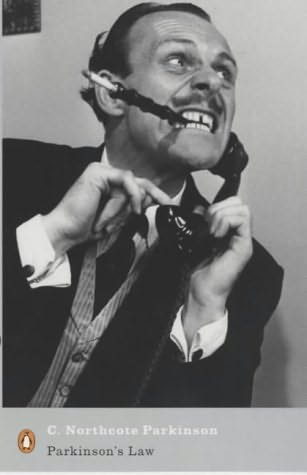
The phenomenal success of Tim Ferriss’s recent book, The Four-Hour Work Week, brought to prominence a distressing trend that has been recently plaguing the self-help community: citing rough summaries of scientific principles as evidence for unrelated how-to advice.
The principle, in particular, that I’m interested in here is Parkinson’s Law. Informally, the law states:
“Work expands so as to fill the time available for its completion.”
This was the opening sentence of the humorous essay Professor Cyril Northcote Parkinson published in The Economist in 1955. The essay went on to explain the results of a study of the British Civil Service. (Click here for an expanded version of the essay published in Parkinson’s eponymous book on the subject).
Unfortunately, as we’ll see, in modern usage the study itself has been discarded in favor of this one sentence opening — a tendency that obscures its true meaning.
The Misuse of Parkinson
Parkinson’s Law is widely cited in Ferriss’s book and in countless blog articles as evidence that when given a task, a human will fill whatever time was alloted for its completion. The conclusion: a feeling of busyness shouldn’t prevent us from reducing the time we set aside for work. In other words, they take the opening sentence from Parkinson’s essay and then interpret it literally.
The reality, however, is more complicated…
Inside the Civil Service
If you read deeper into Parkinson’s work, you soon discover that he is not making a general claim on how humans procrastinate. He is, instead, summarizing a rather rigorous statistical proof he devised to explain observations of a very specific context: the British Civil Service. Parkinson, it turns out, was intrigued by the following paradox: the number of people employed in the British Colonial Office bureaucracy increased even as the British Empire imploded — an event that decreased the amount of work available.
Parkinson’s Law is not a catch phrase, but instead a statistical model devised by Professor Parkinson to describe the factors that control the growth of bureaucracy. It’s central conclusion: growth is independent of the amount of work to be done.
Among the non-work related growth factors he identified were:
- The tendency of slightly overworked officials to hire pairs of subordinates to relieve the strain — the pair being necessary to prevent any one from usurping the original official’s functionality. The added work capacity here far outstrips the demand.
- The well-known ability of officials to create work for those below them.
Parkinson Doesn’t Care About Your To-Do List
In light of Parkinson’s full findings, the adage that “work expands to fill available time” takes on a new meaning. To Ferriss, and other how-to writers, it’s interpreted, as mentioned, to mean that individuals will procrastinate and drag out tasks to fill an arbitrary work day. To Parkinson, however, the adage was meant to highlight a truth about large bureaucratic organizations: growth can be unrelated to work.
Parkinson would be amused at best, and confused at worst, to see his conclusion applied to self-employed, blog-reading, high-tech entrepreneurial types struggling to maintain a work-life balance. It’s a worthy cause. But certainly not one that concerned the good Professor.
Finding New Relevance for Parkinson
At the risk of suffering the same sin I just urged you to avoid, I suggest, tentatively, that there is still some modern value to be mined from Parkinson’s work. When you forget the famous one sentence summary, and dive, instead, into the guts of his study, the following more profound conclusion shakes loose:
Well-established work cultures can harbor irrational behavior. Beware!
In the civil service, this meant employee growth can occur even as work demands decrease. For a college student, on the other hand, this could refer to the irrational belief that physical suffering — in the form of all-nighters and long study marathons — is the key metric for proper test preparation and paper writing.
This isn’t logical. As Study Hacks readers know, a little pre-planning and some efficient review techniques can eliminate the need for such suffering all together. But a strong work culture — as Parkinson observed — can exert surprising strength on your behavior.
Conclusion
To conclude, be wary of any writer, myself included, who uses a brief high-level summary of some scientific principle as justification for any manner of unrelated ideas. What lurks beneath the fortune-cookie headline invariably provides richer insight.

What a fantastic post. This is what I come here for! I had no idea that’s where the phrase originated. It makes sense; we don’t actually expand the work we do, we just put it off and/or do stupid extra stuff that fills the time that would fall to the bottom of the priority list if we had stricter limitations. Viewing it from the point of view of bureaucracy puts on a different spin entirely.
Oh, and… it’s “its completion!” Sorry, couldn’t help it 😀
@Eve:
Good eye! Made the change…
I haven’t heard much of the references to Parkinson’s Law being aimed at the research itself per se. Rather, just the common sense principle that work tends to expand to deadlines. But it’s nice to see some deeper research.
-Scott
@Scott:
It has sort of morphed into this common sense principle. The problem, however, is that it gives the impression that the common sense principle is some sort of law that has been studied (like the real Parkinson’s Law), which, arguably, is dangerous, because common sense has a way of not being quite right…
“Well-established work cultures can harbor irrational behavior. Beware!”
Does this mean if you’re study techniques are well-established, they will eventually cause irrational behavior? So then what’s the difference of studying like a grind and studying your way, if the end product is the same?
Haha, sorry, I just felt the need to point that out. Obviously studying using your advice is much better than the way a grind does it..
@Lee:
Good question. An irrational work culture is one where factors unrelated to results — i.e., peer pressure or guilt — drive work habits. For example, at graduate school, there is often a work culture that says that ‘good’ grad students should always be working late and feeling stressed. This drives many people to stay late and give up weekends, even though the actually work they need to be completed could be completed with much less time.
You still never disproved the idea!!!
You only explained that it was misinterpreted. But the “misinterpreted” idea still holds on its own unless you disprove it.
You still never disproved the idea!!!
You only explained that it was misinterpreted. But the “misinterpreted” idea still holds on its own unless you disprove it.
I’m 8 years late to the party here, but I couldn’t let this go. An idea isn’t true just because it hasn’t been specifically proven false. You can believe whatever you want but if you’re going to try to pass it off on someone else then you need to prove it.
Cal rightly pointed out that Parkinson’s Law hasn’t been proven in the context in which it is commonly invoked.
It’s also demonstrably false. Consider the case of the elderly woman sending a postcard. You might find it imaginable for her to spend the better part of a day working on this project, but think about if she had given herself a week. Could she manage to spend 5 full days of labor on this? How about a month? The example just doesn’t hold up to scrutiny. There is certainly an upper limit on tasks if someone is actually spending intentional effort on it.
I never claimed that the idea espoused by Ferriss and company is not true. I’m establishing that Parkison’s Law has nothing to do with it.
I think it’s interesting that Parkinson’s law doesnt really apply in a lot of situations, and yet still gets so much press because of its applicability in hierarchical organizations. Here is an interesting article on why Parkinson’s Law isn’t always necessarily applicable: https://www.mindreign.com/en/mindshare/Global-Economics/Less-is-More/sl35291137bp353cpp10pn1.html
Tim Ferriss, where is your response?
I really enjoyed reading this. For me, the application of “Parkinson’s adage,” (the popular version) is helpful in practicality given critical thought. Any law or theory a person bases their action on without critical analysis is misused as this one–though you clearly weren’t trying to disprove the idea itself as it is used by Tim Ferriss. The one sentence summary he uses has been helpful for me as a starting place to test exactly how much or how little allotted time affects my productivity. If the issue is the origin rather than the content of the idea, however, I think you’re points are right on.
Let’s assume that the Parkinson Law holds true for individuals. Even in that case it never states that decreasing the time allocation for a task will let you complete it (with a desired degree of quality). It only points that if you allocate either x hours or 3x hours, in both cases, you would (tend to) spend all your time on the task. From this, in no way does it follow that you would be able to complete the task in x hours. Simple logic.
This is the entire point of my article: we’re not free to assume anything about Parkinson’s law. It’s his law, based on his research, and it has nothing to do with how you manage your personal workflow. If you want to propose a law about the latter, call it something new.
Once again Cal, you’ve just gone and blown yet another pre-conception I’ve had out the water. Brilliant stuff.
If I am not mistaken it is a corollary…
The way I see it is just a law that holds true in another context.
What Parkinson observe is what is in between I call “the rise and the fall”, even thought the bureaucrates might have been more and more, I am sure at some stage it declined. The way I see it, when you don’t have to pay for the salaries (The state does), you can easily employ more and more people to do less and less work yourself…but in this case it would not have been substainable…2cents
It’s been years since I’ve read Parkinson’s Law but I remember him using an example of a retired woman writing a letter, spending all morning looking for a stamp, looking up the address, etc and then dressing to go post it while a busy person would have taken care of it in 10 minutes. So I think while Parkinson derived his research from the British Civil Service he had at least a tongue in cheek application to our personal time management. So I think Ferris was justified in using Parkinson.
Bruce, your memory serves you well. It’s the opening paragraph from the Economist article in 1955 (https://www.economist.com/node/14116121):
IT is a commonplace observation that work expands so as to fill the time available for its completion. Thus, an elderly lady of leisure can spend the entire day in writing and despatching a postcard to her niece at Bognor Regis. An hour will be spent in finding the postcard, another in hunting for spectacles, half-an-hour in a search for the address, an hour and a quarter in composition, and twenty minutes in deciding whether or not to take an umbrella when going to the pillar-box in the next street. The total effort which would occupy a busy man for three minutes all told may in this fashion leave another person prostrate after a day of doubt, anxiety and toil.
It’s also shown in the link provided by this article’s author. As he stated, this was not necessarily the intent of the “law” per se, though I agree that Parkinson’s own usage in the opening graph gives some credence to the contemporary application.
hahaha, i love this article, it definitely doesn’t make sense that suffering should be a metric for success in test preparation and essay writing. I thought it was funny you did exactly what you critiqued Ferriss for doing at the end hahaha.
Thanks for clearing up what Parkinson’s law! very helpful article for me!
Found your blog while looking around on Google to research Parkinsons Law.
Received the email below, from a business called MJB Seminars who were trying to sell me tickets to a seminar, and was curious as to what the “Parkinsons Law” was that they were referring to.
________________________________________________________
Have a clear vision for the future. In your mind see how your life looks, how it feels,What it smells like and tastes like.
See who is involved…who is with you in your vision for the future.
When I first started doing this, I started with just one day.
I asked myself, “What will my day look like tomorrow?”
I would do this early in the morning, just as I was waking.
I would visualise and feel my day.
Your creative mind is actually most active in it’s waking state.
In fact, you create 85% of your day
before you even get out of bed.
Hmm interesting…
Imagine taking control of your day
before you get out of bed…?
Lets not stop at creating your day but what about your week?
Hang on a minute…
If I can create my day and my week,
then surely I can create my life!
Yes you can, as no one else is going to do it for you and this is how you will create it anyway.
I’m simply pushing you to take control of that creative capacity.
Think about what you’re thinking about for the day
And if in your observation of what you realise that what you are thinking is not meaningful or fulfilling
Replace it with how you would love your day to be.
Every morning before you get up, create your day,
Then your week and ultimately your life…!
This is known as Parkinson’s Law: time (a mind) not filled with high priority topics is filled with low priority B/S. (Excuse the language)
Lastly, If we didn’t believe in the next world or realm or day there would be no need to even consider being a moral human.
Mitch
http://www.mjbseminars.com.au
_______________________________________________
In my opinion the above email content does not seem to be quoting the real gist of Parkinsons Law?
What say you?
Needless to say, I did not purchase tickets to the seminar.
Although it is true that Parkinson’s original article was primarily about the growth of bureaucracy rather than individual productivity based on time allotted to work, it is also true that Parkinson’s conclusions were given the second meaning very early on (as well as by Parkinson himself in the very first paragraph of his essay). As early as 1967, a research study was undertaken based on “Parkinson’s Law” to determine whether people took more time on a task if they were given more time (conclusion: they took more time). See: https://www.sciencedirect.com/science/article/abs/pii/0022103167900297
Multiple studies have been conducted since that time confirming that work indeed does expand to fill the time allotted on an individual level. While that may not have been Parkinson’s primary original intent, there’s nothing to “debunk” – the “law” established in his name is valid and using it can help considerably with focus and productivity
I was diagnosed with Parkinson’s Disease (PD) more than 6 years ago. The tremors started affecting my left hand at first; 3 years later, it affected my left leg, causing me to walk funny (jerking movements) every time. I was taking levodopa/carbidopa. In April 2017, I had a deep brain stimulation (DBS) procedure done. DBS helps me tremendously, but I still have to take levodopa/carbidopa 3 times a day, maximum dose: 25 mg/100 mg x 2. I try amantadine, but it’s no help. I was approved by my neurologist to try feasible alternatives to my current prescribed medication in the hope of improving my quality of life. And I have to say this natural treatment is a 100% game changer for anyone with PD. There has been a complete turnaround with my balance, mobility, swollen feet, speech, and tremors. This is the best that I’ve felt in years. Visit Limitless healthcenter. co m. I have stopped taking levodopa completely for several months, at least 7 months now, and still feel great.”