
The Zen Laptop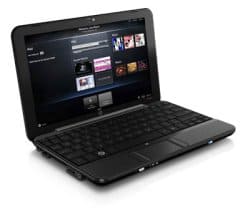
In the current issue of Wired magazine, Clive Thompson gushes over the rapid rise of the netbook: inexpensive, low-powered, small laptops optimized for simple tasks like web surfing. Clive compares the existing PC industry to “a car company selling SUVs,” noting that they have been pushing “absurdly powerful machines” even though most consumers just need something that gets them to the grocery store.
For some people, the full power of a desktop or laptop is crucial. For example, those who edit movies or play high-end games. But for most college students, these needs aren’t relevant. In fact, 99% of what we do is writing, e-mailing, and web-surfing with the occasional romp through the land of Powerpoint: exactly what a netbook is optimized to perform. And unlike a full-powered laptop, a netbook costs only $300 – $400 and has a battery that can last over six hours per charge.
After mulling these facts I began to ask myself an interesting question: Do colleges students need a laptop in the age of netbooks?
I spent the last month putting this question to the test.
My Month with an HP Mini 1000 Mi
My first stop was to obtain a netbook. Fortunately, my same friends at HP who keep giving me free stuff to give away agreed to send me their latest netbook, the HP Mini 1000 Mi, to review.
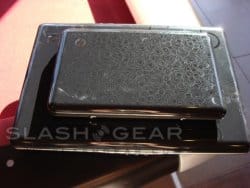 The computer was satisfyingly small and light. To the right is a picture I stole from SlashGear showing the Mini’s size in comparison to a regular laptop.
The device runs linux. Being a nerd I was excited to begin customizing the machine to run the full suite of opensource apps that fuel my work at MIT. Unfortunately, that dream was soon dashed when I discovered HP had sealed off the guts of the operating system with a fancy dashboard interface, clearly built directly from a demographic report on teen interests (“We should have a space for photos, and music, and funky skins featuring the Jonas Brothers snowboarding with Lauren from The Hills!”).
It runs firefox, a PDF reader, and the Open Office versions of Word and Powerpoint (which are perfectly compatible with the Microsoft versions, as I’ve discovered from my many years of using linux machines.)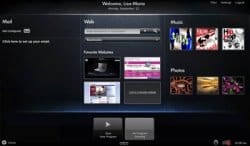
For detailed reviews and performance benchmarks, check out the article round-ups here and here. As far as I can tell, the HP Mini is one of the most highly rated (if not the most highly rated) of the current crop of netbooks.
But what did I think? I’ll admit that I developed a love/hate relationship with my netbook, which I explain below.
Let’s start with the negative…
The reduced vertical dimension of the screen threw me. When browsing the web or writing a document, the toolbars take up a huge amount of the visual real estate, leaving you with a nagging sense that what you’re trying to see is perpetually being cut-off. The result: lot’s of scrolling.
However, I could never quite get the hang of the built in scroll strip on the touch pad, often leading to frustration when trying to navigate complex web pages — especially those with forms! Writing blog posts or surfing Google Reader (with its many small scrollable panels), for example, became an exercise in annoyance.
In terms of the positive…
No matter how upset I became at my Mini, however, I found myself using it way more than my other computers. Here’s why:
- It turns on fast. (One review measured startup at 14 seconds from standby mode.)
- It’s light.
- It’s battery lasts a long time, so I rarely have to worry about plugging it in.
These simple traits proved hugely attractive when I needed to look something up online or jot down some notes — especially when compared to the epic 5 – 10 minute RAM-starved battle my Thinkpad fights with the Windows updater as it struggles to load. In this sense, the netbook really did live up to its potential as being something you can just grab and use.
Bottom Line
For students who own one of those mega-laptops with 3-foot wide screens, 190 TB of RAM, and a tripod-mounted laser cannon, or whatever, spending $379 (the starting cost of a HP Mini) on a netbook, if you can afford it, might be an easy way to get you using a computer outside of your dorm; i.e., for taking notes in class and studying in blissfully isolated locations. Alas, I cannot, however, advise using a netbook as a laptop replacement — even a netbook as highly reviewed as the HP Mini 1000 — as the value of occasionally being able to use a full-sized screen proves to be incalculably high.

This is exactly the kind of review I needed to see from the kind of mind I need to hear from. I need to buy a laptop and I won’t be going with a netbook. Thanks.
This is just what I need! I might get a netbook after I get a laptop.
Thanks,
Nate
Netbook or this?
https://twitpic.com/1t6bq
Hmmm….
Only thing the netbook I bought (Acer Aspire One) is used for is taking notes in class with google docs. Other than that I use either my Dell Latitude or the HP desktop. Papers and such can be done on the netbooks, but I wouldn’t advise it.
I bought a Dell Inspiron Mini 9 (with Windows XP) back in September and due to a crazy number of back orders at Dell, I received it sometime in late October. I was able to take this to class and put it on those small half-width desktops we have in some classrooms. The keyboard took some getting used to but I can easily take notes with it now. With the upgrade from 1 GB to 2 GB of RAM, I was able to run my Arena simulation software on it (no programs in the background to take up resources.)
Overall, I have been extremely pleased with a netbook. If anything, it’s a conversation starter when you pull out a 8.9″ screen netbook in a class full of 15-17″ screen laptops.
Or you could just get an Apple – they are more expensive but they start up fully in less than 30 seconds or so, lightweight and fully functional. Plus they don’t get viruses. I love mine and would not go back to a PC! The OS is awesome.
Well put… tons of applications are going online. “Cloud computing”. Just in case you still want a personal laptop, check out this article on how to save money on a new computer for college
I had one of my most organized, brilliant semesters ever with an Acer Tablet PC and OneNote back in 2005 — an Acer c104, I think. It weighed nothing — like 2lbs. I used it for every single lecture, every single class for an entire semester, and was stunned to notice how organized I was without trying.
I was a bio major. For classes that required lots of diagramming, I just flipped it to tablet mode and hand-wrote the whole time. For classes that didn’t, I mostly typed, but drew straight on the screen with the screen upright if I needed a diagram. When a friend who chronicly skipped class needed notes, I could just email her the whole thing in a couple of clicks.
I also recorded audio for every single lecture. It was so cool to click on a word and hear what the professor was saying when I wrote it — seriously handy when I didn’t understand what I had written. (The handwritten notes could also be searched, like typed notes. It was insanely awesome.)
I switched to a mac in grad school, and loved it — less tinkering, more work done — but I have to admit, that one semester with a tablet pc and OneNote, I understood what Bill Gates was trying to achieve. It’s such a pity it never took off. It was far more comfortable than a netbook — normal size keyboard, 10.4″ screen, $700 on eBay.
Gosh writing this post is making me want to buy another one.
I have two classmates who are using a netbook (on High-School, like wtf^^) and it seems pretty neat. But it is a lot of scrolling indeed, so when I go to the University, I’ll just buy a laptop. You just have far more options. The only thing why a netbook is nice is to take notes..
Why not get a netbook with an external monitor and keyboard for use at home/in the dorm? I have an Eee 901 hooked-up to a 24-inch HP monitor with an external keyboard & mouse and it works beautifully. If you go with a smaller monitor, you could do a similar set-up for $400-$500 total.
When my last laptop died on me I took the plunge into the netbook world. I’ve been using an Asus EEE Pc 1000HA for about 4 months now, and I really like it. It’s fast, light, lasts 6+ hours, and it’s just more convenient to have than a full sized laptop.
I’ll admit though, you really do have to scroll a lot. I’m satisfied though.
I assumed the monitor would be too big of an expense. How much is even a smaller monitor?
I’ve got a laptop atm, but when I go to university this autumn I’ll definitely be getting myself a netbook. It’s the weight, mainly, as no way would I be lugging my current one around to all my lectures! I want something small and light that basically does Word and Firefox, nothing more complicated than that. This sounds perfect.
Cal (and all the commentators too)- My name is Jeff and I work with the Office Live Outreach Team. First off, great review. This is an interesting case study you have come up with and it is now sitting in my bookmark section in case I need to reference it in the future. I am now past my college days but certainly wish I had the chance to attend lectures and take notes on a netbook instead of lugging my laptop to class.
Stu mentioned in the 7th comment “cloud computing” and I think this evolution of computing is especially pertinent to netbook owners. Office Live Workspaces is a great example of how cloud computing makes it easy for netbook users to share documents and files between their netbook and their desktop or laptop without having to transfer files with a thumb drive or e-mail them to one’s self. More info and examples of Office Live Workspace’s capabilities can be found here: https://workspace.officelive.com/
Cheers Everyone,
Jeff
Office Live Outreach Team
Cal, you mention that netbooks can handle the “occasional romp through the land of Powerpoint,” but what is your experience with using LaTeX (or other document-preparation packages) on netbooks?
Has anyone tried this?
It wasn’t clear to me how to install new programs on the netbook I was using. I know you can, but they don’t make it easy…
As a future engineering student, the netbooks pack no where near as much power necessary to run system-demanding design programs and similar applications. Most universities require a machine that can handle such for their engineering (or similar disciplines) students.
While they’re cute, light, and convenient, I’d have to use this paired with a desktop. Perhaps they’d be useful for average college students that just use it for note-taking, browsing, and word processing, but anything else and you’re pushing it.
I think that netbooks would be great as something for universities to stock up and be able to loan to students, but not as good for personal laptop use.
Really? I was an engineering student at UIUC and I found that the engineering computer labs around campus were excellent for getting homework done. I had AutoCAD, Matlab, and other programs on my desktop and laptop but it was too distracting to work with them. As Cal has said, your work environment is a huge factor. I trudged off to the labs on Sunday mornings so I wouldn’t be be playing games in the dorm or checking FB in the library with my laptop.
I’m even going to go out and claim that engineers don’t need a computer anymore than their LAS counterparts, or need a laptop in lecture. In my first year I was taking notes by equations and diagrams for my engineering and math classes, which is really unfeasible with a laptop. (I know about tablet PCs, but they’re pretty expensive). I only really needed my laptop for humanities/social science classes in capturing long-winded lectures. It is a misconception that you’ll need – or be using – your own beefy PC a lot in engineering. E.g. in the beginning level ECE class I took last year we turned in homework into a funky website designed in 1995. It was a bit of a shock for some of my classmates sporting Alienware-type laptops, courtesy of their parents 🙂
I agree with you there. As a computer science student, both undergrad and grad-level, I’ve basically never used my personal laptop for anything school related.
Backstopp enables organizations and individuals to perform a remote deletion of data files on any lost or stolen PC, Laptop, PDA or Mobile phone utilizing either the GSM (mobile) network, Internet or RFID.
Well, for me at least, OneNote is a must. As is having two windows side-by-side. So a netbook just won’t do it, all that efficiency lost in scrolling =(
“Or you could just get an Apple – they are more expensive but they start up fully in less than 30 seconds or so, lightweight and fully functional. Plus they don’t get viruses. I love mine and would not go back to a PC! The OS is awesome.”
1)Operating systems are software. Doesn’t matter what hardware you install it on.
2)Compatibility issues.
3) Battery life and portability were the key things that a netbook sells itself on.
4) People don’t make viruses for MacOS because it’s suffering enough to have to use it (but really: Viruses just don’t get made because it’s not a time productive thing, we are seeing that change more and more)
And
5) The most important point for last: As students most of us require statistical/mathematical modelling programs that are not distributed for MacOS. I use 3 that I know only come in win/lin and one that is linux only.
I’m confused by this Cal. In your red book, didn’t you say you used your laptop to take notes in classes?
I used my laptop in non-technical classes. I recommend in the red book that for technical classes, requiring technical notation, paper notebooks work best.
I just bought a Samsung N140 and I can say I am very happy with it. The N140
has an specially good keyboard so typing will not be a major problem. I have
always taken notes with paper but I will give it a chance on electrical
form. In the UIB most of the professors do not allow laptops so I do not have
enought experience with it, but I will post more in just for the record.
About the screen size, it is really a problem if you use stock
applications. I have a combination of gnome+xmonad that makes me fullscreen for
all programs. Moreover am I always inside a terminal with emacs so the 600
vertical pixels are usually enought.
On the LaTeX stuff, in my experience it works quite well. These machines
usually have an slow processor by todays standards so genering the PDF takes a
little, but it is not a great problem since you will spend lot of time just
writting. Even that, I usually never compile during classes, making how long it
takes to create the PDF irrellevant.
Hey Cal,
You can use the fullscreen option when web-surfing to stop that annoying scrolling issue – works on my Vaio W with no probs, even though the screen is 10″
I had my friend fiddle with it, so all I have to do is hit F3 and the view immediately changes to fullscreen – convenient!