
From Good to Great
Unlike many hacks you read here, the strategy I want to describe today is not designed to reduce your study time (though I don’t think it will add much to your schedule either). Instead, its purpose is to help you transform from a good student into an exceptional student.
It starts with the simplest possible tools…pen and paper.
The Notebook Method
This method applies to the following academic situations, among others…
- Writing an essay or paper.
- Working on a problem set or technical take home exam.
- Tackling a difficult book or reading assignment.
- Designing a project for a computer science or engineering class.
The idea is simple…
- Buy a sturdy college-ruled notebook dedicated to the relevant class. (I use the 100 page, 1 subject, college-ruled Stasher by Roaring Spring, but many people also swear by the Black n’ Red.)
- Buy a good pen. (Nothing beats a black uniball micro 0.5mm.)
- Take your notebook and pen and go to the most relaxing, meditative, non-distracting place possible. The deep stacks of the library is okay. Hiking 30 minutes into the woods or onto the dunes overlooking a windswept springtime beach is even better.
- Spend 1 – 3 hours working out your thinking on the task at hand in the notebook. Spend the last 20 minutes carefully summarizing your results on a clean page that you mark with the date and a title.
For example, here is a snapshot from a page of my PhD thesis notebook:
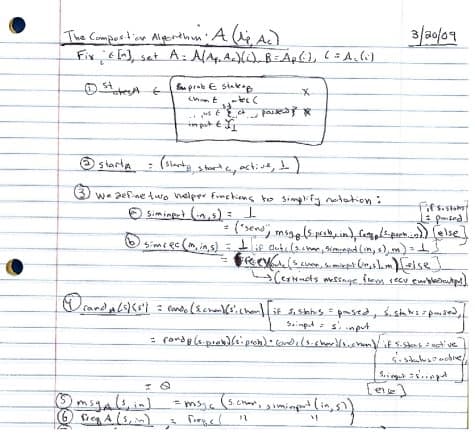
Preceding this summary page in the notebook is another few pages of rougher notes, also from today, on which I was trying to work through the tricky details of these same ideas. This final page details the polished result of this thinking. I needed to get this right, and a long afternoon with my notebook was the only way I could coax what I needed from my mind.
Inside the Method
In an age of distraction, the notebook method produces a rare commodity: high-quality thinking — the type of thinking that can make a student into a star.
Its power sources from the following truths…
- Writing down your thoughts forces you to clarify what you’re thinking and confront ambiguities or inconsistencies. It’s hard work! You’ll probably feel painful resistance the first few times you try this method, but you must persevere. Eventually you gain familiarity with the novel sensation of deep thinking.
- You can’t check e-mail using a spiral-bound notebook. You also can’t update your Facebook profile or tweet about your YouTube channel. If you’re high up in the library stacks, or, better yet, in the woods or on the beach, it’s just you and your notebook. Eventually your urge toward distraction will give way.
- Paper facilitates creative thinking. You can draw arrows, and circle concepts, and sketch structures. Something about a good ballpoint scraping across a thick-grained paper stock unlocks areas of your mind that tend to hibernate when you’re slumped over your laptop in a crowded study lounge.
This method applies anywhere that requires deep creative thinking. Use it to figure out your argument for an English course, or to master organic chemistry equations, or to deduce why, exactly, that Nietzsche book frustrated you so much on your first read through.
Regardless of how you apply this method, its result will be the same. It takes you out of student survival mode and helps you down the path toward mastering the increasingly lost art of good, hard, deep thinking.
Related Posts
- Adventure Studying: An Unconventional New Approach to Exam Preparation
- An Adventure Studying Case Study
- How Two Extra Hours Can Make Your Paper Two Times Better
- Conquer Complicated Material with the Mini-Textbook Method
(Photo by Absolut1)

Great post! If it makes it harder to check my email though…I am not so sure. 😉 Just kidding!
This is a great method!
Thanks,
Nate
We need more stuff like this man. Thanks a lot!
Good to now that i’m not the only one who does this =P
I love the feel of a pen gliding on a big spiral-bound notebook. There’s someting there that makes me all warm inside. It must be the wide open space of an empty page that gives my thoughts room to spread out.
Nice!
That’s what I do a lot of times, just make mindmaps on paper. On paper, on paper and on paper. List everything and write it down.
Forget all the cool hightech applications, just learn. I wrote a post lately about flashcards, I never used them before but I tried it, and it worked!
To read the post: TheDutchSchoolKid.blogspot.com
Thanks!
Stefan/DSK
I’m entering doctoral school in the fall and a fellow student I’m taking an independent study with had me start a research journal. I got one of those big Miquelrius books and it’s become a journal, a central notes-store, a place to pour out despair an insights, etc. She said it’s good to keep it for a while and then go back to read earlier entries, as you’ll find clues to what interested you then that you may have forgotten about.
I can definitely vouch for this approach! It’s also a great way to free yourself from self-editing, because writing on paper feels less like a final draft than typing something into a computer. I probably waste hours just sitting in front of a computer trying to find the right word for something. On paper, there’s less pressure to be perfect so I just leave a line where the word needs to go and it usually pops into my head automatically when I’m typing it up.
Exactly, nothing beats having a dialogue with yourself on a paper, drawing diagrams, thinking aloud, highlighting the most important points later with a set of color pens. I definitely vote for this approach
As often as I try to rely on my Macbook for notes and so on, I keep returning to a notebook. Pen and paper is the way to go! Thanks for sharing an example. 🙂 Cheers!
-Mig
Some of my math and science teachers made us keep class journals in high school: review and reflect on what you learned that week. Guess its a similar thing as this if not the same. Never enjoyed it in HS tho and didn’t get the point back then; I mostly just made up stuff the night before.
I like pencil and a cheap notebook from the dollar store because they have this mad genius feel to them (as opposed to the corporate feel of an expensive pen and notebook), but otherwise I totally agree with the premise.
I especially like how you said, “You can’t check email using a spiral notebook.” We certainly invite enough distractions these days, don’t we? I find that taking notes and re-typing them into Word is a great way to re-listen to the information and works great for memorization and studying. When I retype notes I feel like I’m logging the information I took down into my brain automatically without working too hard at the act of “studying.” Thanks for showing the benefits of the old notebook method!
What about using Binders instead of notebooks? I like to have a binder with notes from all my classes conveniently stored in it.
Excellent post, Cal. I agree with your major points. They work for me. But one minor detail to add. I too love the uniball micro 0.5mm pen, and I too love the Black n’ Red notebooks. But i have found that the uniball bleeds too much on the Black and Red pages. I have to end up using a ball point pen (I like the Zebra F-301) in my Black n’ Red.
I now remember that I have this same problem with uniball micro in my moleskin notebooks. On the other hand, they seem to work fine on legal pads and the cheap lined paper in standard college-ruled notebooks.
I know it shouldn’t make a difference, but it does. Holding a binder with looseleaf paper is just not the same as propping a notebook on your knee. I tend to use plain manila folders to store papers for classes.
I commend you on your site, but as an elementary-school teacher, this is what most of us grew up doing by Grade 5-6! Unbelieveable that college students now need help like this.
Eileen
Dedicated Elementary Teacher Overseas
elementaryteacher.wordpress.com
Superb post as usual. And yes, college students do need help with this because many of us have been lured into thinking that laptops will solve all of our problems, with schools like mine making laptops mandatory for all students… and for what? They are hardly ever used in class for anything official; most professors I’ve had hate them.
I use a paper notebook to do all my work and it makes everything a breeze. One technique I like to use is to formally write down the job/task I’m working on when I sit down, and to track start time, end time, total duration, and any distractions.
I just realized I’ve been doing this for most of my projects without really thinking of it as a strategy. It was just a habit I liked.
I’ll be more aware of the power of this study habit now, and use it better. Thanks!
awesome post. I made myeslf into a strong chemistry student by taking my binder to a deserted beach every Sunday and figuring out why certain answers were wrong–without the help of Google 🙂
It’s not often I come across a piece of advice worth taking, but this is an excellent method. Deep down I knew this is what I needed to do, but reading this has given me the last push to put it into action. Thank you.
I love writing things down! It’s also just physically sitting and writing it down that makes it so comforting.
Do you have any more ways to keep from getting distracted by things like email and facebook and stuff? Becaause that’s what I know is one of my biggest weaknesses for studying and working.
@Eileen:
I’m glad that you have a more enlightened approach to organization in elementary and middle school. In contrast, where I did 1st through 7th grade each class had its own, specialized requirements (in English one year, you might have to have a specific type of composition notebook, whereas the next year you might need a 3/4″ three-ring binder with five divisions that would only ever be used for that class). Every assignment had to start with the same heading. The school actually produced its own assignment notebook, which you could never be without. A system like this can, I think, set in place overly rigid ideas of what it means to work and be productive.
In contrast, this post is free of these bureaucratic details. You just get a notebook and a pen that you like and use them in a way that makes sense to you, without worrying about offending someone’s sensibilities by scribbling something out (unacceptable penmanship!) or drawing arrows across the page to connect important ideas (distracting!) before you distill your work into a clear, legible summary. The only requirements here seem to be that you articulate your thoughts in rigorous detail, and that you concentrate on nothing else for a few hours. So I think it does represent something that many students may really never have tried.
This is such a simple idea, but it makes so much sense! I start every day by writing in a notebook, journal-style, because it helps me clarify my thoughts. Why wouldn’t I do the same thing for my classes?
Curiously enough, this is similar to the method I use for designing websites or code (especially object oriented code). I don’t go into the woods (it’s cold here), instead I do it in-between classes or when I’m too tired in class to stay awake (in which case being awake, alert, and distracted is superior to simply being asleep); but the general idea is the same: I don’t have a laptop, my notes are all taken on paper, so I start writing and diagramming, and all those questions of how X does Y or how I’ll do Z get written down for later, letting me ponder. That “letting me ponder” is important, more than most seem to realize; it’s funny how often I run across a smart capable person who doesn’t need me to answer their questions if they’d just realize that they could ponder it over and figure it out. Of course after I finish the lovely notebook period, there’s all that messy work with actually doing it…
Basically, as Daisy said before me, it’s just a something that I liked, that worked, that used up time that was otherwise wasted, never really thought of it as a “strategy”, but now that I do I realize this by far the superior way to design a website. Though because of the constant “redesign” aspect it can be nice to do it on a whiteboard; on the other hand re-drawing things in a notebook allows you to keep track of progression and return to or re-incorporate an old design.
I love holding a pencil in my hand and writing down my thoughts. Its very relaxing, whether I’m journaling or studying it helps me concentrate.
Ok, so this is a somewhat obsessive question…but what size notebook is best for this purpose? A5 or A4? Lol 😛
@Jessie
A4, going by the screenshot…?
Hi Cal
Can you update the link to the pens you use? Just listened to your podcast about the Timeblock Planner V2 and I think it would be cool to get the ‘full experience’ just for fun.
I found various 0.5 micro pens on Amazon. Just wondering which ones you specifically use.
Thanks in advance!
Several EXCELLENT copywriters I know swear by writing out all their copy by hand. It frees their minds to write without judgment. Then, they can edit/rewrite as needed to make it a “finished” copy. Pen and paper for the win!