
From 30 Minutes of Studying to a 4.0
I recently received an e-mail from Ricardo, a sophomore majoring in computer science at the University of Maryland. For the past three semesters he has maintained a 4.0 GPA — a feat he accomplished “without stressing at all.” At the core of his success is an unconventional technique that makes use of a wiki, his iPhone, and my infamous stealth studying philosophy. This technique is so effective that he dedicates only 30 minutes to review on the day before his computer science exams — yet still aces them.
In this post, I detail Ricardo’s method, including step by step instructions and screenshots…
Stealth Studying 2.0
Back in the early days of Study Hacks, I published a popular article titled The Art of Stealth Studying: How to Earn a 4.0 With Only 1.0 Hours of Work. At its core was a simple idea:
If you can…slice and dice [test preparation] into a large number of small, 5-10 minute chunks, integrated naturally into your daily routine…it will feel to you as if you are doing no studying at all.
In researching the red book, I met a pair of straight-A students who used this approach to eliminate “studying” (i.e., large amounts of review in the days leading up to an exam) from their schedule altogether. The stealth studying article was my attempt to bring this wildly unconventional take on academic work to the attention of a wider audience.
I recommended that students immediately process their lecture notes into small, question-based study guides, and then study from these while walking between classes. These quick bursts, I argued, when spread out over an entire semester, can eliminate the need for long study sessions.
Ricardo took this basic idea, and then added a high-tech twist.
In more detail, he did the following:
- He created a free wiki using PBworks.
- For each course, he created a page on the wiki for the next exam.
- After each lecture, he put aside time to add the relevant notes to his wiki. To do so, he would create a subpage for each topic, and then list the main points, add snippets of sample code, or summarize any other information relevant for the exam.
- Following the stealth studying philosophy, he would then access his wiki using his iPhone while walking to class and waiting for the lecture to begin, doing quick bursts of review. (PBworks plays nicely with iPhones, making it easy to browse the wiki on the run.)
These quick bursts of review, conducted throughout the term, prevented the need for long stretches of studying. Ricardo admits that on the day before an exam, he might take “30 minutes to look over my wiki, do a few sample problems that the professor posted, and then get a good night’s rest.”
His 4.0 over three semesters testifies to the surprising reality that this approach can really work.
In More Detail…
Let’s fill in some more details of what this strategy looks like in practice. I asked Ricardo to send me some screenshots of his system as used to study for CS 131, a class in object-oriented programming.
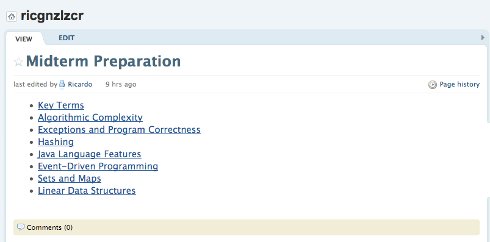
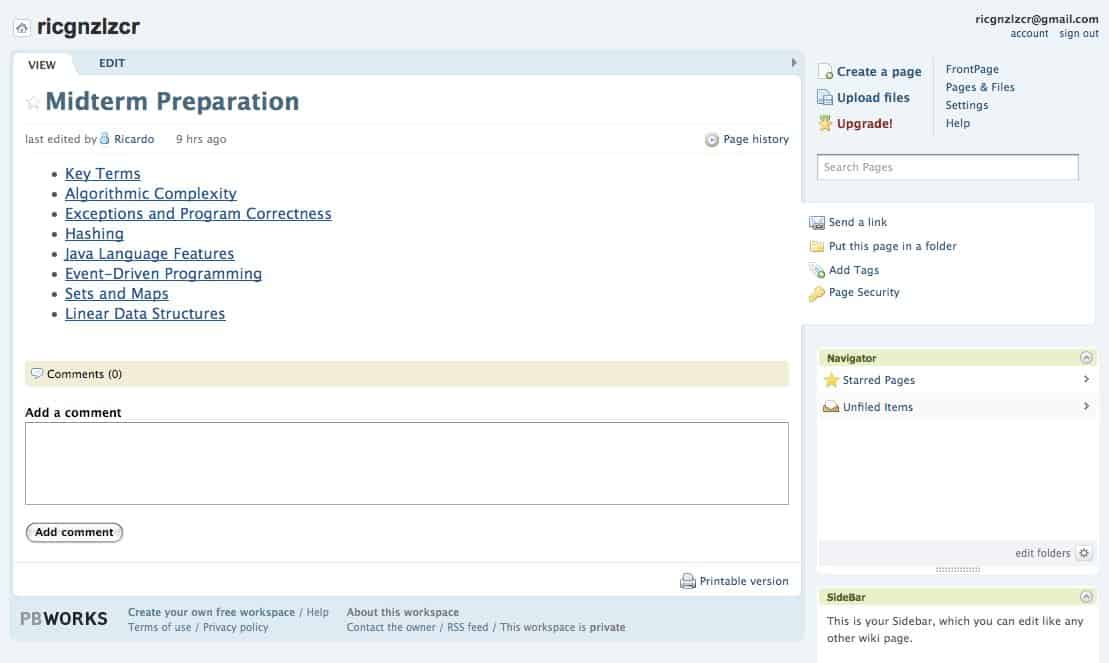
Below is the page he setup for the first midterm in the course (click here for a larger version):
There’s nothing flashy going on here. He links to a subpage for each topic that might be covered on the midterm. On average, his professor covers one topic per class, so Ricardo was adding pages at the rate of one or two per week.
Below is one of these topic subpages (click here for a larger version):
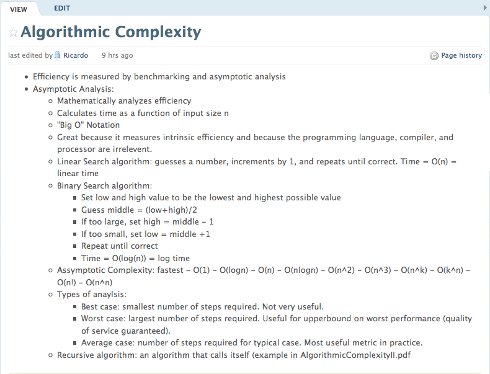
Notice that Ricardo uses basic formatting to keep the pages readable when accessed on his iPhone.
To study from the subpage above, he would convert each line into a question on the fly. For example, seeing the term “Binary Search Algorithm” on his screen, he would turn away from the screen and try to recreate the bullet points that follow from memory.
And that’s it.
This procedure assumes, of course, that you’ve already mastered the fundamentals of being an efficient student. For example, that you’re trying to really understand the information as its presented in class — raising your hand to ask questions when confused. (If you daydream through lecture, you won’t be able to create an effective study guide.) And that you have enough control over your schedule to ensure that these pages get made right away. (For students who deploy an autopilot schedule — or something similar — this should pose no problem.)
Beyond Computer Science
What strikes me about Ricardo’s approach to computer science was his willingness to start from scratch. The details of his system might not work for you, but the big idea of reducing a problem to its basics, and then coming up with an original strategy, is applicable to many situations.
Next time you face an energy-sapping academic, extracurricular, or even professional challenge, take a step back to ask two simple questions:
What do I really need to accomplish here to succeed? Ignoring the conventional approaches, what would be the least painful, most effective possible way to get this done?


How do you ever ask out that girl in your class if you’re staring at your wiki in between classes?
Program a PHP-driven autoreminder system that integrates with the wiki backend to provide semi-autonomous social cue alerts.
Obviously.
I read stuff like this and figure that in theory it could be that simple, but I think in practice it’s not. If I relied solely on my lectures then I would not do very well in my class. It also involves a lot of background reading- which is not mentioned in this post at all. While I do support short bursts of learning, I think that you make it sound too easy. Background reading- be it skimming texts, or selectively reading around a topic- is equally, if not more, important.
Cal,
There’s more going on to his method than meets the eye, I believe. The fact that he’s using the wiki and creating the tight, clean hierarchy probably resembles the strong synaptic processes going on between the concepts in his brain. It’s strengthening the holistic relationships (nod to Scott Young) between many concepts. His mind map of these many complex topics probably resembles the “wiki map” he’s created online.
Thanks for the information, and your ongoing work.
Gee I overlooked that. You specifically mentioned that mastering the fundamentals will guarantee acing exams regardless of the system.
Wow, I’m amazed once again.
I haven’t read the stealth method yet (now I have) and I think it is awesome. It is obvious that it works. But why don’t we do it?
I experience the big chunks of studying the week before the test, it’s horrible, you have so much stress, and at the test you still feel like you don’t know everything.
I think lectures are worth a lot more if you look them over right away, making small study guides.
But as Luis said, I don’t do these things between classes, I drink coffee with friends, have a laugh. I’m going to try implementing something similiar, but when I’m home after school. When I’m away from my friends..
I agree, this is amazing; however, for those of us lacking an IPhone or any other pocket sized, updated device, how can we implement such a routine. For me such a method works well, but I don’t like carrying around notebooks or other large items (I rarely bring my laptop with me) to other class days. How can I carry around study notes similar to his while not gaining any of the inconveniences of a laptop,flash cards, or notebooks for other classes?
I literally got 6 emails today asking me whether it was really possible to study 30 minutes a day and get a 4.0 GPA. I think I’m going to direct students to your blog post from now on!
Cal, I have an unrelated question, about the laundry list of activities vs. doing one thing really well. What happens when your one thing is incredibly time-consuming? All I do is theatre, but all the rehearsals, preparation, shows etc take up such a lot of time. Am I missing something here?
Wow that’s amazing. Technology and a bit of creativity can do a long way. I think a of people want the feeling that its not really study because they know that it shouldn’t feel monotonous all the time. Great post. I might come back to this one.
What kind of PBworks did he use? Educational, private, business??
So that’s what the chicks are looking for!
Seriously, really great idea. But don’t discount wiki’s on your computer too, they can be useful for notes and linking them together.
TK;
Do you have an ipod? Most of them you can import text files into. Alternatively, get a program like Text2Mp3, and convert your notes into audio to listen as you’re walking around.
This seem fine if you are sitting *very* simple exams like the complexity one shown above, but I would like to imagine that any course which contained such little information and scope for problem solving would always be a trivial pass.
You’re right to note that the specifics depend on the subject. Computer science, for example, doesn’t usually require reading outside of class. Many other subjects do.
An interesting question, however, is how to modify this technique for different material. It’s possible, for example, to take reading notes in the wiki and still do short burst review. The key is synthesizing the notes into reviewable concepts — not a paraphrase of the material.
Absolutely, there’s no escaping this synthesis stage. One of the nice things about Ricardo’s approach is that he’s doing this synthesis early — i.e., right after lecture — instead of waiting until a few days before the exam, pulling out transcript-style lecture notes, and trying to do it all in one go.
The original stealth studying article recommended that you do take your laptop to class, then, at the end of lecture, print your study guide notes to a nearby printer, picking them up on your way to your next obligation. The stealth studying than makes use of paper you can fold up and keep in your pocket.
If you wanted to go even more low-tech, transfer your notes to studyable index cards during (and right after) class.
It’s just all the more reason to just be doing one thing.
I don’t know. Probably just private.
I wouldn’t extrapolate so much about the course having just seen a screenshot of one page of notes on one topic.
To the person who said they don’t have an iPhone, what I did before I got mine was to use index cards, because I’m too cheap to pay a printer for something I could do when I get home. So on the front of my index card, I wrote the question, and the answer was on the back. Pocket sized, and delightful! I used a different colour of index card for each class.
Now that I have an iPod touch, I use Evernote, and write my processed and synthesized course info into notes, centred around particular topics on my desktop Evernote. Then, I sync my touch, and star the notes, as that’s that only way the app lets you see notes when you’re not connected to wi-fi.
It’s not a complicated system, but it works!
Hey, you know what?
He’s also building a knowledge vault (Search in Study Hacks).
Helpful post
yeepeeh!! 5 star cal.This just might make things easier for me.BTW, where can I get a free iphone? lol
The first few semesters of college are all CORE classes/University requirements, only having to tackle a couple Intro CS classes. I am interested to see how the 4.0 GPA holds up later in college when he is thrown into nothing but high level CS/Mathematics courses. Regardless, this seems like a good method towards studying.
I’m very impressed by the creativity but the real meat isn’t the wiki, but the creativeness and analytical skills that Ricardo used.
He didn’t just use a wiki. He saw how to study effectively in an unconventional way. In most classes lectures are where everything at. In some there are readings that are really important. For most CS classes where lectures and practice are usually at the heart of excelling at the material, this is perfect because of the repetition. I have studied CS and observed CS friends. You truly need to ‘live’ CS to be very effective in it.
For others, the wiki has some applications. Classes requiring solely lecture notes are obvious. But even if some classes have readings in them, the MAIN IDEA or TAKEAWAY can still be reviewed or put down in this wiki.
The power of this wiki is that it is very flexible to what you need to do. What cinches the deal is that I have an iPhone or smart phone and can review this whenever I choose to.
I’ve just started making a wiki for this semester. I already condense my work into word documents for each subject to create study guides, and doing it on a wiki instead makes it much more portable. I’ve also noticed that you can export each page to PDF files.
I’m studying Law, so I have very heavy reading outside of class. It’s rather simple – you just integrate the notes from readings, cases etc into class notes.
Is there any way to do somthing similar with an android phone. Any hints would be great.
I do the same thing, except I use Google Drive. I take notes in Microsoft Word documents during class on my laptop, creating study guides as I go along as described in the original Stealth Studying post, and then I save them into a folder that automatically syncs with Google Drive. Then I open them in the Drive app on my Android. If I forget my laptop, I can even take class notes on my Android – with the Swype keyboard, it’s just as fast as my laptop, but I can’t format it the way I like.
To make this even cooler, you could take notes in Q/E/C format, put them on PBWorks, or some other word processing tool, and save time of making up questions, if you have trouble doing so. I have Office Online on my phone, but I can still access my notes offline, so its really easy for me to be a serious stealth studier. It’s awesome.
I think I’ll do the same but use Evernote instead. It’s multiplatform and one can upload all kinds of other media too (if required; less is more).