
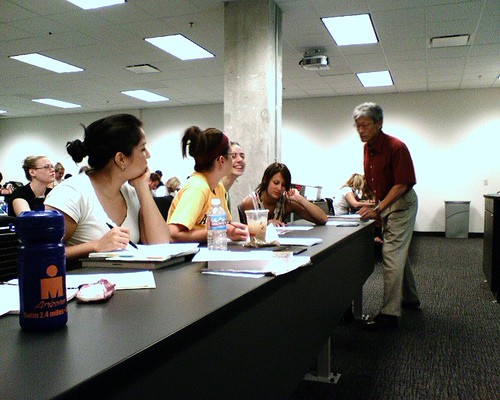
Predicting Greatness
The impact of teachers is profound. If you rank the world’s countries by their students’ academic performance, the US is somewhere in the middle. In a 2009 New Yorker article, Malcolm Gladwell notes that replacing “the bottom six percent to ten percent of public-school teachers with teachers of average quality” could be enough to close the gap between our current position and the top ranked countries.
“[Y]our child is actually better off in a ‘bad’ school with an excellent teacher than in an excellent school with a bad teacher,” Gladwell concludes.
But there’s a problem: “No one knows what a person with the potential to be a great teacher looks like.”
Or at least, according to Gladwell.
Teach for America, a non-profit that recruits outstanding college graduates to teach in low-income school districts, disagrees. This organization is fanatical about data. For the past 20 years, they’ve gathered massive amounts of statistics on their teachers in an attempt to figure out why some succeed in the classroom and some fail. They then work backwards from these results to identify what traits best predict a potential recruit’s success.
As Amanda Ripley reports in a comprehensive look inside the Teach For America process, published in the Atlantic Monthly, the results of this outcome-based approach to hiring are “humbling.”
“I came into this with a bunch of theories,” the former head of admissions at Teach for America told Ripley. “I was proven wrong at least as many times as I was validated.”
When Teach for America first started 20 years ago, applicants were subjectively scored by interviewers on 12 general traits, like “communication” ability. (A sample interview question: “What is wind?”) By contrast, if you were one of the 35,000 students who applied in 2009 (a pool that included 11% of Ivy League seniors), 30 data points, gathered from a combination of questionnaires, demonstrations, and interviews were fed into a detailed quantitative model that returned a hiring recommendation.
This data-driven approach seems to work. As Ripley reports, in 2007, 24% of Teach for America teachers advanced their students at least one and a half grade levels or more. Two years later, as the organization’s models continued to evolve, this number has almost doubled to 44%.
I’m fascinated by Teach For America for a simple reason: the traits they discovered at the core of great teaching are unmistakably a variant of deliberate practice — not the pure, coach-driven practice of professional athletes and chess grandmasters, but a hearty, adaptable strain that’s applicable to almost any field.
Put another way, these outstanding teachers may have unwittingly cracked the code for generating a remarkable life…
Inside the Classroom of an Outstanding Teacher
In her Atlantic piece, Ripley recounts an afternoon spent in the math classroom of William Taylor, a teacher in southeast Washington D.C. who ranks in the top 5% of all math teachers in the district.
When Taylor enters the classroom his students fall into a strictly-choreographed interaction.
“Good morning,” he calls. “Good morning!” the students answer.
The period begins with Mental Math. Taylor calls out problems which the students answer in their heads. They then write their solutions on orange index cards which they all hold up at the same time.
“If some kids get it wrong, they have not embarrassed themselves,” Ripley notes. But Taylor now knows who needs more attention.
After Mental Math, Taylor teaches the class a new method for long division. The students try the strategy in groups of four, each led by a “team leader” that rotates on a regular basis. (Taylor found that students were more receptive to help from their fellow students.) After having the students try the method on their own, Taylor begins calling them up to the board, selecting names at random to ensure no one is overlooked.
“I try, but I can’t find a child who isn’t talking about math,” Ripley recalls about her afternoon in the classroom,
The class continues with a spirited game of Multiplication Bingo. Before the students leave, they have to answer a final problem on a slip of paper that they hand to Taylor at the door — another method for him to assess who is still struggling with the day’s material.
What Makes Great Teachers Great?
“Strong teachers insist that effective teaching is neither mysterious nor magical,” says Ripley. “It is neither a function of dynamic personality nor dramatic performance.”
Instead, Teach for America has identified the following traits as the most important for high-performing teachers such as Taylor:
- They set big goals for their students and are perpetually looking for ways to improve their effectiveness.
(In the Atlantic article, Teach for America‘s in-house professor, Steve Farr, noted that when he sets up visits with superstar teachers they often say something like: “You’re welcome to come, but I have to warn you — I am in the middle of just blowing up my classroom structure…because I think it’s not working as well as it could.” ) - They’re obsessed about focusing every minute of classroom time toward student learning.
- They plan exhaustively and purposefully, “working backward from the desired outcome.”
- They work “relentlessly”…”refusing to surrender.”
- They keep students and their families involved in the process.
An expert quoted in the article summarized the findings: “At the end of the day…it’s the mind-set that teachers need — a kind of relentless approach to the problem.”
The first four traits above should sound familiar. Setting big goals, working backwards from results to process, perpetually trying to improve, relentless focus — these sound a lot like the traits of deliberate practice.
Indeed, when selecting teachers for their program, Teach for America’s complex recruiting model identifies graduates who show evidence of having mastered this skill. Two effective predictors of a recruit’s classroom success, for example, are improving a GPA from low to high and demonstrating meaningful “leadership achievement.” That is, improving a 2.0 to a 4.0 is more important then maintaining a 4.0, and doubling a club’s membership is more important than simply being elected president. Teach for America wants signs that you can take a difficult goal and then find a way to make it happen.
A Different Kind of Deliberate Practice
A recent article in the Wall Street Journal estimated that it takes around 500,000 hours of deliberate practice for an NFL team to make it through a season. To put that in perspective, that’s about 32 hours of hard work for each foot the ball moves down the field. This effort, of course, is carefully controlled and coached — for example, the article quotes the Colt’s defensive end, Keyunta Dawson, talking about the intense training needed to make split second decisions based on subtle positioning of the head or foot of the opposing lineman.
“I thought college was a grind,” said Dawson. “But this is a job.”
When we think about deliberate practice, we tend to think about examples like Dawson, or chess grandmasters, or piano virtuosos being painstakingly coached through a difficult, but well-established, path to mastery.
The examples of this process playing out in classrooms, however, have a different feel. William Taylor doesn’t have a coach or decades of well-established training methodology to draw on.
His approach is more free-form. He started with a clear goal — when he presented a concept, he wanted every student to understand it — and then became obsessed with its achievement. His Mental Math exercise, his random selection of students to do problems at the board, the “exit slips” he collected at the end of the period — these activities evolved from a drive to constantly assess his classes’ comprehension.
Over time, the extraneous was excised from his classroom schedule (he developed hand signals for the students to use to indicate a need for the bathroom — a way to eliminate the wasted time and distraction of calling on them). He exhaustively plans his lessons, and then ruthlessly culls or modifies any piece that isn’t effective.
“I found that the kids were not hard…[i]t was explaining the information to them that was hard,” Taylor recalls about his first year. He kept working until he cracked that hard puzzle.
Freestyle Deliberate Practice
Here are the main components of Taylor’s approach to deliberate practice:
- Build an obsession with a clear goal.
- Work backwards from the goal to plan your attack.
- Expend hard focus toward this goal every day.
- Ruthlessly evaluate and modify your approach to remove what doesn’t work and improve what does.
Let’s call this approach freestyle deliberate practice to differentiate it from the more structured strain written about in the research literature. Here’s my argument: for most fields, freestyle deliberate practice is the key to building a rare and valuable skill.
Most people fall short of this standard — even those who are highly-motivated to get better. From my experience, two obstacles trap people at an “acceptable plateau” of performance. First, we’re uncomfortable blowing up our assumptions and ruthlessly evaluating our approach. It’s much easier to choose a plan that feels right, and then follow it blindly. Second, exhaustive focus, on a daily basis, is hard. It’s not necessarily hard to do — we’re only talking a couple hours out of the day — but in an age of constant electronic distraction, many have lost their ability for hard focus.
Freestyle deliberate practice is not a clearly-structured system that you can plug into your schedule and follow mechanically toward results. It’s demanding and personal — touching upon the deepest levels of your character. It requires you to get down in the sweaty trenches of effort and attack short-term projects with an almost animalistic passion.
“Damnit,” you’ll cry, “good is not good enough…if I can’t make this so excellent you’ll weep, than it’s not worth even trying.”
Fortunately, this process also feels great. Not the weak, squirt of dopamine from an interesting Twitter exchange, type of pleasure, but the deep down in your bones, captial-Q, Pirsig-esque appreciation of Quality experienced by master craftsmen throughout history.
I’ll end with a simple question: If you’re interested in building a remarkable life — be it as a student or industry veteran — what would it mean to integrate freestyle deliberate practice into your life? This is a question I’ll certainly be thinking (and writing) about in the weeks to follow.
(Photo by Daniel Greene)

This is really good stuff, Cal.
I have one question (so far): How can one determine the “rare and valuable” ability in their field? What characteristics would this ability have to help one identify it?
I’m created a website that helps others create a green lifestyle – what might the rare & valuable ability be here? Or, how could I start to figure out?
I am also a university professor, and this piece helps understand just DP looks like. But what might the rare & valuable ability be here in my field? Or, how would I know when I find it?
I apologize if this sounds muddled and confused.
Great post!
I’m really looking forward to more on this topic.
You’re on to something, so please keep going.
This is definitely the big open question to tackle next. I have a hypothesis — work backwards from the stars in your field — but I’m still trying to develop it into a post…
(By the way, I love your smarter context website…)
Nice follow up to the DP post. I find this more open and focus on the fact that nothing replaces intense focus and drive. I like where you’re going with the “work backwards from the stars in your field” idea. Even just working backwards from people markedly successful would be good because I relate more to their set of circumstances.
I really enjoyed reading your Grandmaster article. Last week, I wrote a blog post about it and it generated some interesting readers comments. A couple of readers commented that the one thing missing from these 6 traits is fun. Where’s the fun?
I like that the freestyle approach addresses this issue. The “fun” is not the quick dose of instant gratification, but rather the deeper enjoyment that comes from mastering a craft.
Another inspiring post.
Thanks
I appreciate the thoughtful post you wrote. I agree with your response to your readers comments. As far as I can tell, there’s not much “fun” in deliberate practice, but there is an ever-deepening sense of real satisfaction. You can get fun from other sources in your life, but that satisfaction of mastery is hard to find anywhere else.
Excited to see what you have to say in the next few weeks.
At this point in my life, I’m not sure what it would exactly mean to “integrate freestyle deliberate practice” into my daily life. There are many things where I need to get better, choosing just one right now is hard to do.
Cal,
First, I believe great teachers believe anyone and everyone can learn.
As for Freestyle Deliberate Practice, it seems the sense of autonomy in defining our own learning paths best ensures the effectiveness of our studies.
I’m really looking forward to this as well. One thing to think about: How do we define ‘star’? One person may make huge advancements in a field but sacrifice quality of life, family, social interaction, etc. in ways that are not holistically acceptable to someone who is looking for a quality life.
While I agree that deliberate practice is a key method to develop excellence, I’m not sure about the DP formulation described here. I think the bit that trips me up is the focus on a generic “goal.”
Both Dan Pink and Geoff Colvin seem to emphasize that the right kind of goal to develop excellence is a “learning goal” or a goal about the “process of reaching the outcome.” I think focusing on the wrong kind of goal is also a common obstacle to DP. Too many people focus on end-game goals: a high salary, a top grade, the big sale. Instead, we should, if I read the literature correctly, be focusing on am-I-getting-better goals.
Attaining a DP goal should be akin to passing a milestone marker on the path to mastery. I feel that obtaining-a-reward goals tempt us away from the path to mastery. If all of my goals are nothing more than a sequence of rewards to gather, then I don’t think I’m on the DP path.
I’d enjoy reading your thoughts about milestone goals vs. reward goals (or whatever they’re called).
I love the focus of this article and the idea that there are traits that can be cultivated that lead to huge amounts of success (duh, that’s why I love this blog), BUT I do think that your assessment of TFA strikes me as a bit odd.
As a former TFA member, I have to say that, while they generally select outstanding people who go on to do great things, I don’t know that they’ve come up with the data driven formula for great teachers. This is why they don’t publish their drop-out rate or the proportion of teachers who receive negative reviews from their superiors or who bring their classrooms down by many percentage points.
Obviously, I love TFA’s mission, and I think that using data about what makes a successful teacher might, in the future, help them to select new teachers who can help close the achievement gap. BUT, (and this is a big but), I read so many articles like yours that focus only on their success stories–by looking only at evidence that CONFIRMS current theories about what leads to success, and not evidence to the contrary, do we really gain everything? Is their data-drive strategy working? Is this a really good example of how to achieve greatness?
Thanks you for another inpsiring article!
/Markus
Recently I had a job teaching math to young offenders in prison. That’s a place to make you re-evaluate your teaching strategies! Instant feedback, mostly explicit and sometimes violent. I have a lot of respect for the people who make a career of teaching those boys.
Thanks Cal! For this answer to my comment. I was looking for a comment reply and you actually have a full blog post. =)
Three points I totally agree with:
1) “exhaustive focus, on a daily basis, is hard” – and in the country I come from, we’re talking about 5 days a week, 40 weeks a year. I do wonder if hard focus is possible when teachers are piled up with tonnes of marking and other administrative stuff and school matters to follow up with. Those really take up time.
2)”It’s demanding and personal — touching upon the deepest levels of your character. It requires you to get down in the sweaty trenches of effort and attack short-term projects with an almost animalistic passion.” – Which is what may make freestyle DP, and by extension, teaching, very hard.
3) Yet the “process (and if I may add, reward) feels great” – figuring out what works/does not work for my kids is a reward in itself! In addition, I refer “reward” to that of seeing each unique child come to the understanding of the concepts I’m teaching. That is just … exhilarating!
There are many practices that I’m being trained in and they do get me confused as to what to do when I really start teaching. But the main components you shared are succinct and helpful. Thanks for this great post!
If I sound incoherent, my apologies. It’s 330am here.
Hi Cal
Great article and site.
One thing :
You said 500 000 hrs per foot in football.
I think it might be better to do time to time.
For example – it is 500 000 hrs for 16 1 hr games,
so 500 000 / 16 = 31250 hrs of practice per 1 hr of game time, or
31250/60 minutes = 520.83 hrs per minute
520.83 / 60 seconds = 8.68 hrs per second.
So every second we watch of a football game, we are really seeing the fruit of eight hours of work! I guess it might be twice this if you consider both teams in the game.
Hmm, interesting article.
I do think that many teachers get lazy due to a lack of incentive to do a good job.
Perhaps they could come up with a system to give teachers an incentive to do a good job like what Frederick Taylor did with scientific management.
This reminds me of The Book of Five Rings by Miyamoto Musashi. It talks about the strategy of a warrior, no matter what the attitude or technique is, the end goal is to cut the enemy.
Not necessarily related to deliberate practice, but was reminded once again what teachers can help to create:
This.
(It’s the HOPE Elementary School “Scholar Ladies” video, if you haven’t seen it already.)
Interesting.
I think Freestyle DP can be boiled down to the following:
1) Try to do the work the best you can when you’re doing work
2) Inhale information about your work & other areas to increase your likelihood of receiving inspiration for new things you can do in your work
3) Identify the parts of your work that most people would try to avoid and do those things
In “‘This Quarter I am Taking McKeon’: A Few Remarks on the Art of Teaching” (University of Chicago Magazine 66 (January/February 1974) Norman Maclean says “…teaching will remain as the art of conveying the delight that comes from an act of the spirit, without ever giving anyone the notion that the delight comes easy.” This is article is reprinted in its entirety in Norman Macleanedited by Ron McFarland and Hugh Nichols, a compilation of works by and about Norman Maclean. The book contains several essays and speeches by Maclean and demonstrates why during his fifty year career as a Professor at the University of Chicago he received the Quantrell Award for Excellence in Teaching (an honor normally only awarded once to a teacher.) Lest one fail to understand how important a well developed sense of humor is to the accomplished teacher, he also said in the same essay that “… all I really know about teaching is that, to do it well, supposedly you should change your necktie every day of the week.”
But the research clearly indicates, in a variety of fields, that how you learn is incredibly crucial.
An incredibly important question. Right now I’m going about it by actually finding some examples that “feel right,” and see where that gets us.
I understand your point, but am not sure what to do with it. Clearly, a feeling of autonomy is important in sustaining interest. Yet when it comes to DP being effective, what’s important is that the goal is clear. I’m not sure how the two intertwine. Perhaps, it’s the greater pursuit that needs to be chosen autonomously, but for the individual goals, clarity is king.
I disagree. They calculate statistics, for example, on what percentage of their teachers move their students up more than a grade level in a single year. This isn’t ignoring bad performance — it’s an explicit part of this calculation. Also, the only rigorous, large-scale, independent randomized trial conducted to date on the program revealed in math superior performance of TFA teachers versus more experienced teachers,
I’m really glad some of these ideas connected with your situation!
Another cool way of looking at it.
I’ll have to look into that.
Love it. This post is spelling this more clearly – allowing me to plug in your ideas in a few scenarios in my life. Thank you very much.
SPELLING ERROR: I think you meant:
“THEN it’s not worth even trying.”
instead of:
“THAN it’s not worth even trying.”
I like this post and i like the teacher..Thanks my teacher teach me up and make me understand everything in my life.
Every assignment from my professor, Arnold, feels like a case study!
Actually, TFA is based upon the exact opposite principle underlying Ericcson’s work on deliberate practice. Ericsson has written “…no characteristic of the brain or body constrains an individual from reaching an expert level.” But, TFA selects students who they believe to be “exceptional” on the presumption that this will make them good teachers. It is an innatist assumption, totally contradictory to the findings coming out the research on deliberate practice.
A more specific critique. Are the approaches, methods and techniques effective for helping low performing (on standardized tests) students in underfunded schools perform well on these same tests the same as what these same students would need to truly excel or for different students to excel? There is a serious selection bias on the one hand, and the outcome measures (i.e. standardized tests) are known to be flawed. Data-driven is only as good as the models and concepts you are using to analyze the data.
I don’t agree. My understanding of the TFA criteria is that they are selecting for people who have experience with the type of deliberate practice necessary to get good in a touch field. This is why, for example, they select for students who start with low grades than turn them around (a result of systematic, goal-centric effort), as oppose to students who maintain high grades effortless (which would fit an innate model of ability).
This may be inspirational in good teaching to good teachers:
Great article, very inspiring.
I’m working in computer science, as a software developer and my question is simple : How ? How to practise DP in this very large field ?