
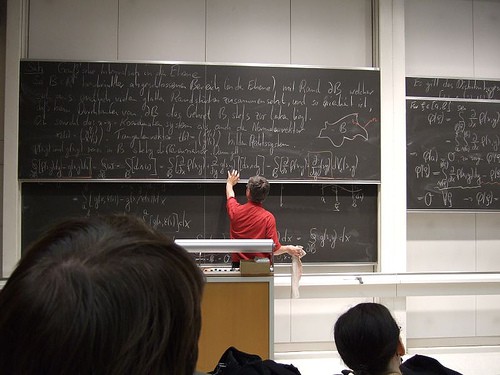
The late summer of 2006 was a heady time for Terry Tao. First, in August of that year, he received the Fields Medal, an elite prize, given only once every four years, that honors the world’s top mathematicians. (One of Tao’s fellow prizewinners in 2006 was Grigori Perelman, the eccentric Russian who roared to international celebrity by solving the long-standing Poincaré conjecture.)
Next, less than a month after his return from the Fields ceremony, Tao learned that he won a $500,000 MacArthur “Genius Grant” — leading the LA Times to dub him a “Mozart of Math.”
Here’s what interests me about Tao: on his well-trafficked web site, he has a contact page that starts…
The best way to contact me is via e-mail.
It then goes on to list 22 different types of e-mails that he will not respond to — a list that includes invitations to “collaborate,” “contribute data to a project,” “give [a] talk,” or “attend seminars or conferences.” He also declines requests for “career advice” and “copies of his work.” On a separate page, he notes that he’s “not giving [media] interviews at this time,” and diverts all other queries to a representative of the UCLA office of media relations.
In other words, Terry Tao doesn’t want to hear from you.
And this is completely understandable.
The world’s top math mind is most valuable to society when it’s solving our knottiest combinatorial quandaries. Dedicating hours to interview requests and career advice seems somehow wasteful.
But this motivates an intriguing question: why have a public e-mail address at all? Certainly it would be simpler for him to omit any contact information from his web page.
I don’t know the specific reasons for Tao’s pseudo-accessibility, but his story emphasizes a general trend I first identified in my essay on quitting Facebook: our society has a warped relationship with communication technology. Instead of deploying tools like e-mail to maximize our effectiveness, we grant them default positions in our lives protected by an impossibly high threshold for disuse — a threshold usually articulated as: “If there is any possible negative consequence of abandoning full-throttled use of this technology, I won’t.”
The scenario that intrigues me is not to move to an opposite extreme and promote a world of techno-Luddism. I like to ponder what the middle ground might look like — a philosophy of work where communication technology is isolated and tuned to specific circumstances where it provides unambiguous benefit, and ruthlessly culled elsewhere.
I’m not sure what such a future would look like, but I can only hope that it doesn’t include contact policies so complex that only a mathematician can fully understand them.
(Photo by Christopher Albert)

That’s hilarious. Thanks for sharing that.
As you say though, it does raise the question of what responsible, or conscious, email use looks like.
I think it has to be situation dependent. After all, I can easily go through my inbox in ten minutes and I don’t sort it at all. Someone with greater influence will obviously have more mail and would therefore require a more elaborate system.
I have a brother-in-law who carries a mobile phone but won’t answer it. He says it’s just for making outgoing calls.
What a waste. (And frustrating if you’re supposed to be meeting his and are trying to contact him.) I could understand if he were famous and his phone were ringing off the hook, but it’s not.
I say, the complexity of the system should be proportional to the demands on the time of the individual. The more demanding the task, the more rules you can have in place.
I think that being able to focus in our society means getting good at ignoring things as much as anything.
E-mail is the best way to get a hold of me as well, but I also filter 99.9% of correspondence. I just have filters to for spam, mailing list traffic, or anything that has low signal to noise ratio. I have several gigabytes of email in my inbox, which I’ve read some tiny fraction of.
The device I’d really like to see go away is the telephone. I suspect telephones will just be replaced with portable text messaging/e-mail devices in a few years, with only audio for emergency purposes.
The main benefit of text over audio, is it’s easier to filter and ignore people over email. Since the fan-in on the network is so high, the vast majority of all communication should be ignored, so ignorability needs to be built into the communication medium.
I think ignoring people only seems rude until you realise that the need for it is just a function of the scale and interconnectedness of our society.
You should email him and tell him that his email policy sucks. Also tell him to add a “what email I will read” section.
One of my maths lecturers told us he emailed Tao after getting puzzled by an introductory statement in one of Tao’s books. Tao replied within 20 minutes.
I’m not sure whether this is just luck or what, considering they are on opposite sides of the world and have no relationship whatsoever.
He added that this is not the first time Tao has done so.
How I deal with email.
I have approximately 100 messages a day that are to some degree ‘important to my business.’ I’ve quickly come to realize that with the speed by which my company is growing, answering email will quickly become my full time job. I’ve recently been trying a new experiment by filtering everything through Sheryl my assistant. She produces a single document ready for me a 9am showing me who emailed me, what action she took and what action I need to take on specific emails. As an example today I had 3 requests for tutoring consultations and sheryl matched each student up with the appropriate tutor. This task used to take 30-60 minutes out of my day to email, confirm and set up meetings. Now I have that hour back!
Terry should try the same thing, I’m sure there would be an army of willing research assistants that would jump at the opportunity.
It’s obvious: he wants to get love letters! 😉
Cal: Good article that hammers in the point of the perils of being too plugged in.
You need to be more specific, though (if you may allow a mathematician to guide you…:) ). Some of the email types he listed are emails that he may reply to, but his replies may be severely restricted due to his heavy commitments.
His pseudo-accessibility is partly due to the public availability of his email address anyway, being in academia and a big user of the arXiv. And when mathematicians start getting famous, some people think that’s a good time to send them new (and improved!) proofs of every conjecture known under the sun. It’s a monster, this fame game, which is why other top mathematicians like Perelman or Grothendieck decide to withdraw totally.
@Siddhartha: My brother complains about the exact same thing. My reply is always that I don’t expect any calls so I don’t switch on my mobile phone.
@Shrutarshi, Anecdote: See my second paragraph above and #12 in Tao’s list for Anecdote’s anecdote.
@Liam: I think your business is awesome, but Tao doesn’t operate under the same business model. Most of the types of email that he list will not end up generating a single cent of income for him, unlike the emails you receive. And research assistants cost money too. So on purely economic grounds, the strict email policy seems pretty justifiable.
@Anna: *chuckle* You noticed that he cited “family reasons” for declining travel?
I think it’s a really interesting question. We tend to work backwards from what we’re already doing when answering, but I’m curious about the solutions that arise when we start from scratch.
A great story. I wouldn’t be surprised if he wrote his e-mail rules in a moment of frustration with work volume, but violates them often. The lure of contact is compelling.
My prediction: e-mail assistants will be the big business within 1 – 2 years. The goal is to remove your need to read e-mail, replacing it with a 30 minute phone conversation once a day.
There’s a small, but growing number of professors who simply just say: “Don’t contact me.” I think this brave. I’m sure you they use private addresses for working with their students and collaborators, and occasionally monitor their official address for work related administrative stuff, but their communication lives are likely much simpler.
And he also re-states the value of low-hanging fruit:
https://terrytao.wordpress.com/career-advice/continually-aim-just-beyond-your-current-range/
This reminded me of Donald Knuth, a great computer scientist who approaches his craft more like a mathematician than most. To give you an idea, he’s been gradually releasing volumes of The Art of Computer Programming for nearly half a century. Supposedly when Steve Jobs claimed he’d read all of Knuth’s books, Knuth said “You’re full of shit.” Anyway, Knuth has an amusing webpage discussing his relationship with email: https://www-cs-faculty.stanford.edu/~knuth/email.html
I think “pseudo-accessibility” is entirely the wrong term. Terry is more accessible than practically any other mathematician I know. He replies to email, to comments on his blog, to comments on his Buzz, etc. And he’s a nice enough guy to give some feedback to the sorts of things that he might not get to. Try emailing any other mathematician with one of these 22 queries and see if you get a response…
Well, he doesn’t explicitly say he won’t answer or doesn’t want to receive such emails (compare to the phone number, where he guarantees a negative response to cold calls). I read that page as being kind of like my Google Reader account; just because I ignore 90% of the items in there doesn’t mean I don’t want them in my feed in the off chance that they might be in the lucky 10% that are actually worth my time. He still wants emails to come in, but he wants the option to not answer them (and it’s really answering or taking action on emails rather than reading them that forms the bulk of the time consumed), so he forewarns potential contacts that he probably won’t respond.
You’ve read my mind, Nick. If Tao is pseudo-accessible, many mathematicians are virtual hermits. Many of the young ones working in Europe don’t even get the luxury of a webpage at their home institution!
In fact, Tao is so pseudo-accessible that it took just a couple of mailings from a 10-year-old kid to set this off:
https://terrytao.wordpress.com/support-usq-maths/
And just to reiterate my proposed answer to the title of this post: his email address is made public on most (if not all) of his papers, for the traditional purpose of allowing the reader to contact the author.
The gentle reader, though, should observe some etiquette.
Now you got me addicted to another blog – Terry Tao. Not the math stuff!!
Just came across this post @ Princeton about a senior who got $250,000 for doctoral work @ Stanford doing rocket science, and will spend at year at Cambridge in between. Looks like an interesting story.
https://www.princeton.edu/main/news/archive/S27/18/00K40/index.xml?section=topstories
Thanks for everything!
I thought this was interesting. I could see why he does it though. It’s funny. His blog is pretty cool too. Thanks for the find.
Here’s what I think his public e-mail is for: Specific, concise requests for information which he is in the best position to give.
An example (not with tao but with a different prominent researcher): I e-mailed a former professor of my university because I was interested in his research group, but its webpage appeared to be mostly broken. I wanted to know if the group was defunct or not and which of his colleagues would be best able to help me with a specific question. He replied quickly and helpfully.
I’d love to see a study done on the amount of time high achievers devote to using social media verses the averaged internet user.
I think that “networking” has it’s time and place, but it’s only really useful if you have something to bring to the table. The real “value” of networking is based almost purely on your own personal value. Why else would it be that the most “popular” people of social media sites are celebrities and musicians?
People tend to network with people whom they value highly and unless you focus on adding value to yourself, the value that social media sites will have to you in pretty limited.
I agree with Supergirl above: Tao doesn’t explicitly say he WON’T answer emails or DOESN’T WANT emails. I read his contact page and take his attitude as one of politeness and not of rudeness. In other words, he doesn’t want anyone to get their hopes up high in receiving an answer because of his time constraints. It appears he does make an effort to communicate when possible. I don’t call that pseudo-anything; I call that honesty. More public figures should follow his lead.
I wrote about Knuth in one my old email zero posts. Fascinating guy.
It definitely is nicer than the standard professor practice which is to simply ignore e-mails. It still seems, however, that with so many prohibitions it might simply be easier just to not have a public e-mail address. I’m less interested in Tao’s generosity than the cultural forces that prevent removing the e-mail address from being a standard option in that situation.
I don’t know, for me, when working on knotty theory problems, it’s the ability to check to see if anything cool is in my inbox that has the biggest impact — it’s the sudden draining of attention, not time consumption, that trips me up.
This shouldn’t be surprising. For a young mathematician, trying to make his or her name in a narrow, insular world, who cares whether you or I can find a his or her homepage? The fact that it does surprise us interests me to no end.
This was useful to you — not him. Whether or not you know the current status of his research group probably matters little to the quality of his work.
Just saying…
I think you guys are missing the bigger point, which isn’t a dissection of the details of Tao’s particular relationship with e-mail. I’m interested in the expectation that of course you have some sort of public accessibility.
Hmm.. Having to respond to email becomes a big part in everybody’s life. I think I like it. You have a great way to communicate with others.
In one way it is a great tool to communicate with people fast, it is easy, free, quick. But on the other hand, you don’t have to respond fast. I never expect people to respond within 24 hours and when I get a respond within a week, it is ok!
I can understand that people, busy with complete other things, like Tao, stop using email (or making a disclaimer like Tao did). But people who have to communicate with others (bloggers/public speaking) should keep using the tool and keep interacting!
Did you try emailing and asking him why?
That mathematician sounds like a hypocrite to me in my opinion (listing a public email address despite not wanting to hear from people).
I’m dating a mathematics professor and believe me, you’re lucky enough to get a response at all. They become so engrossed in their work that it’s a wonder they have a personal life at all.
I followed your link to Tao’s Contact page and I thought it was crystal clear what Tao would answer and what he would not answer–and when he said he wouldn’t answer a type of query he typically provided an alternative link for submission. Seems to me he put a lot of thoughtful effort into the subject in order to avoid not only wasting his time but the time of those who would like to contact him. I think Newport’s statement that Tao doesn’t want to hear from you is unfair and inaccurate in the extreme. Before commenters criticized further, I’d suggest they take a moment to go to his page and judge for themselves.
Tao doesn’t want to hear from you is unfair and inaccurate in the extreme