
The Rhodes Effect
“The 2011 Rhodes Scholars were just announced, which made me depressed and wondering about how they accomplish all the things they do!”
This was the opening line from a recent e-mail. To illustrate what troubled this e-mailer, I’ve reproduced below the official bio from one of the 2011 Rhodes Scholars:
Nicholas A. DiBerardino, is a senior at Princeton where he majors in music (composition). A campus leader in student government and a junior member of Phi Beta Kappa, Nick is an accomplished composer with many awards for his compositions. He has been a composer in residence at the Brevard Music Center and the European American Musical Alliance in Paris. He founded the Undergraduate Composer Collective at Princeton. While in high school, Nick founded a program to collect, refurbish and distribute used instruments and to provide instruction to needy students in Bridgeport. He plans to do the M.Phil. in music at Oxford.
Like all Rhodes Scholars, Nicholas’ bio is stunning. It’s not just the quantity of the accomplishments, but also their quality: every accolade is impressive. It’s no wonder that my e-mailer felt down on himself: when you encounter elite students like Nicholas, it really can seem like you’re not doing nearly enough.
But here’s what’s interesting: when you spend time around Rhodes Scholars, as I did when researching the yellow book, you become skilled at understanding not just what they did, but also how they got it done, and this understanding leads to a surprising conclusion: the proper reaction to an elite student such as Nicholas is not “I should be doing more,” but instead: “I should be doing less.”
The Missing Information
To understand Rhodes Scholars, you must understand that their official bios, like those of most elite students, are missing two key pieces of information: time and interaction:
- Time.
In a bio, all accomplishments are listed together, which gives the incorrect impression that the student juggled many parallel pursuits. The reality of big accomplishments, however, tends toward the serial, with little to no overlap between different endeavors. In Nicholas’ case, for example, his work refurbishing instruments preceded his time at Princeton, where he focused almost exclusively on improving his musical ability. His involvement with the Brevard Music Center and European American Musical Alliance describes a pair of student musician summer programs he attended over two successive summers, preventing collision with his school year pursuits. The only place we find Nicholas working on two major activities at once is the collision between his composing and his role as a class senator in the student government. - Interaction.
In a bio, it’s easy to imagine each big accomplishment in isolation, marveling at the quantity of work it required. The reality of these accomplishments, however, features a large amount of interaction. Elite students leverage hard won ability to gain as many related successes as possible. In Nicholas’ case, his extracurricular accolades almost all reduce to his intense focus on music. Winning a spot in the prestigious Brevard Music Center’s summer program (which accepts around 200 students each year), for example, was the result of the time he invested in his music composition, not an unrelated achievement.
The Oxford Minimalist
When you add time and interaction back to the bio of Nicholas DiBerardino you encounter a portrait of a minimalist. He was a class senator (for some, but not all of his years at Princeton) but otherwise invested his extracurricular energies into his music: a commitment to doing less that eventually led to a Rhodes.
Here’s what strikes me: His scheduled is significantly more streamlined than the vast majority of ambitious students who write me each week for advice — yet he ended up significantly more impressive.
This pattern is common among elite students: they do very little, but do what they do very well; an observation that motivates the advice I gave to the e-mailer whose cry of inferiority opened this piece:
“To paraphrase Shaw, you don’t want to reach graduation and find yourself saying; ‘I’m sorry I’m not more impressive, but I didn’t leave myself enough time to actually get good at something that matters.'”
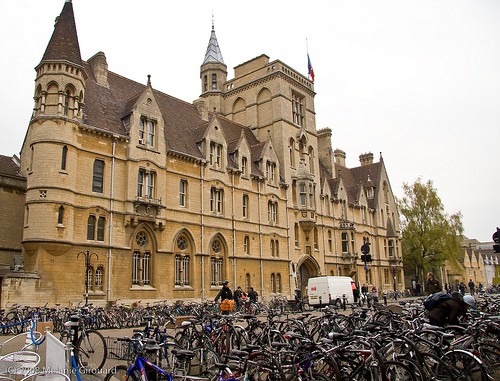
(Photo by diluvienne)

This is quite true. At my school, most computer science and technical-oriented majors rarely go outside of the curriculum in classes without much to add to the other students who do the same. Those who do, however, go forth and learn about programming and complexities of software in the world today have much more background to show for themselves at the seasonal career fair.
I witnessed this myself and saw quite a difference in the reactions of recruiters. To prepare best for the post-collegiate world, you’re going to have to venture outside of your studies and comfort zone and learn something new.
My roommate at Stanford in the mid-1960s was offered a Rhodes Scholarship. (He turned it down in favor of going straight on to medical school at Columbia.) I can tell you that he had parallel interests: studying, water polo (he was an All-American), and wrestling. He spent time (a) in the stacks at the library, studying, (b) in the pool, and (c) at the gym. Very, very rarely, he went out with the guys for a beer or went free diving for abalone which he sold to restaurants for pocket money. Point being: he was absolutely focused (riveted would be a better word) on his interests. My spiritual teacher defines will power this way: energy plus attention, directed toward a desired end. The key appears to be desire. “Ganas,” as Edward James Olmos put it in “Stand and Deliver,” a successful and relevant film. Nothing can replace wanting it badly enough – not talent, brains, or opportunities.
Runbei:
I totally agree. Look at J K Rowling as an example. She graduated with a degree in classics. Just a normal stock standard humanities graduate, yet her success came from her total immersion (for her sanity’s sake) into her writing. Her lack of gadget distraction and her need to occupy her mind with her work, in this case for the sake of her mind and her baby daughter, allowed her the freedom to write (even though such freedom was interwoven with poverty).
Hi Cal. Your blog has inspired me over the last year. I’ve had a brewing feeling of letting myself down for a while now. This post brought the issue up again.
The background:
I’ve been a consistent top notch student through school, top 0.1% in the country at A and O levels. Racked up awards for art, writing and quizzing. Dabbled in sport and music. Edited the school magazine, headed the student government.
Went on to an excellent medical school. Burnt out/got disillusioned with medicine in the middle, let the grades slip. Climbed back up.
I’m impressive as a postgraduate student but feel like my career is never going to be as stellar as it could have.
I can’t seem to shake the feeling that I missed the boat to world class greatness. I’m trying to grapple my way to the top again, but feel like my low spots have put me out of the race to conventional academic stardom.
I wonder if you have any thoughts for people in my position.
N, I am in basically the same situation as you, I also was a top notch student with a variety of interest and got completely burned out and disillusioned by medical school.
Now wanting to get back to the top. 🙁 Will see how it goes. Attitude is key.
@N Im not saying Ive been there.. but ive been close to where you are. Something that helped me was that I read in a very intriguing article somewhere on the net that for very accomplished people success just comes too easy for way too long. When it no longer comes as easily(possibly they have gotten into a very challenging course or something similar), they get frustrated and they let things slide.
Whereas people who dont have it as easy(probably not as sharp, or not as smart), consider things as challenges and set themselves up to succeed. Because when they dont succeed or in order to learn something new, they think of it as a challenge and try novel ways to learn.
The attitude that your job/studies/issues are challenges to overcome really can change your perspective enough to help you find your way. Try it.. and let me know. Anyway, I hope it helps. It certainly has helped me.
@N
I think I might be in a similar situation you described. But for some reason, while reading your comment I though: but why is that important? Yes, we all want to be successful. But should that be all that counts? I sometimes feel the way you do, but for some reason reading your comment made me see how wrong that is. Do you love what you do? That is what you should be concerned with.
I think the takeaway from this, and from reading the comments, is that success comes from having non-abstract goals. What I mean is that success comes from those who have their eye on something, anything really. This goal could change year to year, month to month, but there is always this tangible goal. With only abstract ideas about where you want to be, what you want to do, it’s hard to see what really matters.
Makes me feel better 😀
Wow, this is so true. I love how simply you put it.
I think the hard thing for some people is finding that special something they are good at. Or maybe its just me.
Hi Cal, this is a very interesting article, and I definitely think it would help a lot of readers if you could do more of this decoding. I’m just wondering if you actually interview this Nick to find out how busy he was as a student and how he managed to accomplish all his impressive credentials. If you do a series actual interviews with distinguished students like Nick, I bet it would be a big hit.
This blog keeps my life in check.
(Not the Nick from the article)
This is pretty good advice. I sometimes lose focus and work on multiple projects at once, in which each project will often stagnate and not really going anywhere. Though if I look back and look at projects where I really focused on that one project, completed it, and then leveraged the knowledge or resources that were born from it… bam. Beauty.
Great insight and a great refresher, sort of a mind check, thank you.
Thanks for shedding light on something that makes all too many students feel inadequate! One other thing I bet elite students are good at: using tools and practices that will allow them to be more efficient (everything from the right software to the right exercise routine).
Great post!
I find for every generation that follows, it becomes harder to focus on getting adept at something, anything due merely to the shear amount of distractions we’re bombarded with. At first, it was joke emails that get circulated. Then instant messaging, them SMS text messaging and now full blown cyber overload with social media and smartphones.
I often hear people ask, “how do you know so much about that?” or “when do you find the time to do all that?” As this post illustrates, it’s about doing less of the things that don’t matter and focusing on achieving greater mastery at what does (whatever matters to you that is). Enjoyed the post.
Hi Cal!
Excellent blog. It has really helped me focus and contemplate on several issues that made me procrastinate or unproductive.
Okay, let me tell you my story. I had always been a good student in school and college and now i’m working. I intend to pursue my post-grad in management maybe after a couple of years. The problem is that when i was in school and college, I only focussed on studies.. No major extra-curricular. Only took piano lessons. And i’m a voracious reader.Thats it.
Having read this blog, sometimes i wish i could turn back time and do something constructive doing my school and college years..
Now, how can be present myself as someone different and better than people who are in school and college having major accomplishments? And i’m talking about the ones who do ‘less’.
Kindly share your thoughts on this. Thank you.
energy plus attention, directed toward a desired end….
This always takes me back to the Zen philosophy here on this site: DON’T try to do a hundred things at a mediocre level, do one thing better than anyone else. That’s a good way to get noticed.
Thanks for this article Cal. I’ve had the exact same reaction reading Rhodes scholar bios. If you have the time it would be great to see a few more examples of the bios deconstructed.
This is a wonderful post, Cal. Like many of your other visitors, I have now read all of the current Rhodes bios and, like everyone else, I find them breathtaking. Thank you for showing that two key rubrics for analyzing Nicholas A. DiBerardino’s achievements are time and interaction. He is obviously enormously talented, but you make a strong case, as always, for doing less and doing it better, rather than doing more.
I endorse other visitors’ request, however, that you should deconstruct some more bios. As I read through the bios, I tried to follow your lead and bracket achievements that could have been accomplished during the summer, or that built on the scholar’s single chief interest. Perhaps I missed something, but that did not seem to cover everyone.
Is it possible that we have to apply two of your principles, rather than just the one about doing less and doing it better? In analyzing some scholars’ achievements, yes, time and interaction are key, so perhaps they really did accomplish so much mainly by doing less and doing it better. But aren’t there other cases where we have to fall back instead on your lessons on time-management? If a student has not only achieved top grades in a demanding major but also, for example, achieved the highest performance level as a professional pianist or played varsity football, wasn’t he or she really doing more, much more, simultaneously, in unrelated areas? I wonder whether the key rubric for these latter students might not be that they are great time-managers.
“for very accomplished people success just comes too easy for way too long. When it no longer comes as easily(possibly they have gotten into a very challenging course or something similar), they get frustrated and they let things slide.”
That was a key point ‘Jcreature’ raised. I’ve struggled with that and tried to change it by hitting back harder. But it took some time to face it.
Thank you for your kind comments, everyone.
Dear Cal,
I have been thinking a lot about your philosophy of doing less and doing one thing better than anyone else. What if it is impossible to become “better than everyone else” at one’s chosen activity? As an example, I will name ballet. It is my passion, but because I started in my late teens it is impossible (simply because of physical reasons) to become good enough to be noticed. The choice of activity seems to me nearly as important as the decision to commit only to that one single activity. What if we choose something(eg. ballet), devote all of our spare time to it in hopes of achieving star status and then realised that all along there was no hope to begin with?
Not all Rhodes Scholars are super bright and accomplished. A friend of mine was one, and she is the first to admit that she paled in comparison to a lot of her Rhodes peers. Depending on what part of the country you apply from, your chances of getting the scholarship are enhanced or diminished. She applied from Georgia, an area long known for having very few candidates of any significance; frequently the scholarships set aside for that area go unfulfilled as there just isn’t anyone worth giving it to. If you apply from an area with a larger population of very qualified students (California, the northeast, Chicago, Texas, etc.) the competition pool is going to be a much larger and stronger. The deep south has terrible schools and a smaller population base, so getting a scholarship from Atlanta is a lot easier than getting one from Los Angeles or Boston. While I would say my friend is bright, she really isn’t anything special. She went to a tiny, non-selective college in Atlanta; she readily acknowledges she’d never have gotten in to a competitive college. I graduated with honors from Stanford, but wouldn’t have considered applying for a Rhodes Scholarship as the pool of qualified candidates in the Bay Area is huge and enormously impressive.
@Noora,
“Ballet” is a big arena. Perhaps you’ll not become a prima ballerina with a major company, but what if because you started late, you are especially understanding of how people learn with their bodies and you find that you are great at teaching? What if you start an organization that gets seniors dancing for the first time? Or one that teaches street kids how to dance? Or you invent a new dance hybrid style, or a new way of stretching, or, or, or…
There are many ways to be a star.
I am interested in applying to Rhodes and I really want your advice on this scholarship.
what about the sports or activity level requirement of the Rhodes? I don’t recall the bio mentioning that.
What if you truly love everything you are doing? If you are accomplishing a lot and spending a lot of time doing extra “stuff” that gets you excited and/or will help you achieve long-term goals? That can’t be a bad thing.
I find it troubling that people are defining success by the standard of some other people set for you just because they are giving out some money. if you look at what a lot of Rhodes scholars are doing after 10-20 years they are not even that impressive
Hi, I am an Australian and our current Prime Minister, Tony Abbott was a Rhodes Scholar. I don’t know if you have ever heard of him or seen him in action , however it is beyond the comprehension of most intelligent and thinking Australians that he received this award!!he is incomprehensible when he speaks, unless reading a prepared speech written by one of his ultra right wing staffers, wants to remove climate change from the next G20 meeting, due to be held here in Brisbane in September, is breaking every UN Convention on the Rights of Refugees and the list goes on and on. Thank you,
In stunned disbelief,
Mary Bridget Hurley
How do you advise a youth that actually wants to be a “jack-of-all-trades”?
One that could choose just one of their interests and really excel but instead will not give up on any passion or is afraid to cut ties with those other passions (ie. art, dance, music, student government, soccer, hair braiding instagram account?? not to mention honors courses)?
Is focusing solely and being extremely passionate about schoolwork (due to not being at a 4.0 and at the top of your class) better than doing extracurriculars and having a less than stellar gpa?
(In terms of becoming a Rhodes Scholar)