
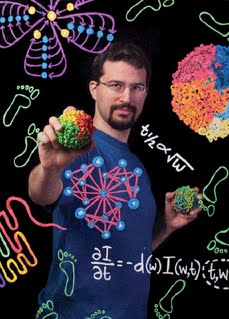
 The Irrepressible Erez
If you’ll indulge me, I’d like to return for the moment to my obsession with Erez Lieberman. As you might recall, Lieberman is a rising star in the science world. He’s currently a fellow at Harvard’s elite Society of Fellows and a visiting faculty member at Google. He was selected for the Tech Review’s 35 Innovators Under 35 list, his work has been featured on the front page of the The New York Times, and the NIH just gave him a $2.5 million New Innovators grant.
When Lieberman’s stint as a Harvard fellow is over, he’ll have his choice of academic positions.
In other words, Erez Lieberman is remarkable, and this makes him interesting to us — not just those of us who happen to be grad students or professors, but to anyone who is interested in my Career Craftsman philosophy, which posits that becoming so good they can’t ignore you is the foundation for building a working life you love.
With all this in mind, I thought it useful to dive deeper into Lieberman’s story and see what insights I could uncover…
A Publication Power Hitter
Here’s what caught my attention about Lieberman: his publication record. His web site currently lists six papers. For someone in his field at his age, this is right around average (if not actually a little low). But what’s important about this list is not its quantity, but its quality.
All six of Lieberman’s papers were published in either Science or Nature. Two of these were cover articles.
For those of you not familiar with the world of science publishing: this is an absurdly impressive feat.
To use a baseball analogy, Lieberman is a power hitter. He’s willing to stand at the plate all day watching the pitcher paint the corners, waiting for that one juicy pitch over the middle that he can crush.
In my experience, most people are hesitant to adopt a power hitter approach to their projects — be it in academia or elsewhere. Assuming you have a fixed amount of time to dedicate to projects, you can either use this time to produce a large amount of solid work or a small amount of great work. To most, the first option seems safer, easier, and more satisfyingly productive.
The more I ponder Lieberman, however, the more I think that he’s stumbled onto a key insight: our hesitation about a big swing approach to projects is flawed. When you understand the true calculus of impressiveness, as I suspect Lieberman does, taking a small number of big swings becomes the only strategy that makes sense.
The Calculus of Imressiveness
At the core of the Lieberman calculus are the following two observations:
- The time required to complete a project grows linearly with its impact on the community (e.g., doubling the impact of a project doubles the time required to complete it).
- The impressiveness of a project grows super-linearly with its impact (e.g., doubling the impact of a project more than doubles its impressiveness).
If we stipulate these observations are more or less true, then Lieberman’s project strategy makes sense. Put more technically, a direct corollary of the above assumptions is that the strategy that maximizes your impressiveness gained per time spent working, given a fixed budget of total time, is to go after the biggest impact projects you’re capable of completing.
Let’s plug in some sample values to make this intuition more concrete:
- Let h be the hours required to finish a project, m be its impact score, and i be its impressiveness (these last two can be measured on some arbitrary scale).
- For simplicity, assume h = m (a linear relationship) and i = m * m (a super-linear relationship).
- Consider two projects. The first, which we can call project A, is ambitious and has an impact score of 4, while the second, project B, is less ambitious, and has an impact score of 2.
- In this example, project A takes twice as long to complete as project B (4 hours versus 2 hours), but it yields 4 times the impressiveness (16 versus 4).
- Project A, therefore, earns you twice as much impressiveness per time spent working as project B (16/4 = 4 versus 4/2 = 2). In other words, the more impressive project may have taken more time, but it yielded twice as much impressiveness per unit of time spent.
The values used in this example was arbitrary, but the general result will be consistent for any example where the two assumptions from above apply: the researcher who aims for more ambitious (and more time consuming) projects will end up more impressive than the researcher who aims for less ambitious (and less time consuming) projects, even if both have the exact same time budget to work with.
The secret to Lieberman’s remarkability, therefore, is not that he outworked his peers, but instead, that he invested his time in a way that maximized his returns.
Beyond Academia
The point made above extends beyond academic publishing. In any field where the two assumptions hold — be it writing or launching a start-up — you’re always better off putting your limited time toward the most ambitious projects you can complete. This observation, however, leads to an important caveat: what if you’re unable to complete ambitious projects? A lot of researchers, for example, no matter how hard they work to score a cover article in Nature, will probably never realize that goal.
There are, it therefore seems, two lessons to be learned here:
- To become remarkable, tackle the most ambitious projects you can complete.
- To get the biggest returns, you need to also invest in increasing the maximum level of ambitiousness you can achieve.
Part of this latter goal is simply dedicating the deliberate practice required to become excellent. Lieberman has a joint PhD from Harvard and MIT, for example, where he studied under Eric Lander, one of the most inventive biologists of the last two decades. This no doubt raised the high-end of what he could achieve.
But I think there’s more at play here. The closer I look at Lieberman’s record, as well as the record of other remarkable achievers, the more I notice other, more subtle strategies at work. The type of strategies that allowed Lieberman to become a star when his classmates, with the exact same training, brainpower, and potential, fell short. The type of strategies that increased the ambitiousness of the projects he could complete, and therefore allowed him to better leverage the calculus of remarkability explained above.
It’s too these strategies I want to turn our attention in my next post. Stay tuned…

If we’re supposed to spend a lot of time on big-shot projects, then what happens to the little bets approach? Or do we alternate between the two? Lots of little bets -> some filter -> one or two big projects?
Shrutarshi-
Yea, I think Cal mentioned this in his previous post on Erez. You try out a BUNCH of small, minimal commitment projects (or joining a bunch of different clubs, etc…), and then when you find one that catches, you drop all the other projects and dive in. At the early stage of testing many different projects, you want the highest payoff with the smallest amount of time worked, so you want to cast a really wide, but really shallow net.
This idea of how you find projects that are big and you are confident of completing…that’s what I want to explore in this series.
Lieberman is an Outlier, having similar education, intelligence, opportunity and upbrining as many of his peers. Assuming his remarkability can be attributed mostly to a series of strategies alone, then I’d also be interested in “how” he stumbled onto these strategies. As Malcolm Gladwell so astutely conveyed in “Outliers” or in Michael Bay’s butchering of Transformers, there’s “more than meets the eye”.
* “It’s too these strategies I want to turn our attention in my next post.”
“It’s to these strategies I want to turn our attention in my next post.”
Wrong “to;” made me twitch a bit.
As usual, great post! Definitely something worth thinking about.
In my experience, how people stumbled into strategies are less interesting than what the strategies are, as the former often involves chance encounters, a particular mentor, a random article they read and hit them the right way, etc.
Erez’s accomplishments are fascinating. Cal, do you think you could get Erez to do an interview for the blog? His personal perspective might yield some novel insights that observation might not.
Hi Cal,
Do you have any thoughts on how to apply things like this to creative industries where “impressive” or “success” may not be easily quantifiable?
I’m a photographer and the “greatness” is so subjective here that it is difficult to design deliberate practice and choose projects to maximise my development.
I think drawing from improvised music deliberate practice ideas may have some benefit, but that doesn’t cover eg choosing good projects before undertaking them, or things like editing a selection of images into a strong series.
Would be very interested in how you see your arguments applying to documentary photography. Many thanks in advance.
Cal,
Interesting analysis. What would be your remarks about those refusing to go for a power hit due to lack of patience or fear of swinging hard and missing (i.e. having no results to show for the efforts)?
Best,
Stanley
Fantastic “to be continued” ! You’ve got us (or at least me) salivating in curious suspense for your next entries where you reveal the strategies.
Cal,
I disagree with you.
Just because Erez doesn’t list more papers on his website doesn’t mean he doesn’t have more, that were less spectacular. Also, he himself admits that he works on way more projects than are ever successful.
Holding out for big problems is the wrong approach entirely. Big ideas come from playing with little problems and little ideas. Since you have been through so many math classes, I am sure you can relate to the feeling that at the beginning all the material is simple, and trivial, and suddenly you find that the simple, trivial ideas build up into very complex and nontrivial ones, and you look back and you can’t really see where things transitioned from simple to complex.
Have you ever heard of the Nobel Prize Effect? It’s when a researcher receives a great deal of recognition (e.g. a Nobel Prize) and stops working on small problems because he thinks he is above them. It’s the little problems that spawn the big ideas, if you stop playing with little problems you go nowhere.
According to legend, when Claude Shannon arrived at MIT, his advisor suggested he work on a small project with telephone switches for his master’s thesis. The result was Shannon’s Expansion Theorem, the most important thesis of the century and the basis of the digital revolution.
The contributions of almost any great genius can almost invariably be traced back to an attempt to answer a small question, or playing with small ideas.
Even in the sciences, exceptional giftedness and extensive experience may be required to spot those big research opportunities when they happen to pass by. In the humanities, where there is less consensus about what the hot topics, even greater giftedness and knowledge may be necessary. The names of the 2011 MacArthur Fellows (winners of the so-called “genius grants”) have been announced. Their projects do not at first glance appear to provide opportunities for big hits. For example, according to the MacArthur Foundation:
[Winner Jacob] “Soll’s first book, Publishing “The Prince” (2005), examines the role of commentaries, editions, and translations of Machiavelli produced by the previously little-studied figure Amelot de La Houssaye (1634-1706), who became the most influential writer on secular politics during the reign of Louis XIV. Grounded in extensive analysis of archival, manuscript, and early printed sources, Soll shows how Amelot and his publishers arranged prefaces, columns, and footnotes in a manner that transformed established works, imbuing books previously considered as supporting royal power with an alternate, even revolutionary, political message.”
https://www.macfound.org/site/c.lkLXJ8MQKrH/b.7731011/k.1A2A/Jacob_Soll.htm
Nick-
I think you’re misinterpreting Cal’s advice. Most of his philosophy is on trying out a bunch of little different ideas (whether it be a project at work, a college major, etc…), and then finding a problem that you’re interested in. Only after you have that problem can you set upon the path to innovate, and solve the problem in ways that make it a big hit. I dont think Cal is advocating “Look for big hits”; He’s more a fan of “Look for something that interests you, then work your butt off (in efficient ways) to make a big impression.”
Cal, while find all this very interesting, does it really do us any good to just look at someone’s list of ambitions? I mean to say, lots of people are ambitious, but not many people follow through on their ambitions. I’d be more interested in hearing about how he persists in the face of day to day obstacles that we all seem to have in the lab and in class. He definitely seems to a strategy that keeps him in lock step with his goals, and I kind of doubt it’s because he just wakes up more ambitious than everyone else. Can we talk about persistence instead of ambition instead?
I guess I see the good in both sides – Cal’s post and our comments. I am studying to become a historian, and to set the record straight, historians have their pick of what to study. We literally could study and write on any topic ranging from the irrigation practices of the Sumerians to what triggered massive genocides in the 20th century. We HAVE to do a little filtering in order to tackle projects that have impact, and sometimes what initially seems like something important ends up giving way to something that originally seemed insignificant. So, for some fields, it’s both embracing the little ideas, while ultimately being on the search for the impressive ones. You can’t afford to ignore one for the sake of the other.
Even if Erez does engage in small projects, small problems, and works on those, it’s clear from his CV that he doesn’t feel the need to judge himself by his publication count – a key metric for many young researchers/academics.
Although Cal has here focussed on giving us some advice for how to practically build capability (through deliberate practice) and motivation (through realising impressiveness is super-linear to time spent) for achieving big projects, one thing I took away from this post (and I’m guessing Cal wanted to impart) was that it isn’t either necessary or sensible to place a heavy emphasis on publication counts – the content of those publications is much more important.
When you’re specialising in any field, saying “I have 30 papers published” can sound more impressive to outsiders than “I have 3 papers published” but, to those in the field, those who award jobs, funding, and the freedom to pursue your own life goals, those 3 publications can seem a lot more impressive than the 30 publications if the content is amazing.
I thought that was an undercurrent to this post.
The practical advice and theorizing Cal gave us helps us to retrain our attitudes, and take some practical steps towards acting on this new outlook.
Doesn’t mean it has to be followed religiously though – Cal’s also talked about “grabbing the low hanging fruit” and, if your research throws up the chance for a publication/project that’s less impressive but doesn’t take much time, it is sometimes sensible to go for it.
I’ve got a feeling Erez may have published more articles, with those publications coming while he was a student. Look at his other activities – all high-powered activities with a lot of competition – he must have been saying something interesting to someone to land those chances. He just also understood, deeply, that when the opportunity presents itself to tackle a big hitter project, it’s better to focus on that and ignore the “status updates” of your peers while you devote more time to that big achievement than they spend on their multiple little ones.
We have an inbuilt and sensible idea that, to progress, we have to take small steps and build on those. It’s true, but sometimes we can take bigger steps (devoting more time and/or more hard focus) and make bigger gains. But the traditional thinking encourages hesitancy there, just in case it doesn’t come off, or we’re perceived as “unproductive”, and sometimes the small steps just lead to treading the same water.
Let’s face it, we’re not all that awesome at designing our own development path. So many people fail, either because they tackle projects too big for them, or because (more frequently) they tackle too many small projects that don’t significantly expand either their learning/capability or their impressiveness.
Seems like Cal’s suggesting we look at taking more “risky” projects, but do so in a sensible way (by using the deliberate practice and time taken advice)
didn’t mean to write an essay :-/
Cal, your posts are always a good kick in the pants for me, and they’ve definitely helped to shape my still-forming outlook on life. This idea of spending your time on the most ambitious projects possible isn’t one that’s new to me – but it’s one that I need thrown in front of me every once in a while to keep me on track and to remind me what projects are the most valuable. Too often, I’ll get caught up in the maelstrom of projects I create for myself, and end up leaving the big ones on the back burner just to I can do the little ones and feel good when I finish them.
You write:
All six of Lieberman’s papers were published in either Science or Nature. Two of these were cover articles.
A slight correction is in order:
THREE of the articles were on the cover. One in Nature and two in Science.
I’m a bit split about this. I obviously agree that high-impact and high status publications are worth more than low-impact and low status publications. Counting my own publications does not give a very impressive number, but I did have a hit rate of more than 50% of my applications resulting in job offers. Expert reviewers consistently pointed out the few “impressive” conferences from my CV, even for the jobs that I did not get. I refuse to believe that is a fluke, because it was different reviewers and they were not all from the same community. This is within the last 5 years, so it’s not a story about how things were in the good old 60’s.
My problem with the formula is that taken to the limit, it will give the maximum number of impressiveness if we do one single project for the duration of the entire duration of grad school, post-doc, or tenure-chase. Maybe that is correct, but we all know that the process of publications is a bit random – we’ve all had the reviewer that erroneously slaughtered our paper and kept going for pages and pages despite being technically wrong from the first paragraph. If this slaughter happens right at the time of your graduation/tenure-review/etc, your publication will not have an impressive venue attached to it, and you might have to wait for a year before you get a second chance to submit it. Beyond that there is also the problem of funding: a few big hits in the past does not really help if you do not have any recent publications. Without any funding you will have to do more teaching and administrative chores, which further takes away time from your research. No funding also equals no students, which is definitely bad in the long term perspective.
I do believe that you are on to something though, but I’m not sure you got it completely right yet. My wife is at a top 10 medicine university. One of the groups there keeps pushing out papers in the journals that have a single word as title. The graduate students from that group never graduate on time, but yet they proceed to very impressive positions after their graduation. This is hearsay, but the rumors are that they pretty much only target the specific journals, and when work is not good enough for these journals, it’s revised until it is good enough.
My mind keeps getting back to the risk though. Putting all your eggs in one basket does not appear very wise. I’ve repeatedly heard the same advice from very accomplished and impressive researchers – they keep working on several problems just like Erez, and one or two of them will turn out to be a big hit. The failures we rarely hear about since they are usually impossible to publish.
Perhaps the best strategy is to cull the middling projects ruthlessly? While, if impact increases super-linearly, you obviously get more ‘bang for your buck’ by working on a few (or one) big idea/projects than several smaller projects, in the real world there is often a need to be seen to be producing something along the way. So a few low-impact, quick and easy min-projects are a necessary evil. Therefore it seems that the medium sized projects are the ones that could and should be pruned to free up the time required to concentrate on the high-impact project.
I have been reading your blog for some time now and needless to say I keep coming back for more. I am a freshman in college studying pre-med and have all ready started implementing some of your advice. I can’t wait for the next post to here what you have to say.
I tend to me more cynical in the analysis of Lieberman. I am not disputing that he is a smart fellow, but I am guessing his success is also circumstantial. I’m guessing that he developed a good/novel method and milked it before its novelty wears off. Besides, how sustainable is it to publish 1 Science/Nature per year? When he sets up his own lab, do you thing he can sustain this publication quality, especially considering that the field he is in would lose novelty over time. Also, have you considered that he might be working in a field that is “new” or “hot” that is more publishable in Science/Nature?
Cal, I was reading your previous article about Lieberman, and how he is an interdisciplinary mathematician. I think that explains a bit. Since I am not in this field, the following is only an intelligent guess, but I’m thinking he applies his strong math background to make novel breakthroughs in fields do not have a strong math background, like his papers on biology and humanities. My guess is that his acceptance in Science/Nature is out of the sheer novelty of his work (literally nobody has approached the problem in this way before). My criticism of his work is that he jumps between disparate fields. One year he is studying evolution, next the DNA structure, and then some humanities project using Google database. The only underlying common theme is that they are based on some supposedly high-end maths that is not normally applied to this field (I think). It sounds like he is “milking” the technique/method he developed by applying it to study as many systems as possible before the technique/method loses its novelty and goes stale. Could this be the case? Remember that novelty is not necessarily good science, especially if it provides no deeper and follow up contribution to the field. Will there come a time when reviewers realize this guy is doing nothing but applying mathematics to disparate fields just for the sake of doing it and publishing great papers in Science/Nature?
George Polya also sort of addresses this ambitious in the Inventor’s Paradox in his “How to Solve It”, although on a scale of success, not on impressiveness. The more ambitious plans may have more chances of success, and that “the more comprehensive theorem may be easier to prove.” It also requires a frequent reworking of the original problem, i.e. having more than just one problem on the stove. Lieberman also fits in this situation in that he is an applied mathematician and can move between fields with relatively more ease.
This makes sense. You could look at Harper Lee, for example, who has published only one novel in her entire career and yet has won a Pulitzer Prize, a Presidential Medal of Freedom, and a place in American history, because To Kill a Mockingbird is simply that literary grand slam that creates a true, failed-simulation aura of impressiveness. Likewise, Fitzgerald could’ve published not a word apart from what is in Gatsby and still have gone down as one of the greatest writers in American history. This is in contrast to many other fiction writers who may very well be more prolific in their output, but never quite attain such legendary status.
“Assuming you have a fixed amount of time to dedicate to projects, you can either use this time to produce a large amount of solid work or a small amount of great work. To most, the first option seems safer, easier, and more satisfyingly productive” definitely captures something. I think you can use a sports analogy: many people feel more comfortable with being “captain of the B team”, where as long as they perform at a comfortable-but-not-extraordinary 75th or 80th percentile on the bell curve they will be assured time on the field and thus some level of recognition, than with moving up to “A team” level, where if they do not consistently perform at 98th or 99th percentile they will be benched and not get to play at all. When the A team in any given field is comprised of power-hitting stars like Erez, many people fear that they will not be able to compete on that level and have their small amount of more time-consuming efforts be overlooked, and so retreat to the safety of producing a large amount of solid work instead.
What makes for an ambitious or impressive project? (in my case, academic). This also needs to be determined. I’d be curious what Cal or others think about this. How can one be sure that the project is impressive? There are a lot of great people doing great research, but how did Erez get his on the radar? What *was* impressive about his work?
It’s also worth noting that he essentially triple majored in physics, math, and philosophy (including writing two theses) at Princeton and graduated magna sum laude. This is absolutely absurd, but it really does give him the ability to dive into almost any imaginable problem.
Another example of this philosophy is best represented by Terrence Malick, who has only made 5 films but is considered one of the greatest American filmmakers and artists.
He is not only an example of working in ambitious projects, but of being a generalist. He is good at maths, his main craft, but he uses them in different fields. He works at the intersection of maths with many fields.
Cheers for Erez.
Cal, your post hit me to think big, and then think bigger, so I can maximize my returns based on time spent. I can never get too many reminders on this message!