
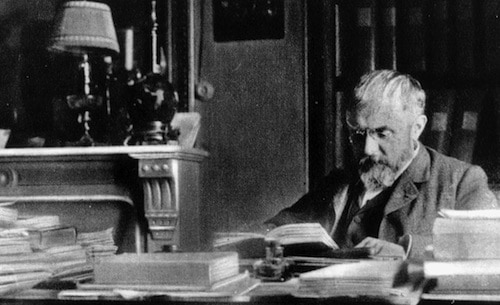
John Cook, an applied mathematician and blogger, recently highlighted the following quote from a new biography of Henri Poincaré:
Poincaré … worked regularly from 10 to 12 in the morning and from 5 till 7 in the late afternoon. He found that working longer seldom achieved anything …
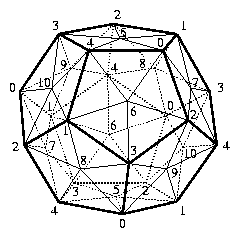 At first, we might marvel at how little time Poincaré spent working. But then we realize that “work” in this context probably means super-intense, hard-focused, uber-concentration; the type of “work” that required him to ponder things like a triangulated homology 3-sphere (pictured to the right).
Still, it doesn’t seem that hard to get 4 hours of hard focus out of an 8 – 10 hour work day. Most probably assume that they hit this mark easily. But then we measure this assumption and get a cold dose of reality.
At which point, we stop marveling at Poincaré’s supposed laziness, shut down our e-mail, and turn back to the metaphorical (or, in my case, literal) chalkboard.
#####
This post is part of my Craftsman in the Cubicle series which explores strategies for building a remarkable working life by mastering a small number of rare and valuable skills. Previous posts include:
- You Probably (Really) Work Way Less Than You Think
- Experiments with the Textbook Method
- You Are What You Write: The Textbook Method for Ultra-Learning
- Work Less to Work Better: My Experiments with Shutdown Routines
#craftsmanincubicle

There was an interesting Lifehacker post this morning that echoes many of your ideas. Check it out!
Did you just comment on my first blog post?
If so, that is amazing, but I can’t imagine how you found it so fast (hence the skepticism). You were probably the first person to read it, which renders the last sentence of the article kind of obsolete.
So thanks a lot for you kind reply and I look forward to keeping the dialogue going.
Yes. The trackback link showed up in my comment moderation queue.
I would guess that he was focused for 4 hours per day but that he ‘worked” for the remaining 20 hours per day thinking about his work.
I think the biggest thing that people struggle to understand is how others define “work.” I didn’t check my email or turn my computer on to start “working” until 4pm yesterday, but I “worked” all morning to organize the kitchen in my new house, which was a productive task I completed. Since I consider myself a professional ultimate frisbee player, I “work” every weekend when my teammates and opponents are just “playing” in the same tournament. It is all about how you personally define your daily activities and what you prioritize. I definitely agree that finding 1-3 dedicated, focused sessions (with variable durations) of hard, productive work a day are ideal and can lead you to achieving your ideal lifestyle.
Cal,
I definitiely relate here. Four hours is just about the maximum amount of deliberate hard focus I can pull out of myself before the focus dims and it becomes much more arduous (and most likely impossible) to do the same type of work.
At that point it’s off to less mentally intesive work.
Thanks for this bitesized productivity post – perfect for a quick weekday read.
I have always wondered, Cal, if you’ll ever write about what you do post 5:30? Surely what you do in your leisure time feeds how you approach work? I’m curious.
You can be a professional ultimate frisbee player!? I want to hear more about this…
That’s an interesting question — as it’s something I give some thought to. Maybe a future post…
Hey Cal, I interrupt this thread to let you know that your new book So Good They Can’t Ignore You has just arrived. As a former poster girl for following my passion, and a late convert to becoming so good, etc., etc., I’m really looking forward to reading it.
My Name is Mark and I am a Mechanical Engineer by education and profession. I will try to kep this short because I am no entirely sure of my point. Perhaps it is to discuss how one’s mental baggage can thwart diligence, talent, passion and opotuntiy. Not sure if you have ever looked specifically at that.
When I was 14, I decided I wanted to go to Berklee college for music. My parents, dad is an engineer, was not having any of it and sent me to school for engineering. This single incident fueled a fire in me to succeed in music despite being held back from attaining a formal music education. I began to study privately with the best teachers I could find. I hung out with musicians to learn what they were willing to teach me. I read. I learned how to read music, rare for a guitar player, and practiced my but off to the tune of 15-to 20 hours a week. Oh, and I worked part time and carried 16 credits a semester. The odd thing was that I never really played out in font of people. I literally spent my life preparing….odd right?
About 10 years ago something went to heck and I quit the instrument. Frustrated because I was not reaching the level of ability that I thought I should have been blaming that for being reluctant to play out. I blamed myself for not working hard enough and also my parents for not letting me pursue what I waned to pursue.
About six months ago my wife asked, are you willing to throw away the next 20 years of music just because you quit for the last ten?
I picked up the guitar again, found a Berklee grad in the area to study with, and started my pursuit again. About a month back in, I auditioned and was given a spot with a rather accomplished jazz swing band. And so began another spiral downward. All of the same devils I battled before are not back ten fold. Despite a ridiculous practice and performance schedule, I still dread the idea of playing out for fear of a mistake. And as for taking a solo, forget it. No matter how many times I played it in the practice room perfectly, it was surely to be a disaster on the band stand.
I hear from everyone who is someone with music in my life that no mater how much I prepare I will screw up hundreds of solo’s gigs before I get proficient. Which brought something to light; it is apparently much harder to fail as an adult than it is a kid. In other words, fail when you are young and everyone just thinks it is cute. As an adult, failure is never cute.
So tell me, how does age and mental state fit in to your models?
Poincare is not alone. GH Hardy believed that it simply isn’t possible to do more than four hours of creative work a day.
As you know, Cal, Murakami, through what he would say is sheer practice, is able to write for five or six hours. I believe this also is consistent with the practices of many other writers: no more than about four or five hours.
This might seem a trivial analogy, but as I work outdoors, I find some flora the same — a direct sunlight only in the morning, an indirect sunlight for the rest of the day. If concentration is that light, and ideas are best thought a kind of delicate thing…but I wonder if Poincare ever had a flash of insight outside those four hours, if he sometimes somehow worked without quite working.
Thanks for the post!
Hey Cal,
I am an undergraduate student. I am so glad to have discovered your blog and slightly annoyed for not having discovered it earlier.Most of the entries you have written speak volumes about my own career choices. Following the passion advice blindly , I have changed majors 4 times times till now. Finally I decided to take up business and management and I am going to stick to it.
In my college , I had a long “laundry list” of activities. I was in the college union, theatre team, dance team, debate team, football team and did two part time jobs.
The last semester I followed your advice and musch to the horror of my teachers and friends, I dropped all my extra curricular activities. I have not known such relief for a long time. Thank you.
@naomi see https://calnewport.com/blog/2009/02/18/want-a-job-dont-major-in-business/