NEW BOOK!
Explore a better way to work – one that promises more calm, clarity, and creativity.

The Single Number that Best Predicts Professor Tenure: A Case Study in Quantitative Career Planning

https://www.flickr.com/photos/bytemarks/5774697346/

An Interesting Experiment

 How do people succeed in academia?

I have notebooks filled with theories about this question, but I’ve increasingly come to realize that insights of this type — built on gut instinct, not data — are close to worthless. Most knowledge work fields are complex. Breaking into their upper levels requires a deliberate effort and precision that is poorly matched to the blunt, feel-good plans we devise in bouts of blog-inspired reflection.

This was on my mind when, earlier this week, I went seeking empirical insight into the above prompt, and ended up designing a simple  experiment:

  1. I started by identifying well-known professors in my particular niche of theoretical computer science.
  2. For each such professor, I studied their former graduate students. I was looking for pairs of students who earned their PhD around the same time and went on to research positions, but then experienced markedly different levels of success in the field.
  3. Once I had identified such a pair, I studied the first four years of their CVs — the crucial pre-tenure period — measuring the following variables: quantity of publications, venue of publications, and citation of published work in the period.

Each such pair provided an example of a successful and non-successful early academic career. Because both students in a pair had the same adviser and graduated around the same time, I could control for variables that are largely outside the control of a graduate student, but that can have a huge impact on their eventual success, including: school connections, quality of research group, and the value of the adviser’s research focus.

The difference in each pair’s performance, therefore, should be due to differences in their own strategy once they graduated. It was these strategy nuances I wanted to understand better.

Here’s what I found…

Read more

Getting (Unremarkable) Things Done: The Problem With David Allen’s Universalism

Getting Beyond Getting Things Done

I first read David Allen’s Getting Things Done (GTD) in 2003. I was a junior at Dartmouth and Allen’s ideas resonated at a time when my obligations were starting to overwhelm me. I committed to his system.

After a few years, by which time I was at MIT for graduate school, I found myself frustrated with the whole GTD canon and was ready to abandon it altogether.

My issue was simple: it wasn’t helping me become better.

I was good at full capture and regular review, and, accordingly, was quite organized. This was a good time in my life to ask me to submit a form or tackle a complicated logistical process. You could be confident that I would capture, process, and then accomplish it.

But I was missing the intense and obsessive wrangling with the hard problems of my field — the type of habit that made people in my line of work exceptional. My commitment to GTD had me instead systematically executing tasks, one by one, like an assembly line worker “cranking widgets” (to use a popular Allen aphorism).

I didn’t need to be cranking widgets. I needed to instead be crazily focused.

Read more

Mastering Linear Algebra in 10 Days: Astounding Experiments in Ultra-Learning

The MIT Challenge

My friend Scott Young recently finished an astounding feat: he completed all 33 courses in MIT’s fabled computer science curriculum, from Linear Algebra to Theory of Computation, in less than one year. More importantly, he did it all on his own, watching the lectures online and evaluating himself using the actual exams. (See Scott’s FAQ page for the details of how he ran this challenge.)

That works out to around 1 course every 1.5 weeks.

As you know, I’m convinced that the ability to master complicated information quickly is crucial for building a remarkable career (see my new book as well as here and here). So, naturally, I had to ask Scott to share his secrets with us. Fortunately, he agreed.

Below is a detailed guest post, written by Scott, that drills down to the exact techniques he used (including specific examples) to pull off his MIT Challenge.

Take it away Scott…


How I Tamed MIT’s Computer Science Curriculum, By Scott Young

I’ve always been excited by the prospect of learning faster. Being good at things matters. Expertise and mastery give you the career capital to earn more money and enjoy lifestyle perks. If being good is the goal, learning is how you get there.

Despite the advantages of learning faster, most people seem reluctant to learn how to learn. Maybe it’s because we don’t believe it’s possible, that learning speed is solely the domain of good genes or talent.

While there will always be people with unfair advantages, the research shows the method you use to learn matters a lot. Deeper levels of processing and spaced repetition can, in some cases, double your efficiency. Indeed the research in deliberate practice shows us that without the right method, learning can plateau forever.

Today I want to share the strategy I used to compress the ideas from a 4-year MIT computer science curriculum down to 12 months. This strategy was honed over 33 classes, figuring out what worked and what didn’t in the method for learning faster.

Read more

You Know What You Write: The Textbook Method for Ultra-Learning

Less Than Ultra Learning

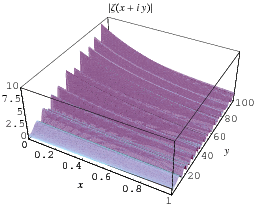
The surprisingly useful Riemann Zeta function in action. (Image from MathWorld.)

As part of my craftsman in the cubicle project, I spent this past week monitoring how I learn new information.

I wasn’t impressed.

At one point, for example, I needed to dive into a topic I didn’t know much about: how information disseminates in random power law graphs. I went to Google Scholar and begin downloading papers with promising abstracts. I printed three and skimmed another half-dozen or so online. In retrospect, I think I was hoping to find a theorem somewhere that described exactly what I was looking for in notation I already understood.

Not surprisingly, I didn’t find this magic theorem. The two hours I spent felt wasted. (Well, not completely wasted, I did learn about the Riemann Zeta function, which turns up way more often than you might expect.)

This experience recommitted me to cracking the code of ultra-learning. Mastering hard knowledge fast, I now accept, requires more than blocking aside time on a schedule; it also demands technique.

The Chair

With this in mind, here was my first stab at cracking ultra-learning:

I bought a traditional leather chair (a longtime dream of mine). My wife and I still need to add some bookcases, a rich rug, and an old brass lamp — but my general  theory here is that this library nook will be make it impossible to avoid mastering new bodies of knowledge, and perhaps also pipe smoking.

Under the assumption that I might need more than the power of The Chair to become an accomplished ultra-learner, I do have one more strategy to deploy — which is what I want to talk about in this post. It’s actually a strategy I’ve known for years (my PhD adviser taught me soon after my arrival at MIT), but have seemed to forgotten recently.

Read more

The Recorded Life

Personal Hacks A reader recently noted the following: It strikes me that you haven’t said much at all on your blog — or for that … Read more

Work Less to Work Better: My Experiments with Shutdown Routines

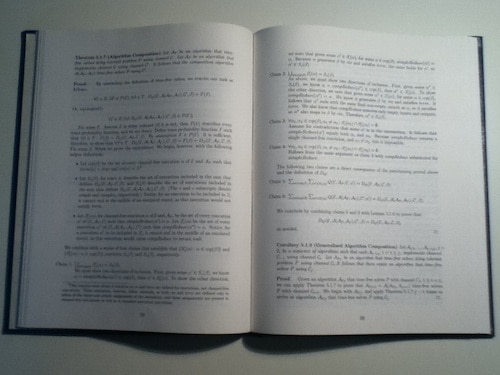
My dissertation. The pages shown here are from a proof that caused significant consternation.

A Novel Dissertation

I began working on my PhD thesis in the summer of 2008. I defended a year later, in early August, 2009.

There’s nothing unusual about this timing. What was unusual, however, was my approach.

By June 2008, I had a fair-sized collection of peer-reviewed publications. The standard practice in computer science would be for me to take the best of these results, combine them, fill in the missing details, add a thorough introduction, and then call the resulting mathematical chimera my dissertation.

To me, naive as I was, this sounded like a waste of a year. So I decided I would prove all new results.

This strategy worked fine for a while, keeping me engaged and happy, but then, in April, 2009, things took a turn toward the difficult. It was during this month that I accepted a postdoc position that would start in September.  This meant that I had to defend my thesis over the summer. Suddenly the allure of tackling all new results began to wane.

Here’s a scenario that became common:

  • I would be working during the day on an important proof.
  • At some point in the late afternoon I would find a flaw.
  • A helpful voice in my head would point out that my whole future depended on finding a fix — without a fix, it argued, the thesis would crumble, I would be kicked out of graduate school and end up homeless, likely dying in a soup kitchen knife fight.
  • After heading home, I would continue, obsessively, seeking a fix — ruining any chance at relaxation that night.

After two weeks of this exercise, I decided something needed to change.

It was then that I innovated my shutdown philosophy…

Read more

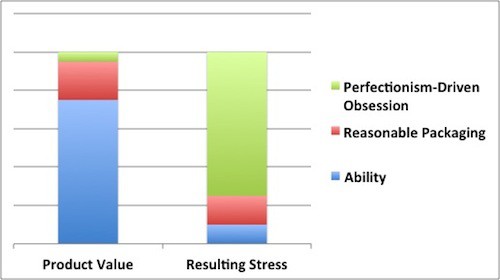
Perfectionism is a Loser’s Strategy

Ocean-Front Writing

Yesterday, I submitted an important grant proposal. In a perhaps overzealous interpretation of my adventure studying philosophy, I wrote the bulk of the content on the island of Madeira, in a hotel room overlooking the Atlantic, which turned out to be wonderfully monastic and productive.

The process was hard. I probably spent around 100 hours total; some energized, but most mired in the dreary hinterland of editing. In standard Study Hacks fashion, however, I was organized, and able to spread the work out.

I bring this up because throughout the process I found myself wrestling with insecurity. Every evening, when I was done with my careful plan for the day, the voice of doubt arrived trying to convince me to spend a few more hours editing or to bother a few more people to take a look at my draft. Did I really want a little bit of laziness to be the reason I lost this award?, it would ask.

I was experiencing the classic battle between perfectionism and lifestyle design. This battle is familiar to those who embrace my career craftsman philosophy, because this philosophy requires a balance between becoming “so good they can’t ignore you” and then leveraging this value to build a life you love.

The former goal attracts perfectionism while the latter can’t work if it’s around.

I’m writing this post to share with you the thought process that helps me navigate this mental minefield…

Read more

Impact Algorithms: Strategies Remarkable People Use to Accomplish Remarkable Things

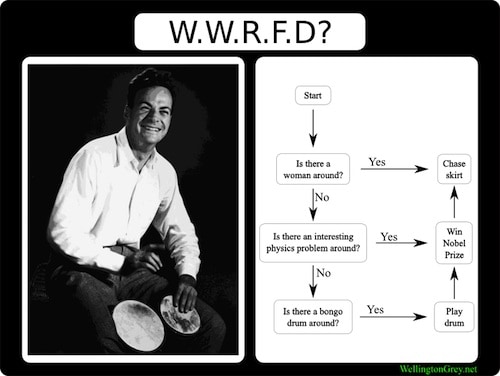
(Image from WellingtonGrey.net via c2.com)

Impact Algorithms

I’ve been writing recently about the impact instinct — the ability to consistently steer your work somewhere remarkable. We know that diligently focusing on a single general direction and then applying deliberate practice to systematically become more skilled, are both crucial for standing out. But true remarkability seems to also require this extra push.

Since writing these posts, readers have sent me an amazing collection of quotes and articles that provide supporting details for this idea. Reviewing these resources, I noticed that the following systematic strategies — let’s call them algorithms — seem to pop up again and again.

Below, I summarize these algorithms, each of which I named for someone remarkable who exemplifies it: I don’t know that they’re all right; I don’t know which work best; but they should provide nuance to our understanding of the impact instinct.

Read more