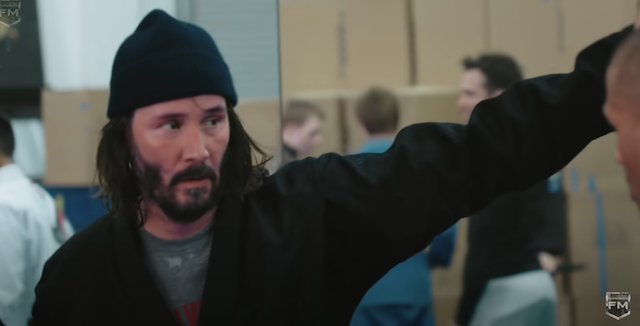
I found myself recently, as one does, watching the mini-documentary featurettes included on the DVD for the popular 2014 Keanu Reeves movie, John Wick — an enjoyably self-aware neon noir revenge-o-matic, filmed cinematically on anamorphic lenses.
At the core of John Wick‘s success are the action sequences. The movie’s director, Chad Stahelski, is a former stuntman who played Reeve’s double in The Matrix trilogy and subsequently made a name for himself as a second unit director specializing in filming fights. When Reeves asked Stahelski to helm Wick, he had exactly this experience in mind. Stahelski rose to the challenge, making the ambitious choice to feature a visually-arresting blend of judo, jiu-jitsu, and tactical 3-gun shooting. In contrast to the hand-held, chaotic, quick-cutting style that defines the Bourne and Taken franchises, Stahelski decided to capture his sequences in long takes that emphasized the balletic precision of the fighting.
The problem with this plan, of course, is that it required Keanu Reeves to become sufficiently good at judo, jiu-jitsu, and tactical 3-gun shooting so as not to look clumsy for Stahelski’s stable camera. Reeves was game. According to the featurette I watched, to prepare for production, he trained eight hours a day, four months in a row. The effort paid off. The action set pieces in the movie were show-stopping, and after initially struggling to find a distributor, the film, made on a modest budget, went on to earn $86 million, kicking off a franchise that has since brought in hundreds of millions more.