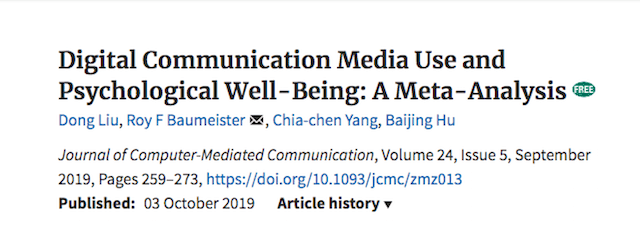
My friend Eric Barker recently pointed my attention to an intriguing paper published earlier this fall in the Journal of Computer-Mediated Communication. It presented a careful meta-analysis of 124 studies looking at the connections between digital media and well-being.
There’s been a lot of academic ink spilled on this subject recently. As I wrote in Digital Minimalism, correlational behavioral studies are exceedingly tricky — you can’t expect slam dunk consistency, but must instead look for general trends in the literature pointing toward some underlying signal in the noise.
Which is all to say, you shouldn’t don’t take any one study too seriously. Even with these caveats, however, I did find this one interesting, as it featured some heavyweight authors, and was clearly written to offer some authority on where the noisy literature seems to be trending at the moment.
The analysis was complicated and contained multiple noteworthy findings, but there was one result in particular I wanted to highlight: