
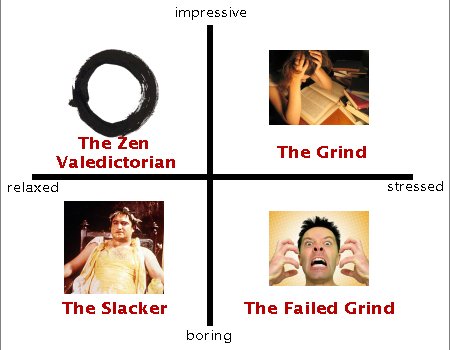
The Four Types of Students
At the risk of being reductive, I argue that we can plot all possible types of college students on two spectra: the first spans from totally relaxed to totally stressed; the second spans from boring to really impressive. In the figure presented above, I present these two spectra as the axes of a two-dimensional plot. Four quadrants are exposed. For each quadrant, I added a description of the type of student who goes through college with the identified combination of traits.
Three of these types should be familar…
The Grind. (Impressive/Stressed) This type of student is overloaded with activities and supercharged course loads and triple majors and would die before accepting a “B.” Some are driven by parental pressure. Some by ambition. Their student life is demanding. Many burn out. But those with the constitution to stick it out end up with impressive post-grad opportunities.
The Failed Grind. (Boring/Stressed) Not every grind-wannabe can keep up with this load. There is an art to pushing yourself to the limit without breaking down. Many push a little too hard in the wrong places and end up with erratic grades, a confusing mash of dropped activities and failed schemes, and a nice big bloody ulcer. The failed grind often feels despair or depression. Their health flags. They hate school. Everything you don’t want.
The Slacker. (Boring/Relaxed) An alternative to the high-stress end of the spectrum is to just say “screw this” and focus on winning your house’s next pong tourney. It might be hard to find a job after you graduate, but, hey, life’s too short for such loser-ass talk. Let’s go drink some more terrible beer.
These three students types are well-known. What makes the quadrant diagram interesting, however, is that it exposes a fourth region — one that is both relaxed and impressive. We are not used to considering this combination of traits. Indeed, many students have a sort inborn blindness to its possibility. When they look at this diagram they look past the upper left corner; as if it doesn’t exist. It’s simply not a possibility. Conventional wisdom says you have to choose between being a grind and a slacker. And that’s that.
But why must we ignore the upper-left? Most students, if pressed, will give the following explanation:
To be impressive requires that you do a lot of hard things. This is stressful.
Let’s push farther. How do you know that’s true? Again, when pressed, most students will admit that this seemingly iron-clad dictate is, in reality, formed from intermittent anecdotal feedback and conventional wisdom. Weak support.
I am officially putting this fear-based, blinded reasoning on notice. No more! It’s time to move beyond the dialectic of the grind and the slacker, and to embrace the possibility of the upper-left quadrant. It’s time for…
The Zen Valedictorian
I call the type of student who lives in the promised land of relaxed impressiveness the Zen Valedictorian. This idea is not new to Study Hacks readers. I have been posting for weeks about many of the ideas supporting this philosophy. But I thought it was time to give the concept a formal name (and it’s own post category tag so you can quickly identify all relevant articles.)
I summarize this philosophy as follows…
If you understand…
- your interests and values,
- the psychology of impressiveness, and
- how to be productive and study efficiently,
then you can construct a student lifestyle that is…
- relaxed and free of chronic stress,
- intellectually engaging,
- wildly social and exciting, and
- just as impressive as if you had followed the path of the grind.
We can sum this all up in the following pithy motto:
Do Less. Live More. Get Ahead.
How does this work? I’ve been seeking answers to these questions for years. My conclusion: adopting the zen valedictorian lifestyle is not trivial. It requires strong will and great self-awareness. But it is, I assure you, worth it. We will continue to explore it’s nuances in the upcoming months.
A Brief Review of What’s Been Said So Far
To get us all on the same page, I thought I would conclude with some pointers to the relevant discussions that we’ve had over the past several weeks on this topic. Much more to follow soon…
- Radical Simplicity
Dramatically reduce your student schedule until you have more than enough time to get everything done. You’ll regain a love of life and sacrifice less impressiveness than you think. - The Laundry-List Fallacy
Why we think that doing a lot of things is impressive, and why, in reality, it can have the opposite effect. - Can a Relaxed Student Get Into Grad School?
Highlighting how the reality of many competitive pursuits — like getting into a good grad program — rewards simplicity and focus over grinding and overload. - The Law of Complementary Attractions
The hidden law that helps Rhodes Scholars manage to look so impressive without becoming overloaded. - Happiness Decoded
How to keep yourself happy. (The bigger question: if you’re not happy, what’s the point?)
As always, I thrive on your reactions and extensions, so let me know what you think…
[Update 4/25/2008: I’ve posted a follow-up article that lays out the key high-level strategies for achieving the Zen Valedictorian lifestyle. This is a good place to start. Beyond that, follow the Zen Valedictorian post category to keep up with relevant articles as they appear.]

Great Article Cal! Heh! I’m a recovering slacker. And being happy with what you are doing will help you be more productive. Taking breaks are important too so a funny movie once a week? But going cold-turkey on youtube and facebook for a while will certainly help :D. maybe facebook like once every three days? (highly impossible for some :).)
@Siva:
Your comment reminded me:
There is this infamous story here at MIT where entire floor of a freshman door decided that they were going to have a movie night, every single night, for their entire first year. They were emboldened to do this because, at the time, MIT made every freshman course pass/fail…but I’m trying to track how things turned out…
I love that you turned your words into a diagram. Yet another way to decode the straight-a-stress-free college lifestyle. Your blog has helped me conquer this semester already!
Nice square. As the above commenter said: great post!!!
I do think that impressiveness should also be viewed as a function of how hard one’s school SEEMS to him and to his classmates. It is one thing for a student to be a Zen Valedictorian in an easy major at a fairly un-rigorous school and another thing for a student to be a Zen Valedictorian because he has good study habits, majors in something that interests him and has “relaxed ambition” about his extracurricular activities and his schoolwork at a rigorous (and even grade-deflated) school. I don’t mean to sound like a snob (which I may inevitably sound like to some people reading this) but what impressiveness means will vary by the rigor of the school just as much as it varies by the student, his potential, and the amount of adversity he faces in his life.
I’m a slacker trying to get back on track. This Zen Valedictorian is what I’m aiming for but can’t figured out how to get there. I must do a time audit, any ideas how xD. Must be zen!
Great post! In general, the way that we are taught from when we are young right through our schooling years promotes the ‘grind’ mentality. We are taught from an early age to read a book in a linear fashion, start to finish. Our maths classes usually start at chapter one of the textbook and progress in an orderly manner through to the end. As we progress through our schooling the amount of work is gradually added on and we are required to do more and more in the school year.
It is easy to become overwhelmed with the amount of reading and problem solving that has to be done and then guilt, stress and procrastination find fertile ground. If we are too conscientious or driven then we can end up in the failed grind quadrant or if we have given up too early then we can end up in the slacker quadrant.
Nice name. I hope for more articles expanding on this topic soon.
Hi Cal,I recently saw this blog of yours and absolutely have gotten addicted to it.Thanks for making such an opportunity for us students. I was wondering if there was any way your book could be found in Bangladesh??I don’t have any credit cards but would love to buy it from any stores.
I believe that if I saw a book titled “Zen Valedictorian”, I would be compelled to buy it, just because. 🙂 If it happened to be written by you, I’d simply have to buy two.
My undergraduate studies have had stellar results already, and all thanks to the approaches detailed in your books. Thank you!
Great post! Although I am not yet an undergraduate student, but I already find your advices helpful and will use them in college. Thanks!
@David:
True. Whether we like it or not, almost anything you do in college will be adjusted relative to the perceived “goodness” of your school.
@Jason:
Stay tuned. Over the next few weeks I’m going to build up the Zen Valedictorian framework which will help you keep your transformation on track. Interestingly, productivity will play just a small part…
@malcolm:
More than the linear nature of learning, I think the lack of understanding of impressiveness leads to trouble. Students are cut loose in the college environment and told: “go start your life.” They have no idea what this means. Grinding is simple. It’s easy to understand. It’s highly visible. So that’s becomes the default.
@Albert:
Stay tuned…
@Sajeda:
We don’t yet have any deals with publishers from the Indian sub-continent. Right now it’s in China, Taiwan, and South Korea.
@Jen:
I should put you in touch with my editor. 🙂 Actually, right now, I’m still filling out the concept. Sort of like my opus. I’m hoping my interactions with you guys will help me figure out if what I have here is important.
@Maggie:
Great. A post I want to write down the line — after I’ve filled in the ZV concept more — is how the same principles apply to the high school student looking to get into college as well as the graduate student.
yep the grind students sounds more like me. LOL. Great post !
As a valedictorian, I definitely agree with your assessment. The key to being a zen valedictorian is focusing on doing what you enjoy, rather than pursuing the grim and joyless path of the grind.
Funny story–when I was named valedictorian of my high school, they passed over several of the most notorious grinds. People were so upset that they demanded a recount. Then when I still came out on top, they started circulating a petition to abolish the valedictorian award. What a typical grind approach!
@Chris:
That story really emphasizes how set we get in our story lines about being a student. It’s funny what sort of things start to sound absurd when you take the time to step back and ask: “why is this true?”
Hi Cal! Just want to say that I love your posts! I’m currently a freshman in college and I stumbled across your website not too long ago, and I’m really trying to put some of your studying techniques into practice.
I attempted in high school to be a Zen Valedictorian, but I ended up being somewhere between the failed grind and the slacker instead. Looking back, I see this as a product of being easily discouraged and dabbling in too many unnecessary activities (and not committing to the ones that I could have done well in).
Now that I’m in college, though, I’m striving to live every day to the fullest, whether through studying or free time. I am going to really live by this philosophy as much as possible. Perhaps one day I’ll be able to reach “Zen Valedictorianhood,” but it’s going to take a while!
How can we use this Zen philosophy to study for MCAT, GMAT PCAT and all other cats and mats..? Please any input would be kind.
After being a “Grind” for many years, I recently ended up staring down the road of a “Failed Grind” and then found your articles. Thanks so much for the redirection. I just removed a couple of extracurriculars from my plate, having realized that there was no point of having them if they were going to contribute to the bad grade I’ve been getting in a class. I can already feel the breathing room! And I still have two extracurriculars still going, and once my grades improve and I have more time/energy, there’s so much potential within those two. Less is more- do less and do it better!
Hi, love your work and this article. I, unfortunately, spent a decent part of my college life in the lower two quadrants. I am hoping that I can apply some of the philosophies of minimalism and simplicity in life after college to allow me to focus better but the regret from failed opportunities and wasted time just weighs a lot. I’m staying positive as much as I can, knowing that I gain nothing from regret of the past, but also staying humble and trying to learn as much as I can from the experience.