
Boring on Horseback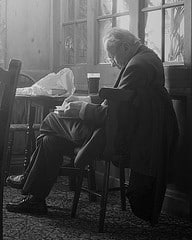
A few weeks back, on the recommendation of Ben Casnocha, I started working my way through David McCullough’s biography of a young Theodore Roosevelt: Mornings on Horseback. I was interested in the subject, but the early chapters of the book, which detail the late-19th century New York social scene, were not grabbing my attention.
Not willing to give up the endeavor, I made some changes. First, I prepared a plate of a pleasantly sharp Australian Cheddar that I had discovered on an absurd sale at our local Whole Foods. I then poured a glass of an Italian Abruzzo (a purchase inspired by my early-September visit to a vineyard in the hills outside of Bologna), and settled onto my couch — the splash of incandescent light from my reading lamp the only illumination in the room.
In this setting, my mind eased free of its previous resistance and began to absorb McCullough’s slice of life details. I found myself engaging the material in a way that just a few minutes earlier had been impossible. Something about the tang of the cheese, and the dry sweetness of the wine, supported by a creeping, yet controlled buzz, opened my mind.
This experience provoked an interesting thought: the context in which you do academic work is extremely important, yet most of us give it little consideration…
Context Matters
Here’s my reaction to this realization: the setting for your academic work is as important as your methods.
If you’re working through class readings, tired and surronded by bored peers in a fluorescence-bathed study lounge, you’re doing yourself a grave disservice. Even if you’re deploying the most advanced study tactics, the context of your work is still weakening your results.
(Many students, I’ve discovered to my horror, are drawn to these terrible locations out of some masochistic sense that if they don’t suffer, they’re somehow slacking off. If this describe you, consider a zen overhaul to your student mindset.)
With this in mind, I charge you to give serious consideration to where you study, at what time, and with what environmental details.
For example…
- If you’re over 21, consider tackling reading assignments at a quiet, (non-student) bar, armed with a good pint. Is there any better way to tackle Scottish philosophers, or literary criticism, then with a dark stout? (If you’re at Dartmouth, try Murpheys; if you’re at Harvard or MIT, try Shay’s Wine Bar in Harvard Square).
- If you’re not over 21, try working through your reading over a good meal at an off-campus restaurant.
- Problem sets, I’ve discovered, are often best tackled on hikes. There’s something about tossing rocks into a mountain lake that shakes loose sticky insight.
- And so on…
I touched upon this concept briefly when I introduced the idea of adventure studying (which recommends awe-inspiring outdoor locations for work), and it’s implied by A* strategies such as the notebook method (which asks you to spend unstructured time with a pen and paper notebook, working through big ideas), but I want push it to become a first-order principle to consider when planning your work.
That is, you should always ask yourself:
- when am I going to study;
- for how long;
- with what strategies; and
- in what context…
If you’re aggressive and innovative in your answer to this last question — seeking the unusual and mentally-stimulating over the standard and easy — you’ll reap benefits in two crucial areas: the sophistication of your understanding, and, more importantly, your enjoyment of student life.
Leave the study lounges to the grinds and last minute slackers, and go pour a pint. College life is too short, and the material too interesting, for you to remained holed up somewhere boring…
(photo by Monster)

Thanks for this post Cal. Loved it. I recently started writing a blog and I’m quickly realizing that I need to find a writing context that works for me. Your post has got me thinking about trying some different venues. (I tend to write posts on my couch in my living room with my roommates shuffling around and the TV on. This is too much stimulus for me.)
Sounds like a good way to approach a lot of things in life that you have to do. College life is indeed too short, but life in general is too short too!
I was thinking about this over Thanksgiving. I would love to build my own study room with lots of plants, wood paneling, bookshelves, and a big heavy oak desk. Unfortunately, I live in a cramped apartment with 2 noisy roommates.
Do you have any special furnishings when you study at home Cal?
Also, can any readers recommend good study spots in Chicago?
I’ve studied a few times with a good beer or glass of wine. Only one drink over 2 or 3 hours, but just enough to relax me a little, and especially shut the hyperactive part of my brain so that I can focus.
Hey, not to sound like a pedant, but if you study while eating, won’t you focus more on the meal than on the reading?
I realize context is very important too. Not only in study, it’s in every actions in our life.
When I reading books, go to somewhere quite , and enjoy it . When I study without any ideas, I want to stay with my group, discuss it after that stay in my corner and get it done.
I really want to study in library, cause I can feel the study atmosphere .
Pubs are also great for grading papers and quizzes – it’s just important to keep it to one slow pint 😉
Absolutely. Though this might be a challenge for more than a few college students…
Good point.
Nah. Some of my best reading experiences have been over meals.
I used to study in my dorm room, with a candle burning and Bach or Vivaldi playing… Somehow the music (important that it was instrumental music, no lyrics) occupied a “chatter” level of my brain, and allowed me to focus better. Oftentimes, by the time the CD was over, I was fully “in the zone” and didn’t need more music.
The trick is to not order something you’ll risk spilling on the book (pasta with long noodles is probably not the best choice). Usually if I’m doing something like this I’ll go to a cafe I like that’s a short walk from campus, order a coffee and a meal, and eat the meal before I get out my reading. The cafe plays music pretty loud, which keeps me from being distracted by other things. I think it’s a useful ritual for me, since I really only do it occasionally, when I know I need to get a lot done, and once I’m there I feel a lot less resistant to get started on something I’ve been putting off.
I’ve yet to find a good bar to study in, though. Most are too poorly lit for reading, and the ones that aren’t don’t have good beer on tap.
You should have gone to school in Boston: a haven for well-tapped bars suited for reading!
I do enjoy reading while I have a coffee or a beer. The biggest problem I’ve had is that most cafes are filled with a lot of people chatting, which tends to distract me.
The context in which Heidegger developed his work was extremely important. He was in the black forest away from his concept of fallenness. He built a cabin on a hill side as far isolated from society and others as possible. You’re right in the regard that context is EXTREMELY important. What if one could reach this state without alcohol? (which “lower’s our guard” so to speak). If you read Heidegger’s “Being and Time” you will realize the appropriate method.
Though I have no evidence of it, I like to imagine that Heidegger was drinking Hefeweizen out in his cabin, as it is a popular German beer.
Alcohol isn’t essential; just an example.
hey cal! absolutely true – i find labs amazing for technical subjects – hide in a quiet one if it has free access and stay away from the computers unless it is needed for the work. A good rapport with the staff of the place you hang out at helps too 🙂
on another note – my hols are here (thank Zarquon that sem was over)! and am working through your articles to come up with a battle plan for next sem (academic ninjutsu style).
Thank goodness I read your book at the beginning of my freshman semester, which AFA study context, also expounded on ditching the school library. I gave the library a chance, but the constant shuffling and chattering of this communal study hub had too often, er, turned my thinking homicidal. 🙂 Now I make sure to reserve “break-out” rooms, designed for grad students, but pffbt, one needs to study.
Do you know any cool study places around MIT that would be safe to go to late at night? Do you go on hikes alone or with a friend?- kind of hard to think about psets with a friend.
You just gave me a reason to have a pint :). I checked my plan and nothing on it, so i tought a slack friday afternoon is ahead, but now ill grab some intresting reading and head out.
A great idea for an MIT student: take a weekend day (or week day without classes) and get on the commuter rail to Concord. Walk the minuteman trail.
Also, Miracle of Science, earlier in the evening, can be a cool place for getting some reading done. Or cross over to Beacon Hill and try Sevens.
why do u need to study late at night? i think that with the proper study strategies as outlined in the red book, there is no need to study late at night. all studies can be completed from morning till midnight.
Cal, what do you do if you attend UChicago (as I do) and really love adventure studying, but the winters are so brutal you don’t even want to go outside for a second much less trek to a secluded area around town?
The Truman biography by D McCullough is better than the TR book. Highly recommend “Truman” – though it’s long, it’s well worth it.
Hi Cal! I love the study over a coffee or beer approach. been doing it for many years. My biggest tip for people is to LEAVE YOUR MOBILE (cellphone) AT HOME! a few years ago, constant interruption at these cafes/bars wasn’t a problem, but now people feel they can call whenever they want for whatever reason…and if the study material isn’t engrossing, it’s likely you’ll be thankful that someone gave you a reason to close your books, drink your coffee and talk about nothing in particular for ages. obviously it’s primarily a question of self-discipline, but i find it’s a test i often fail, better just to take the mobile out of the equation.
This is so right! I really wish my college would take this seriously. It’s terrible to do any kind of design work on a computer with the $5000 worth of software in a bright room with rows of computers. Not much artistic fluids flowing. But at the same time, if my college had a coffee shop, I probably wouldn’t go to it. There’s just something motivating and relaxing about getting away and hiding from the problems and stressors of college.
Good points here. I try to make my working environment at home as pleasant as possible, and when I am home alone I can also use the couch in the living room for relaxed reading or other activities not involving writing or using a computer.
Apart from location and food, I find that also the things you use can be of influence. For instance, a nice new pen makes me want to write with it, so I work more. This can be used to your advantage, as in treating yourself to a new pen or notebook or whatever to get yourself to work on something difficult.
The bathtub all the way. It is the only way I got through my Literary Theory course. My water bill was sky high though!
So we find the mood best for us, what happens if that is being in a crowded lounge with a lot of noise?? And isn’t it stated you do best on tests/quizzes when you are in the same mindset from when you studied the material. So the people that drink during studying should be drinking during the test?