Only at MIT…

From Drinking to Ulcers Earlier this week, I stumbled across the following letter to the editor, published in the New York Times. It was written … Read more

Grit, Grinds, and Living the Low Stress Life

Update (7/8/09): I’ve returned from California and am once again online. (The picture below is of the trip; I’m the guy in the back.) I have 30 – 40 e-mails from readers, built up during my absence, that might take me a while to work through, so excuse the delay in my responses. I will eventually get back to everyone.

In Praise of GrittinessCal in Cal

While on vacation, I read two books. The first was Matthew Crawford’s Shop Class as Soulcraft: An Inquiry into the Value of Work, which has been causing an idealistic stir among the usually cynical intelligentsia. The second was Winifred Gallagher’s Rapt: Attention and the Focused Life. Both intrigued me, though I’ll admit that I’m still processing the ideas. You’ll probably hear more about them from me at some point in the future.

Today, however, I want to briefly mention one piece of social psychology research, described by Gallagher in Rapt, that resonates well with our conversation here at Study Hacks.

Read more

Drastically Reduce Stress with a Work Shutdown Ritual

Schedule Shut Down, CompleteSchedule

Here’s what happens, without exception, at the end of my normal work day.

First, I make sure my master task lists are up to date. During the day I tend to collect todos in a text file on my computer desktop because it’s fast and easy. I also have a small spiral notebook that I use to capture things when I’m away from my desk. (I always have this with me!) I transfer everything new from these collection bins into my master task lists.

I then read over these lists in their entirety. If something pops out as being somewhat urgent, I set its due date for the near future. Because I use Google Tasks, this means it will show up on my calendar as well. I do this review every day so that I trust that if I put something on a task list, it won’t be forgotten. Without this trust, the tasks would still percolate around my brain.

Read more

What If My Dream Major Turns Into a Nightmare?

Deep Trouble

I recently received an e-mail from our friend Tyler. As you may recall, he found peace last year by swapping a premed major that never interested him for a classics major that did. He went on to pare down his schedule and then focus on becoming an A* student. In short, he was a perfect example of the study hacks philosophy: do less; do better; know why.

Then things got bad again.

“I know you keep saying ‘pick a  major and stick to it.'” Tyler told me in his e-mail. “But the only thing saving me from academic oblivion is the fear of failing.  My major recently has only been sucking up my time and causing me major stress.” He then proposed that he should switch majors; even though he is only 2 – 3 classes away from a classics degree. He didn’t know what else to do.

Tyler is not alone. His e-mail is probably the 5th or 6th I’ve received this spring that offers some variation on the same common conundrum: what do I do if my dream major is turning into a nightmare? In this post I tackle this issue with a series of observations on the lost art of cultivating a healthy relationship with your academic concentration.

Read more

The Unheralded Splendor of the A* Strategy

Good Will (Not) Studying

One of my favorite scenes from the tortured genius weepy, Good Will Hunting, is the montage of Matt Damon working with an eccentric MIT math professor. The professor slaps a transparency on an overhead projector, splashing a series of graph structures on the screen. (There’s a professor on my floor here at MIT who actually does this.) Will stares at the screen for a thoughtful, brooding moment. Then he stands, grabs a marker, and adds some extra edges. They slap five.

Proof solved!

To American students, this vision of the genius who instantly solves problems has become the platonic ideal for a star undergraduate. This leads to the belief that the best students complete even the hardest work easily. Therefore, if you want to prove that you’re a top student you need to take the hardest possible course load and get the best possible grades. The goal is to make it seem like your brain is so supercharged that you can swat aside problem sets and exams like Matt Damon solving proofs on the MIT blackboard.

I call this the Good Will Hunting (GWH) strategy for becoming an academic star. Here’s the thing about this strategy: if you can pull it off, it will yield rewards. People are impressed by the 4.0 student with the triple major. But there are two problems:

  1. Most people who attempt the GWH approach don’t pull it off.
  2. It is incredibly stressful and painful, and will probably send you into deep procrastination.

As far as I can tell, many students view the GWH strategy as the only way to stand out academically. (Here at MIT, I had a student tell me that if she didn’t take a killer course load people would just assume she’s not smart.)

In this post, I want to explain a different, more sustainable path to academic stardom…

Read more

Using Fitness “Algorithms” to Stay in Shape Without a Rigid Workout Plan

The Fitness Guru ReturnsAdam Gilbert

Way back in the early days of Study Hacks, I introduced you to fitness guru Adam Gilbert. I was drawn to his story because he had left his high-prestige job at Ernst & Young to start My Body Tutor, a web-based company that has Adam, and his team of trainers, work daily with clients to help them stick to their fitness plan. I like stories of young people following innovative paths, and Adam’s path was certainly fascinating.

Since then, Adam has become my go-to guy for fitness advice. I recently asked him to help me put together an article I’ve long envisioned: a collection of simple fitness algorithms that can help a college student stay in shape without requiring a rigid schedule or complicated, finely-tuned workout. I was inspired in these efforts by Michael Pollan’s famous simplification of eating advice: Eat food. Not too much. Mostly plants.

Adam came through. Below are his simple fitness algorithms. (Of course, if you like what you hear, or are interested in becoming more serious about fitness or weight loss, check out Adam’s site.)

Read more

How to Go From College to an Extraordinary Life (and Bank Account)

Meet RamitRamit Sethi

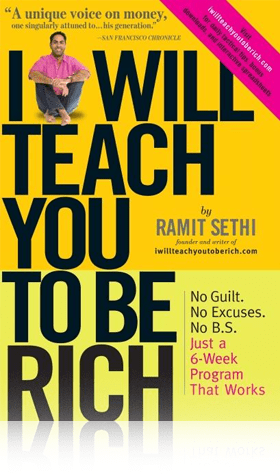
My friend Ramit Sethi lives an extraordinary life. Like me, he graduated college in 2004. While a student he consulted for big companies, and then, after graduating, co-founded a hot technology start-up and launched a writing career. Today, his full time job is running the web site I Will Teach You To Be Rich, which offers no-bullshit personal finance advice for young people.

His path is a great example of lifestyle-centric planning. He knew what he wanted his life to be like — flexible, financially sound, engaging, based in a big city — and then started making moves to make it happen.

Learn From the Master

I’m telling you about Ramit for two reasons. First, his new book, I Will Teach You to Be Rich, was just published. I review it later in this post, but let me give you a spoiler: buy this book if you want to save a lot of stress in your life over the next 10 years.

Second, Ramit and I recorded an hour-long podcast about his story and his advice for students looking to go from college to an extraordinary life. Among other topics, we cover a simple trick for guaranteeing admission to graduate school, cultivating great mentors, picking work that matters, and dominating your peers.

Here’s our offer: if you buy Ramit’s new book within the next 48 hours and forward your Amazon receipt to studyhacks@iwillteachyoutoberich.com, he’ll send you a link for downloading this interview.

My full review of his book continues below…

Read more

Start Your Semester Off Right By Quitting Something

Ben’s YearTrash

In a recent blog post, Ben Casnocha summarized his adventures during 2008. Here are some excerpts:

I traveled to Quito and the Ecuadorean Amazon jungle, Zurich, Prague, all over Costa Rica, Alaska, and rural Tennessee… Gave a dozen paid speeches in various U.S. locales. Read 60 books. … Wrote a hundred thousand words on my blog…Won an essay contest. Made new friends. Tried to become closer still to old friends…Fished for halibut off a boat…Met one-on-one with David Foster Wallace and then mourned his death. Philosophized. Watched too many Seinfeld episodes….Plotted world domination.

This seems like a lot. And it is. But in this post I draw an unexpected conclusion: the long length and indisputable awesomeness of this list should inspire you during this upcoming semester to do much, much less.

We begin with a simple question…

Read more