NEW BOOK!
Explore a better way to work – one that promises more calm, clarity, and creativity.

How to Cure Deep Procrastination

The Deep Procrastination Crisis

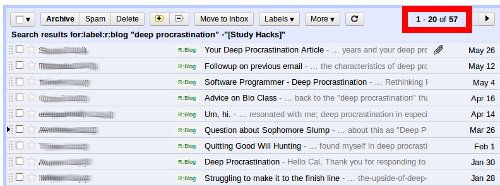
Above is a snapshot of my blog e-mail inbox, filtered to only show e-mails from students struggling with deep procrastination. Notice that there are close to 60 such messages. If I include blog comments in the search, the number jumps into the hundreds.

Deep procrastination is a distressing affliction. Students who suffer from it lose the ability to start school work. Deadlines pass and they hand nothing in. Professors provide special extensions, but the students still can’t bring themselves to do the work. And so on.

As evidenced by my inbox, this issue is surprisingly common, especially at elite colleges. Yet it’s also almost entirely off the radar of traditional student counseling, which is why I dedicate time to it here.

In my previous post, I introduced a dubious evolutionary explanation for an otherwise very real phenomenon: procrastination, in my experience, is not a character flaw, but instead evidence that you don’t have a believable plan for succeeding at what you’re trying to do. In this post, as promised, I want to apply this evolutionary perspective to help better understand, and therefore better combat, the deep variety of this common issue.

Read more

The Procrastinating Caveman: What Human Evolution Teaches Us About Why We Put Off Work and How to Stop

Survivor: Paleolithic Edition

Rewind time 100,000 years ago: several different species of humans co-exist on earth.There was, of course, our own species, Homo sapien, but we were joined by our more athletic siblings from the Tree of Life, Homo erectus, who had left Africa and colonized Asia long before we ventured beyond the mother continent, all the while another sibling, the stocky Neanderthal, was hunkered down in a European ice age.

Advance another 90,000 years, however, and our species is the only game left in town.

Scientists have worked hard to figure out why we survived while other early humans did not. The answer to this question lies at the core of our species’ story, but it also provides insight into a topic of significantly less importance on the grand scale, but nonetheless one that haunts many of us in our everyday lives: procrastination.

Read more

Anatomy of an A+: A Look Inside the Process of One of the World’s Most Efficient Studiers

Scott Young’s Graduation Gift to Study Hacks

I have to give credit to Scott Young: it was talking blogs with him back in 2007 that helped convince me to start Study Hacks. The fact that I link to Scott’s material again and again and again and again should tell you that we think in similar patterns.

The reason I’m bringing up Scott today is that he’s about to graduate from university. One of the things that intrigued when I first met him four years ago is that, like many students I profiled in the red book, he had the ability to score top grades without needing to study much.

It turns out that he kept this up: He will graduate this month with a GPA that hovers between an A and an A+, even though he almost never studied for more than a handful of hours.

In honor of Scott’s graduation, I asked him if he would share his secrets. I don’t want vague philosophies, I told him. Study Hacks readers are more interested in a blow-by-blow case study of exactly how he studied for a specific test, including screenshots of his notes and a careful accounting of his time.

Fortunately for us, Scott agreed. Below you’ll find the details of how he scored an A+ on a corporate finance exam that had a 50% failure rate at his university. His total time studying: 3.5 hours.

Take it away Scott…

Read more

How to Become a Rhodes Scholar: Decoding the Accomplishments of Elite Students

The Rhodes Effect

“The 2011 Rhodes Scholars were just announced, which made me depressed and wondering about how they accomplish all the things they do!”

This was the opening line from a recent e-mail. To illustrate what troubled this e-mailer, I’ve reproduced below the official bio from one of the 2011 Rhodes Scholars:

Nicholas A. DiBerardino, is a senior at Princeton where he majors in music (composition). A campus leader in student government and a junior member of Phi Beta Kappa, Nick is an accomplished composer with many awards for his compositions. He has been a composer in residence at the Brevard Music Center and the European American Musical Alliance in Paris. He founded the Undergraduate Composer Collective at Princeton. While in high school, Nick founded a program to collect, refurbish and distribute used instruments and to provide instruction to needy students in Bridgeport. He plans to do the M.Phil. in music at Oxford.

Like all Rhodes Scholars, Nicholas’ bio is stunning. It’s not just the quantity of the accomplishments, but also their quality: every accolade is impressive. It’s no wonder that my e-mailer felt down on himself: when you encounter elite students like Nicholas, it really can seem like you’re not doing nearly enough.

But here’s what’s interesting: when you spend time around Rhodes Scholars, as I did when researching the yellow book, you become skilled at understanding not just what they did, but also how they got it done, and this understanding leads to a surprising conclusion: the proper reaction to an elite student such as Nicholas is not “I should be doing more,” but instead: “I should be doing less.”

Read more