NEW BOOK!
Explore a better way to work – one that promises more calm, clarity, and creativity.

Why I Never Joined Facebook

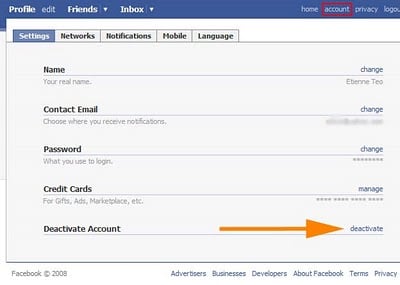
Deactivating Facebook

Facebook Arrives

I remember when I first heard about Facebook. I was an undergraduate at Dartmouth College. At the time, the service was being made available on a school-by-school basis, and, one spring day in 2004, it finally arrived at our corner of the Ivy League.

Many of my friends were excited by this event. They were surprised when I didn’t join.

“What problem do I have that this solves?”, I asked.

No one could answer.

They would, instead, talk about new features it made available, like being able to reconnect with people from high school or post photos. But my lack of ability to connect with old classmates or to publicize my social outings were not problems I needed fixed.

“Every product and service ever invented offers new features,” I’d respond, “but what problem do I have that Facebook’s features are solving? Why should this product, of all products, earn my attention?”

Again, no one could answer.

After a while, I stopped asking this question, and just moved on with my life without a presence on Facebook. Ten years later, I still have never had a Facebook account — nor any social media account, for that matter — and have never missed it.

I have close friends. I still have lots of readers and still sell lots of books. And I’ve preserved my ability to focus, allowing me to make a nice a living as a theoretician.

Read more

Why Did Most of Dartmouth’s Valedictorians Become Investment Bankers and Consultants? The Need for a Deeper Vocabulary of Career Aspiration

The Brain Drain

My alma mater, Dartmouth College, graduated five (!) valedictorians this year. The majority are moving on to jobs in finance or management consulting.

Dartmouth, of course, is not alone in sending a disproportionate number of its best and brightest to these narrow sectors. In recent years, to name an oft-cited example, Princeton sent 36% of its students to finance jobs while Harvard sent 17%.

There are many reasons proposed for this brain drain (whether or not this is really a “drain” is a different debate, though I tend to agree it is), including: prestige, money, the need to pass a new competitive admissions process to signal value, and psychologically-astute recruiting tactics.

I’m particularly interested, however, in an explanation offered by David Brooks in a recent column:

“Many of these students seem to have a blinkered view of their options.”

According to Brooks, elite students assume their choices are limited to: (a) making lots of money in finance and consulting, or (b) saving the world by working for a boots-on-the-ground non-profit. [Stanford students, Brooks notes, get an extra option less popular on the East Coast: (c) starting a tech company.]

This rings true.

Read more

The Courage Crutch: A Remarkable Life Requires You to Overcome Mediocrity, Not Fear

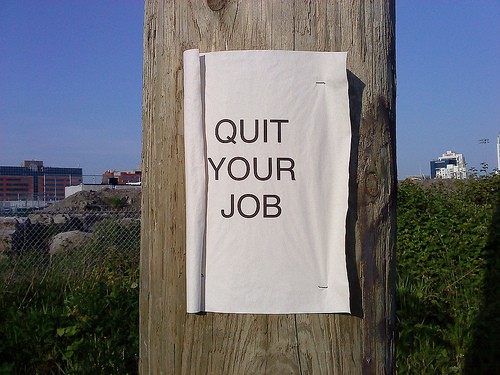
quit-500px

The Cult of Courage

The rhetoric surrounding career advice is saturated with calls for “courage.” Here are a few representative quotes I grabbed at random from the web:

  • “[S]ensational and successful entrepreneurs…had the courage to pursue what makes their heart sing.”
  • “As we move out of our comfort zones towards either accomplishing new things or approaching new levels of greatness, it’s normal to lack courage…”
  • “A great deal of talent is lost to the world for want of a little courage.”
  • “In our day-to-day lives, the virtue of courage doesn’t receive much attention…Instead of setting your own goals, making plans to achieve them, and going after them with gusto, you play it safe. Keep working at the stable job, even though it doesn’t fulfill you.”

The storyline told by such quotes is simple: You know what career decisions would leave you happy and fulfilled, but “society” and “your family” are fearful, dull, stupid, and devoid of useful wisdom, and will therefore try to scare you out of following this good path. You must, therefore, build the courage to overcome their fear-mongering so you can live happily ever after.

The influence of this narrative, and the broader courage culture (as I named it in SO GOOD) that supports it, provides me a ceaseless source of annoyance. Given that it’s graduation season, and the topic of career happiness is therefore relevant, I thought I’d offer a few thoughts about why this trope irks me so much, and why you should treat it with caution.

Read more

Controlling Your Schedule with Deadline Buffers

deadlinebuffer-500px

A Hard Week

Last week was hard. Four large deadlines landed within a four day period. The result was a week (and weekend) where I was forced to violate my fixed-schedule productivity boundaries.

I get upset when I violate these boundaries, so, as I do, I conducted a post-mortem on my schedule to find out what happened.

The high-level explanation was clear: bad luck. I originally had two big deadlines on my calendar, each separated by a week. But then two unfortunate things happened in rapid succession:

  1. One of my two big deadlines was shifted to coincide with the second big deadline. Because I was working with collaborators, I couldn’t just ignore the shift. The new deadline would become the real deadline.
  2. The other issue was due to shadow commitments — work obligations you accept before you know the specific dates the work will be due. I had made two such commitments months earlier. Not long ago, however, their due dates were announced, and they both fell square within this brutal week.

The easy conclusion from this post-mortem is that sometimes you have a hard week. Make sure you recharge afterward and then move on.

This is a valid conclusion And I took it to heart. But it’s not complete…

Read more

How Can Two People Feel Completely Different About the Same Job? — Career Drift and the Danger of Pre-Existing Passion

gradstudent-500px

The Emersonian Doctoral Candidate

I’m flying down to Duke on Tuesday to speak with their graduate students. Preparing for the event inspired me to reflect on my own student experience. In doing so, an Emerson quote came to mind:

“To different minds, the same world is a hell, and a heaven”

Emerson does a good job of capturing the reality of a research-oriented graduate education. Even though students enter such programs — especially at top schools — strikingly homogenous, in terms of their educational backgrounds and achievements, after a few years, the group tends to radically bifurcate.

Some students love the experience and thrive. They dread the possibility that they might have to one day leave academia and take a “normal job.” To them, graduate school is Emerson’s heaven.

Other students hate the experience and wilt. They complain about their advisors, and their peers, and the school, and their busyness. They can’t wait to return to a “normal job.” To them, graduate school is Emerson’s hell.

I began to notice this split about halfway though my time at MIT. I loved graduate school, so I was mildly surprised, at first, to encounter cynical students secretly plotting to abandon ship after earning their masters degree, or to stumble into dark blogs with titles such as, appropriately enough, Dissertation Hell (” a place to rant…about the tortures of writing a dissertation”).

Why do such similar students end up with such different experiences?

Because I happened to be a professional advice writer at the same that I was a student, I studied the issue. I think the answers I found are important to our broader discussion because this Emersonian division is common in many professions, and understanding its cause helps us better understand the complicated task of building a compelling career and the pitfalls to avoid.

Read more