How to Win a Nobel Prize: Notes from Richard Hamming’s Talk on Doing Great Research

You and Your Research

In March 1986, the famed mathematician and computer scientist Richard Hamming returned to his former employer, Bell Labs, to give a talk at the Bell Communications Research Colloquia Series. His talk was titled “You and Your Research,” and it’s goal was straightforward: to deliver lessons for serious researchers about how to do “Nobel-Prize type of work” (a topic familiar to Hamming given the large number of Nobels won by his colleagues during his Bell Labs tenure).

This talk is famous among applied mathematicians and computer scientists because of its relentlessly honest and detailed dissection of how stars in these fields become stars — a designation that certainly applies to Hamming, who not only won the Turing Prize for his work on coding theory, but ended up with an IEEE prize named after him: the Richard W Hamming Medal.

A problem with his talk, however, is it’s length and density. It’s easy to lose yourself in its transcript, nodding your head again and again in agreement, then coming out the other side unable to keep track of all the ideas Hamming outlined.

My goal in this blog post to help bring some order to this state of affairs. Below I’ve summarized what I find to be the major points from Hamming’s address. To identify the sections of the speech that correspond to each point I use the  wording from this transcription.

I can’t claim that the following is comprehensive (among other things, I do not annotate the questions after the talk), but I’m confident that I capture most of what’s important in this seminal seminar.

Idea #1: Luck is not as important as people think.

[location: see the section that starts with the sentence “let me start not logically, but psychologically…”]

Hamming notes that luck is a common explanation for doing great research. He doubts this explanation by noting that great researchers — like Einstein — do multiple good things in their career.

As an alternate explanation, he cites the following Newton quote: “If others would think as hard as I did, then they would get similar results.”

Read more

How We Sent a Man to the Moon Without E-mail and Why it Matters Today

apollo

The NASA Paradox

In 2008, Dan Markovitz was meeting with a group of R&D engineers at a high tech company. The engineers began complaining about e-mail.

They were overwhelmed by the hundreds of messages arriving every day in their inbox, but at the same time, they agreed that this was unavoidable. Without such intensive e-mail use, they reasoned, their teams’ efficiency would plummet.

This conclusion led one of the engineers to ask an interesting question:

If this is true, “how [did] NASA’s engineers manag[e] to put a man on the moon without tools like email?”

Think about this question for a moment. The Apollo program was massive in size and complexity. It was executed at an incredible pace (only eight years spanned Kennedy’s pledge to Armstrong’s steps) and it yielded innovations at a staggering rate.

And it was all done without e-mail.

How did the Apollo engineering teams manage something so complicated and large without rapid communication? Fortunately for this particular group, an answer was available. It turned out that a senior engineer at this high tech company had also worked on the Apollo program, and someone asked him this very question.

Read more

Deep Habits: Don’t Web Surf During the Work Day

browser-history

Swimming to the Offline Shore

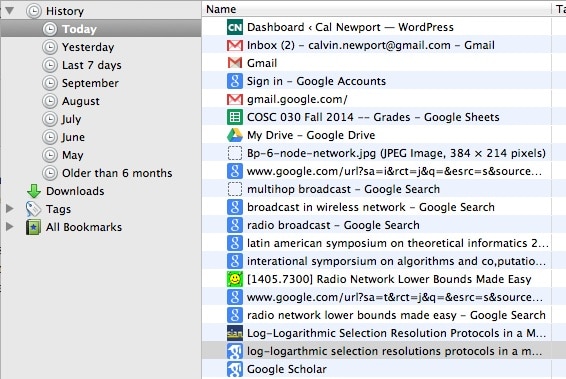
By 2004, I was an expert web surfer. I had memorized a sequence of web site addresses that I could cycle through, one after another, in rapid succession. I would do this once every hour or so as a quick mental pick me up to help get through the work day.

At some point, soon after starting graduate school at MIT, I dropped the habit altogether. It’s been close to a decade since I considered the web as a source of entertainment during my work day.

Indeed, I’m so out of practice with web surfing, that I’ve found on the few occasions that I’ve recently tried to relieve some boredom online, I wasn’t really sure where to go or what to do. (Most of the articles I end up reading online are sent to me directly by readers, not encountered in serendipitous surfing.)

To illustrate this point, the image at the top of this post is a screenshot of my complete browser history for today, taken at 2 PM. (Note: I doctored the list slightly to remove redundant entries for a given visit to a given site.)

Read more

A Personal Appeal

Saturday Update: Today was the charity event and it was a big success. With your support, our team ended up the top team fund raiser … Read more

Don’t Pursue Promotions: Contrarian Career Advice from Ancient Sources of Wisdom

Forest

An Innovative New Voice in the Advice World

For the past six months, my friend Dale Davidson has been executing an epic project.

Eager to optimize his life, and frustrated with much of the advice he encountered online and in contemporary books and magazines, Dale decided to go back to basics and start drawing lessons from humankind’s most ancient and enduring philosophies and religions.

To do so, he focuses on one ancient philosophy or religion per month. During this month he chooses a core ritual to practice. He then extracts wisdom relevant to his  modern life from these ancient prescriptions.

The logic driving his project is simple. These systems have undergone centuries — and in many cases, millennia — of brutal cultural evolution. The ideas that survived this competition must have done so for a good reason: they work.

Why start from scratch in finding answers to life’s challenges, big and small, when you can reference the solutions human civilization has already painstakingly developed and tested?

I’ve been fascinated by Dale’s progress with this project, which he details on his Ancient Wisdom Project blog. I think more people should know about what he’s up to, so I asked him to write a guest post for me.

Below is the (epic) result. In the guest post that follows, Dale briefly summarizes the structure of his project, then identifies five contrarian tips he’s learned so far. To keep the article relevant to our recent discussions, I asked Dale to focus on tips relevant to career issues.

Some of the ideas below you may agree with and some you may not. But they should all get you thinking more deeply about how you approach success and happiness in your career…

Take it away Dale…

Read more

Seeking Examples of Focus

Finding the Focused Few I’m looking for stories of people who use radical strategies to reduce the amount of distractions in their life and improve … Read more