Study Hacks Blog

On Using Inspiring Locations to Inspire Deeper Work

uscapital-640px

A Rite of Spring

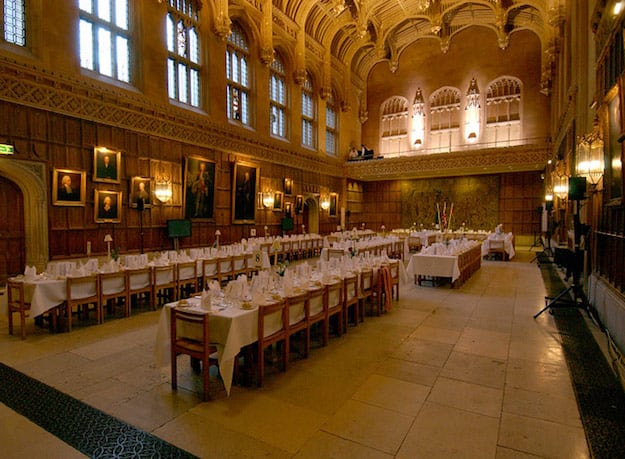
The return of spring marks the return of one of my favorite deep work strategies: the concentration circuit.

This strategy helps you make progress on a cognitively demanding task by having you work in a rotating series of locations that are: (1) not your normal office; (2) novel and/or aesthetically arresting.

As I’ve written before, concentration circuits are like deep work jet fuel:

  • they get you away from your normal energy-draining office routines,
  • they give your mind the sustained freedom from context switches needed to dive deep into a single problem, and
  • they leverage visual and environmental novelty to help shake loose new insights.

At the same time, they provide a reminder that elite-level knowledge work is about creating things with your brain — not just shuffling messages and writing PowerPoints — and that this activity, when isolated and supported, is massively rewarding.

Most important: they’re also a lot of fun.

A Recent Circuit

Anyway, two weeks ago I found myself down near the Capitol to tape an appearance on the Federalist Radio Hour. At the time, I was working on a tricky result.

I decided I would take advantage of the early spring weather to build an epic, Washington D.C.-themed concentration circuit.

Here are some of the locations I visited that morning…

Read more

From Productivity to Workflow Engineering

car-625-px

The Ford Transformation

The craftsmen hand-building cars at the Ford Motor Company’s Piquette Avenue assembly plant in the first decade of the 20th century were, among other things, impressively productive at their tasks.

Two or three workers would gather around each partially-assembled car, taking parts, checking their fit, adjusting them on a metal lathe as needed, then checking the fit again, and so on. To watch them work would be to watch experts practiced in their movements and efficient in their tool use.

But as we now know, this productivity was irrelevant, as their approach to the work as a whole was sub-optimal.

By the second decade of the twentieth century, Henry Ford perfected his assembly line model and combined it with a commitment to producing interchangeable parts.

This new workflow was less natural, required significant capital investment, and introduced many new logistical headaches: but it also unleashed a level of value production that the old method of car construction could never match — no matter how skilled or efficient its practitioners.

Read more

The Case Against Email Strengthens

smashed-computer-620px

A Modest Proposal

Last month, I wrote an intentionally provocative article for the Harvard Business Review’s website. It was titled, “A Modest Proposal: Eliminate Email.”

The article starts by conceding that email, as a technology, is not intrinsically bad. The weed that’s currently strangling knowledge work is instead the workflow enabled and prodded by the presence of this tool.

As I expanded:

Accompanying the rise of this technology was a new, unstructured workflow in which all tasks — be it a small request from HR or collaboration on a key strategy — are now handled in the same manner: you dive in and start sending quick messages which arrive in a single undifferentiated inbox at their recipients. These tasks unfold in an ad hoc manner with informal messages sent back and forth on demand as needed to push things forward.

This workflow, I argued, leads inevitably to a state where constant email checking, during work hours and beyond, become necessary to keep the wheels of progress turning. And this state, in turn, is transforming knowledge workers into exhausted human network routers who are producing at a fraction of their cognitive capacity.

I concluded:

Given the tangled relationship between email and our current approach to work, however, it’s also clear that [a transformation to a better workflow] is almost certainly going to require a radical first step: to eliminate email.

Revealing Responses

What’s interesting to me about this discussion is less the details of my argument, but instead readers’ reactions.

Read more

Seneca on Social Media

Seneca-620px

Seneca on the Myth of Free

In Letter 42 of his Epistulae morales ad Lucilium, Seneca touches on the hidden costs of seemingly “free” pursuits. In doing so, he offers to his correspondent — Lucilius, the procurator of Sicily — a warning that resonates strongly today:

Our stupidity may be clearly proved by the fact that we hold that “buying” refers only to the objects for which we pay cash, and we regard as free gifts the things for which we spend our very selves.

These we should refuse to buy, if we were compelled to give in payment for them our houses or some attractive and profitable estate; but we are eager to attain them at the cost of anxiety, of danger, and of lost honour, personal freedom, and time; so true it is that each man regards nothing as cheaper than himself.

(– From Letter 42, Paragraph 7 of the Richard Gummere translation)

Over a billion people currently use Facebook — many at the cost of anxiety, lost honor, personal freedom, and certainly time. If asked why, however, many would reply, “why not?”

Read more

Write an Attention Charter

old-charter-640px

Ambiguous Distraction

In the war to reclaim your attention, some battles have clearer fronts than others. It has become clear to me that these differences matter.

Social media, for example, is digital nicotine. It’s engineered to hook you so you can be sliced and diced into advertising fodder. It’s not worth losing your cognitive autonomy over — unless your job depends on it, you should probably quit.

But the real issues seem to arise not from the obvious whimsies, but instead from the commitments that are less obviously harmful, and in fact, in the right dose, might actually be vital.

Consider, for example…

  • an invitation to speak at a compelling conference,
  • a request to hop on a call with an interesting person,
  • a long email asking a question you know something about,
  • an offer to collaborate on a project that fits your interests, or
  • a new service that might make parts of your working life better.

To place a blanket ban on such activities would induce a monasticism that would likely stall your career, or, at the very least, make it unbearably monotonous.

(Even my deep work idol, Neal Stephenson — who has no public email address, and only ventures into public for book launches — ended up involved in a sword fighting video game and consults for an augmented reality pioneer.)

And yet, in my own experience, I find that the occasions when I most despair about the tattered state of my schedule are almost always the result of the accumulation of a dozen yeses that each made perfect sense in isolation.

So how do you balance these competing concerns?

Read more

The Mind is Like a Locomotive

Deep Thwings Charles Franklin Thwing is a largely forgotten but impressive figure from the early twentieth century. He graduated Harvard in the 1870s, entered seminary, became … Read more

Email Zero Is Easier Than Inbox Zero

computer-outside-640px

The Attack of the Inbox

Not long ago, I was listening to Pat Flynn’s podcast. Pat is an excellent podcaster, so it doesn’t take much to convince me to listen, but this time I was particularly interested because the episode title caught my attention: 9000 Unread Emails to Inbox Zero.

Pat tells the story about how his email inbox grew along with the success of his online brand. He used to try to empty his inbox. After a while, he began to consider “only” 100 unread messages as a victory. Then, one day, he looked up and his inbox had expanded to 9000 unread messages.

Something had to give.

Pat’s solution was radical: he hired a highly-trained executive assistant who could devote many additional hours to sorting through the communication deluge before it reached Pat. He still spends a lot of time on email, but at least now it’s tractable.

Longtime readers will not be surprised to learn that the subtext of this story depresses me.

I am, as you know, a big proponent of deep work — as I think this activity can produce a professional life that’s both successful and deeply meaningful. But as Pat’s experience seems to attest, our current digital economy has perverse incentives: forcing you, it seems, to fragment your time into increasingly small, anxious slivers as recognition for your skill grows.

To me, the idea of needing to hire assistants to increase the amount of one-to-one communication you can fit into a single day is, to steal a relevant phrase from George Packer, a truly “frightening vision of the future.” 

But then Brett McKay came along and gave me hope…

Read more