Today I needed to finish a tough chunk of writing. The ideas were complicated and I wasn’t quite sure how best to untangle the relevant threads and reweave them into something appealing. I knew I was in for some deep work and I was worried about my ability to see it through to the end.
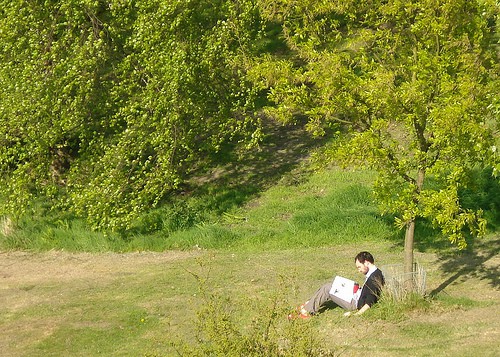
So I packed up my laptop and headed outside. Here’s where I started writing:
They were overwhelmed by the hundreds of messages arriving every day in their inbox, but at the same time, they agreed that this was unavoidable. Without such intensive e-mail use, they reasoned, their teams’ efficiency would plummet.
This conclusion led one of the engineers to ask an interesting question:
If this is true, “how [did] NASA’s engineers manag[e] to put a man on the moon without tools like email?”
Think about this question for a moment. The Apollo program was massive in size and complexity. It was executed at an incredible pace (only eight years spanned Kennedy’s pledge to Armstrong’s steps) and it yielded innovations at a staggering rate.
And it was all done without e-mail.
How did the Apollo engineering teams manage something so complicated and large without rapid communication? Fortunately for this particular group, an answer was available. It turned out that a senior engineer at this high tech company had also worked on the Apollo program, and someone asked him this very question.
By 2004, I was an expert web surfer. I had memorized a sequence of web site addresses that I could cycle through, one after another, in rapid succession. I would do this once every hour or so as a quick mental pick me up to help get through the work day.
At some point, soon after starting graduate school at MIT, I dropped the habit altogether. It’s been close to a decade since I considered the web as a source of entertainment during my work day.
Indeed, I’m so out of practice with web surfing, that I’ve found on the few occasions that I’ve recently tried to relieve some boredom online, I wasn’t really sure where to go or what to do. (Most of the articles I end up reading online are sent to me directly by readers, not encountered in serendipitous surfing.)
To illustrate this point, the image at the top of this post is a screenshot of my complete browser history for today, taken at 2 PM. (Note: I doctored the list slightly to remove redundant entries for a given visit to a given site.)
David Brooks’s most recent column ends up on the subject of geopolitics, but it begins, in a tenuous but entertaining fashion, with a long digression on the routines of famous creatives (which Brooks draws from Mason Currey). For example…
Maya Angelou, we learn, was up by 5:30 and writing by 6:30 in a small hotel room she kept just for this purpose.
John Cheever would write every day in the storage unit of his apartment. (In his boxer shorts, it turns out.)
Anthony Trollope would write 250 words every 15 minutes for two and a half hours while his servant brought coffee at precise times.
To summarize these observations, Brooks quotes Henry Miller: “I know that to sustain these true moments of insight, one has to be highly disciplined, lead a disciplined life.”
He then offers his own more bluntly accurate summary: “[Great creative minds] think like artists but work like accountants.”
Or, to put it in Study Hacks lingo: “deep insight requires a disciplined commitment to deep work.”
I’m currently trying to solve a fun problem that’s captured my attention and refuses to relent. Here’s the basic setup:
A collection of k devices arrive at a shared channel. Each device has a message to send.
Time proceeds in synchronized rounds. If more than one device tries to send a message on the channel during the same round, there’s a collision and all devices receive a collision notification instead of a message.
The devices do not know k.
In this setup, a classic problem (sometimes called k-selection) is devising a distributed algorithm that allows all k devices to successfully broadcast in a minimum number of rounds. The best known randomized solutions to this problem require a*k rounds (plus some lower order factors), for a small constant a > 2.
What I am trying to show is that such a constant is necessary. That is: all distributed algorithms require at least b*k rounds for some constant b bounded away from 1 (and hopefully close to 2).
The Dash Method
What I’ve noticed in my thinking about this problem over the past week or two is that at the beginning of each deep work session, I’ll typically come up with a novel approach to attempt. As I persist in the session, however, the rate of novelty decreases. After thirty minutes or so of work I tend to devolve into a cycle where I’m rehashing the same old ideas again and again.
I’m starting to wonder, therefore, if this specific type of deep work, where you’re trying to find a creative insight needed to unlock a problem, is best served by multiple small dashes of deep work as oppose to a small number of longer sessions.
That is, given five free hours during a given week, it might be better to do ten 30-minute dashes as oppose to one 5 hour slog.
Today I spent the morning in the library. As often happens, I arrived with a specific book in mind, but soon a long trail of diverting citations lured me in new directions.
I’m a sucker for libraries.
One such happy discovery was the book, The New Faculty Member, by Robert Boice, a now emeritus professor of psychology at Stony Brook. This book summarizes the findings of a multi-year longitudinal study in which Boice followed multiple cohorts of junior professors, at multiple types of higher education institutions, from their arrival on campus until their tenure fate seemed clear.
(He also wrote a non-academic version of this book called Advice for New Faculty Members, which I haven’t read, but assume is similar in its conclusions.)
I was particularly drawn to his chapter on research productivity. It turns out that Boice hounded his subjects on this topic year after year. He didn’t trust self-estimates of work accomplished and instead required the young professors to produce newly written pages to verify progress.
After four years, only 13% of these professors had produced enough (and had good enough teaching evaluations) to make tenure seem highly probable. Here are some of the main differences Boice identified in the research habits of these “exemplary young faculty” as compared to their peers:
He loads up a template that contains seven questions about the deep task he’s about to begin. These questions force him to specify why the task is important and how he’s going to tackle it (see the above screenshot of the template taken from one of Aaron’s work sessions). The issues addressed in this template come from a classic Steve Pavlina post titled “7 Ways to Maximize Your Creative Output.”
Getting through these steps takes around five minutes. As soon as Aaron’s done typing in his final answer he turns immediately to the scheduled deep task.