In my book Digital Minimalism, I emphasized the danger of a newly-emerged condition that I called “solitude deprivation.” As I wrote, the introduction of the smartphone caused our relationship with distraction to mutate into something new:
“At the slightest hint of boredom, you can now surreptitiously glance at any number of apps or mobile-adapted websites that have been optimized to provide you an immediate and satisfying dose of input from other minds. It’s now possible to completely banish solitude from your life.”
I went on to argue that this condition was worrisome. Us humans evolved to experience significant amounts of time alone with our own thoughts. Remove this solitude from our lives and we’re not only bound to get twitchy and anxious, but we miss out on much of the subtle but deep value generated by a wandering mind.
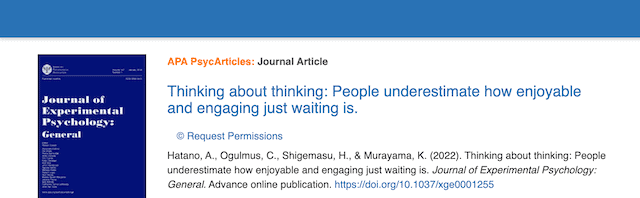
A new paper, published by researchers at the University of Tübingen, and appearing in the Journal of Experimental Psychology, provides some support for these claims. “Psychologists who studied a group of more than 250 people encouraged to engage in directionless contemplation or free-floating thinking,” summarizes The Guardian, “said that the activity was far more satisfying than the participants had anticipated.”