One of the key elements of my deep life philosophy is its emphasis on craft. This topic applies to both professional and leisure pursuits, but in this post, I want to focus on the former. (See Digital Minimalism for more on the latter.)
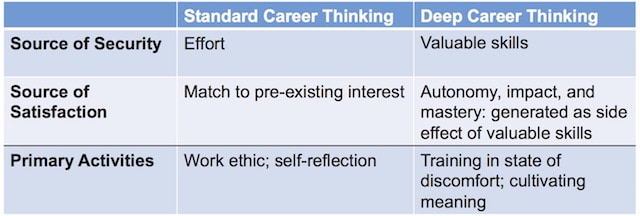
I became really interested in career development ideas around 2010, when I began the research for what eventually became my fourth book, So Good They Can’t Ignore You. Here’s what I discovered about the standard career thinking embraced by many college-educated young people in our country:
- It understands jobs to be like a contract: you do the work assigned, you get to keep the position.
- It believes career satisfaction results from finding the right job for your natural pre-existing interests. This mindset is summed up by the ubiquitous advice to “follow your passion.” If you don’t like your job, it’s because you chose the wrong field.
The deep life philosophy offers an alternative vision centered on valuable skills:
- It believes security comes from being able to do things that are valuable, and, more generally, being comfortable picking up new valuable skills quickly when circumstances require.
- It believes that satisfaction comes from some combination of autonomy, impact and/or a sense of mastery, which (as I argue in So Good) require valuable skills as a necessary precondition.