NEW BOOK!
Explore a better way to work – one that promises more calm, clarity, and creativity.

Study Hacks Blog

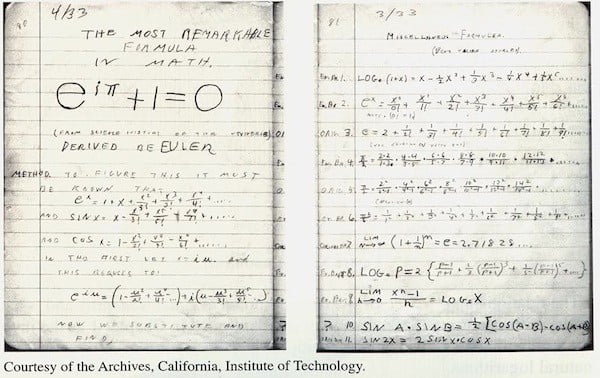
Richard Feynman’s Deliberate Genius

feynman-600px

Gleick’s Genius

I’m currently re-reading Genius, James Gleick’s celebrated biography of physicist Richard Feynman.

I was particularly drawn to the opening chapters on Feynman’s childhood in Far Rockaway, Queens. It’s tempting when encountering a brilliant mind like Feynman’s to resort to cognitive hagiography in which the future Nobel laureate entered the world already solving field equations.

But Gleick, whose research skills are an equal match for his writing ability, uncovered a more interesting origin tale…

Read more

Spend More Time Managing Your Time

weeklplans-600x

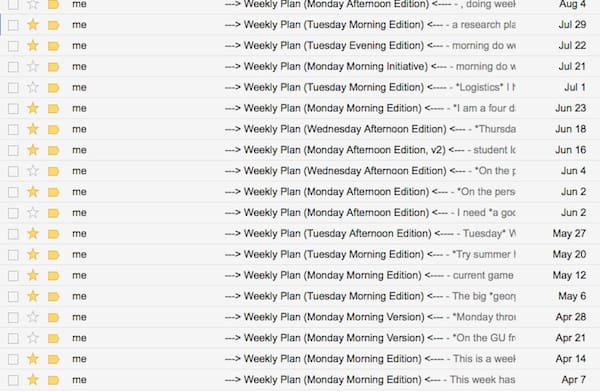
Making Time for Time

Something organized people don’t often talk about is how much time they spend organizing their time.

I think this is a shame.

The past half-decade has seen a trend in (online) time management discussions toward simplification. It’s now accepted by many that it’s enough to jot down each morning a couple “most important tasks” of the day on an index card, and if you get those done, consider your day a success.

Think about this for a moment. This belief essentially cedes the majority of your working hours over to meetings separated by bursts of non-productive inbox shuffling and web surfing.

I for one am not yet willing to give up so many hours, as doing so would significantly reduce what I’m able to accomplish in the typical week. Which brings me back to time spent organizing time…

Read more

Deep Habits: WorkingMemory.txt (The Most Important Productivity Tool You’ve Never Heard Of)

wm-1-600px

Productivity Problems

Here’s a typical scenario. Looking at your daily schedule, you see that you’re entering a period of time that’s not dedicated to deep work or a specific large shallow task.

This seems like a good opportunity to tackle some of the small tasks that accumulate in most knowledge work schedules (e.g., e-mails, planning, bills, looking up information, arranging meetings, filling out forms, etc).

Tackling these administrative blocks in an effective manner, however, can be elusive for most people — especially if you find yourself arriving at the office after a weekend, or a trip, or any other instance when an overwhelming number of obligations have been piling up, waiting to ambush you.

It’s easy to start such blocks with a reasonable plan, such as “let me answer some e-mails.” But this will soon generate many more new obligations than you can fit into your limited working memory at one time.

At this point, you might start lurching around, perhaps trying to knock off the new obligations as they arise (so you don’t forget them), then giving up on this goal as futile, then seeing even more urgent messages, and having those generate even more things that you can’t quite finish all at once, and then, the next thing you know, you look up after an hour of frenzied e-mailing and feel more overwhelmed than when you began!

Whew.

The solution to such scenarios, I will argue, is to augment your limited neuronal capacity with some digital help…

Read more

The Power of the Outdoor Office

outdoor-office-1-600px

The Weirdo in the Woods

I took this picture last week. While most people enter the woods with a hiking stick, or perhaps a dog, I was the weirdo carrying a cup of coffee and a notebook.

But I was stuck on some early stage problems and needed some serious deep thinking to try to shake things loose — so I grabbed the tools of my trade and headed into the wilderness.

After about a half hour of walking and thinking, I stopped here to organize and record my thoughts:

Read more

Top Performer is Now Open

After Three Long Years of Development… As I mentioned last week, I’ve spent the last three years working with Scott Young and his education company … Read more

A Productivity Lesson from the Prison Debate Team that Defeated Harvard

Debate

The Underdog Debate

News broke wide earlier today about something unexpected that happened last month at a maximum security correctional facility near Dannemora, New York: a team of prisoners won a debate contest held against Harvard’s vaunted three-time national champion team.

As reported by the Washington Post, a twist that made this outcome even more unlikely is that the prisoner team completed their extensive preparation without access to the Internet.

They were forced instead to make formal requests to the prison administration for the books and articles they required, and to then wait for days — and sometimes even weeks — for approval.

The easy storyline here is that this underdog team triumphed despite the hardship of being less connected. While this description might be largely true, the Post’s reporting suggests that something more interesting might have also happened:

Read more

On Full Horizon Planning and the Under-Appreciated Power of Workflow Systems

The Missing System

Here’s something that baffles me: the fact that most companies don’t invest in helping their employees develop effective workflow systems.

(It’s probably worth taking a moment here for definitions: When I say “workflow system,” I mean a set of habits and tools used to organize what work you do and when you do it. And when I say “effective,” I’m referring to the amount of value you produce.)

Most people don’t dedicate much thought to such systems. The default, instead, is to run your day as a reaction to events and deadlines on your calendar, an inconsistently referenced task list, and, most of all, the flux coursing through your inbox.

As productivity nerds know, however, there are much more effective ways to get important things done.

Read more