Study Hacks Blog

Write an Attention Charter

old-charter-640px

Ambiguous Distraction

In the war to reclaim your attention, some battles have clearer fronts than others. It has become clear to me that these differences matter.

Social media, for example, is digital nicotine. It’s engineered to hook you so you can be sliced and diced into advertising fodder. It’s not worth losing your cognitive autonomy over — unless your job depends on it, you should probably quit.

But the real issues seem to arise not from the obvious whimsies, but instead from the commitments that are less obviously harmful, and in fact, in the right dose, might actually be vital.

Consider, for example…

  • an invitation to speak at a compelling conference,
  • a request to hop on a call with an interesting person,
  • a long email asking a question you know something about,
  • an offer to collaborate on a project that fits your interests, or
  • a new service that might make parts of your working life better.

To place a blanket ban on such activities would induce a monasticism that would likely stall your career, or, at the very least, make it unbearably monotonous.

(Even my deep work idol, Neal Stephenson — who has no public email address, and only ventures into public for book launches — ended up involved in a sword fighting video game and consults for an augmented reality pioneer.)

And yet, in my own experience, I find that the occasions when I most despair about the tattered state of my schedule are almost always the result of the accumulation of a dozen yeses that each made perfect sense in isolation.

So how do you balance these competing concerns?

Read more

The Mind is Like a Locomotive

Deep Thwings Charles Franklin Thwing is a largely forgotten but impressive figure from the early twentieth century. He graduated Harvard in the 1870s, entered seminary, became … Read more

Email Zero Is Easier Than Inbox Zero

computer-outside-640px

The Attack of the Inbox

Not long ago, I was listening to Pat Flynn’s podcast. Pat is an excellent podcaster, so it doesn’t take much to convince me to listen, but this time I was particularly interested because the episode title caught my attention: 9000 Unread Emails to Inbox Zero.

Pat tells the story about how his email inbox grew along with the success of his online brand. He used to try to empty his inbox. After a while, he began to consider “only” 100 unread messages as a victory. Then, one day, he looked up and his inbox had expanded to 9000 unread messages.

Something had to give.

Pat’s solution was radical: he hired a highly-trained executive assistant who could devote many additional hours to sorting through the communication deluge before it reached Pat. He still spends a lot of time on email, but at least now it’s tractable.

Longtime readers will not be surprised to learn that the subtext of this story depresses me.

I am, as you know, a big proponent of deep work — as I think this activity can produce a professional life that’s both successful and deeply meaningful. But as Pat’s experience seems to attest, our current digital economy has perverse incentives: forcing you, it seems, to fragment your time into increasingly small, anxious slivers as recognition for your skill grows.

To me, the idea of needing to hire assistants to increase the amount of one-to-one communication you can fit into a single day is, to steal a relevant phrase from George Packer, a truly “frightening vision of the future.” 

But then Brett McKay came along and gave me hope…

Read more

The Book Facebook Doesn’t Want You to Read

A Focus Opus

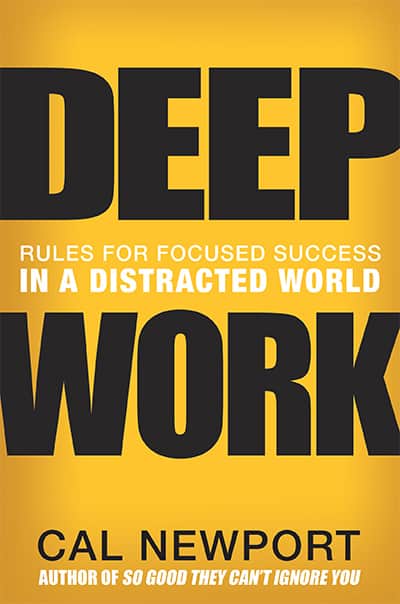
Deep Work: Rules for Focused Success in a Distracted World by Cal NewportIt’s official, today is the release of my new book, Deep Work: Rules for Focused Success in a Distracted World

The book argues that deep work (focusing without distraction on a cognitively demanding task) is becoming more valuable in our economy at the same time that it’s becoming more rare.

The implication: if you’re one of the few to take advantage of this trend and cultivate a deep life, you’ll thrive.

Not only will you produce at quantity and quality levels that stun your peers, you’ll also find your work more meaningful and less exhausting.

To make this claim more concrete, consider me as a case study. As a longtime devotee to depth, I’ve been able to publish close to 50 peer-reviewed papers as an academic (earning over 2500 citations), write five books as an author (selling over 200,000 copies), and build a popular blog (300,000 page views last month) — all without working at nights and rarely working on weekends. The secret is my fanatic commitment to deep work.

This highlights an important point that I want to emphasize: This book isn’t a cranky screed about how kids these days spend too much time on the Facebook, and it isn’t a collection of warmed over suggestions about how you should turn off notifications on your phone and not check email first thing in the morning.

It instead calls for a radical transformation to your work life in which focusing with great intensity becomes your core activity, not an occasional indulgence.

With this in mind, the book then details specific strategies, divided among four “rules,” that you can use to accomplish this transformation — covering topics from focus training, to effective scheduling, to rituals and routines, to aggressive tactics for taming the tide of shallow obligations that constantly threaten to drown the typical knowledge worker’s day.

Give Yourself the Gift of Depth

To help you learn more about the book, I’ve included below an annotated table of contents and a link to a long excerpt.

In the meantime…

  • If this topic sounds interesting to you — whether you’re a longtime reader of my writing or new to the party — please consider buying a copy of this book.
  • If you already bought the book and found it useful, please consider buying copies for your friends or colleagues (if you do buy multiple copies, send me an email so I can thank you personally).

I’m proud of this book and believe it can have an impact on how we think about work in a digital age.

Deep Work is available now at Amazon (kindle and hardcover), Audible, Barnes and Noble, IndieBound, or anywhere else books are normally sold.

Read more

Resolve to Live a Deep Life

thinking-outside-640px

A Deep Omission

In preparation for the upcoming release of my new book, I’m doing a lot of interviews about deep work. This process of talking about depth again and again helped me identify a shortcoming in my treatment of this skill here on Study Hacks.

I realized that I spend a lot of time explaining the importance of intense focus and detailing strategies to help you focus better, but I’ve neglected the big picture questions about what it really means to prioritize this skill in your life; e.g.,

  • What are the major changes to your life required by a commitment to deep work?
  • What are the large scale goals you should be striving to achieve using the types of small scale habits and strategies I so often discuss?
  • What, in other words, is the sixty-second summary of what it means to live a deep life?

In this post, I’ll try to answer these questions…

Read more

Deep Habits: The Danger of Pseudo-Depth

thinking-640px

Depth Deception

A difficulty I’ve faced in promoting the practice of deep work is that many people think they engage in this activity regularly (and don’t get much out of it), even though what they’re really doing is far from true depth.

To better understand this possibility, consider the following two hypothetical scenarios:

  • Scenario #1: Alice has to write a difficult client proposal. She decides to work away from her office for the first half of the day. She begins by going for a long walk to clear her head and play around with the different proposal pieces. She ends up at the local library, where she settles into a quiet corner for an hour and tries to write a rough draft. She feels the pitch is still too muddled, so she walks to a nearby coffee shop for more caffeine and works the outline over and over on paper. Finally she hits a configuration she likes and returns to the library to work it into the draft. After another hour she has something special. For the first time that day, she checks her e-mail before heading into the office.
  • Scenario #2: Alice has to write a difficult client proposal. She checks her e-mail, sends off some replies, then drives into work. At the office she closes her door to work on the proposal. She finds it hard going, but sticks with for a couple hours. She only checks her e-mail a few times an hour during this period (much less than normal) and peeks at Facebook to relieve her boredom only once. She does take a break halfway through to gripe about an unrelated manner in the office kitchen with a colleague.

In both scenarios, Alice dedicated a good stretch of time to working on a cognitively demanding task. Many people, new to the concept, would therefore consider both scenarios to describe deep work.

But they would be wrong.

Read more